

thermal and chemical stability. Nitrogen-doped carbon dot/TiO 2 composites synthesized via hydrothermal method degraded 95% of rhodamine B in 30 min using
500 W Xe lamp (Zhang et al. 2013). Similarly, photodegradation analysis using
carbon dot/TiO 2 nanocomposites synthesized by hydrothermal method or sol–gel
method was carried out by various researchers against methyl blue, methyl orange,
and rhodamine B photodegradation (Saud et al. 2015; Wang et al. 2015; Li et al.
2010b, 2018a).
Ke et al. (2017) prepared carbon quantum dots via hydrothermal method and
carbon quantum dots/TiO 2 via sol–gel method, and photo-efficiency was observed
against methyl blue dye under visible light. About 90% of methyl blue was degraded
in just 120 min, and carbon quantum dots/TiO 2 reveal nearly 3.6 times higher
efficiency as compared to bare TiO 2 . On the other hand, the unique up-conversion
property of carbon quantum dots which could convert low-energy photons into highenergy photons is utilized for the construction of heterojunction (Jia et al. 2012).
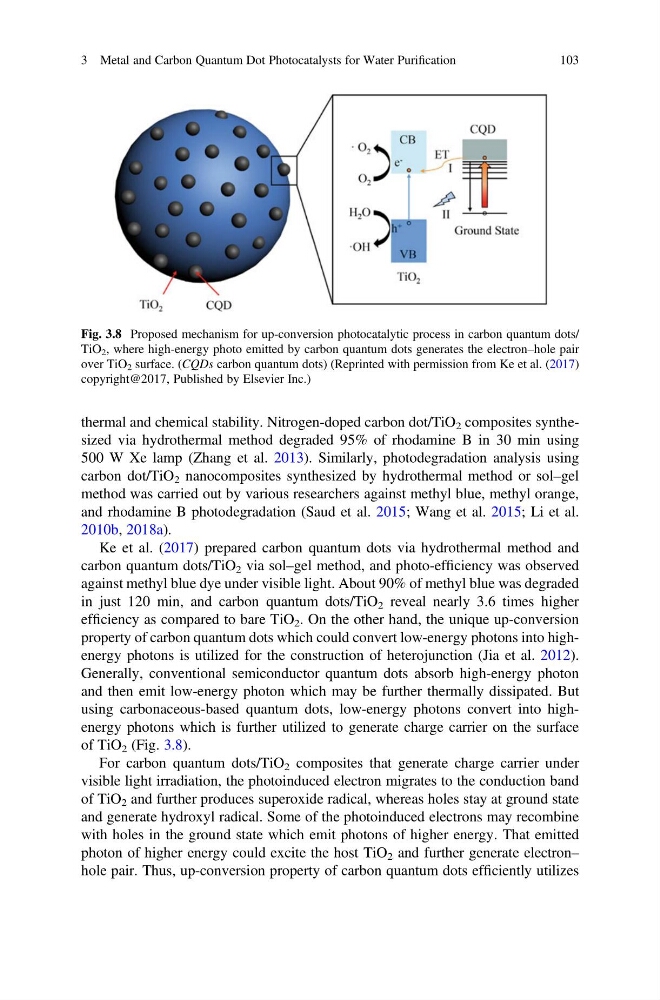
Generally, conventional semiconductor quantum dots absorb high-energy photon
and then emit low-energy photon which may be further thermally dissipated. But
using carbonaceous-based quantum dots, low-energy photons convert into highenergy photons which is further utilized to generate charge carrier on the surface
of TiO 2 (Fig. 3.8).
For carbon quantum dots/TiO 2 composites that generate charge carrier under
visible light irradiation, the photoinduced electron migrates to the conduction band
of TiO 2 and further produces superoxide radical, whereas holes stay at ground state
and generate hydroxyl radical. Some of the photoinduced electrons may recombine
with holes in the ground state which emit photons of higher energy. That emitted
photon of higher energy could excite the host TiO 2 and further generate electron–
hole pair. Thus, up-conversion property of carbon quantum dots efficiently utilizes
Fig. 3.8 Proposed mechanism for up-conversion photocatalytic process in carbon quantum dots/
TiO 2 , where high-energy photo emitted by carbon quantum dots generates the electron–hole pair
over TiO 2 surface. (CQDs carbon quantum dots) (Reprinted with permission from Ke et al. (2017)
copyright@2017, Published by Elsevier Inc.)
3 Metal and Carbon Quantum Dot Photocatalysts for Water Purification
103
500 W Xe lamp (Zhang et al. 2013). Similarly, photodegradation analysis using
carbon dot/TiO 2 nanocomposites synthesized by hydrothermal method or sol–gel
method was carried out by various researchers against methyl blue, methyl orange,
and rhodamine B photodegradation (Saud et al. 2015; Wang et al. 2015; Li et al.
2010b, 2018a).
Ke et al. (2017) prepared carbon quantum dots via hydrothermal method and
carbon quantum dots/TiO 2 via sol–gel method, and photo-efficiency was observed
against methyl blue dye under visible light. About 90% of methyl blue was degraded
in just 120 min, and carbon quantum dots/TiO 2 reveal nearly 3.6 times higher
efficiency as compared to bare TiO 2 . On the other hand, the unique up-conversion
property of carbon quantum dots which could convert low-energy photons into highenergy photons is utilized for the construction of heterojunction (Jia et al. 2012).
Generally, conventional semiconductor quantum dots absorb high-energy photon
and then emit low-energy photon which may be further thermally dissipated. But
using carbonaceous-based quantum dots, low-energy photons convert into highenergy photons which is further utilized to generate charge carrier on the surface
of TiO 2 (Fig. 3.8).
For carbon quantum dots/TiO 2 composites that generate charge carrier under
visible light irradiation, the photoinduced electron migrates to the conduction band
of TiO 2 and further produces superoxide radical, whereas holes stay at ground state
and generate hydroxyl radical. Some of the photoinduced electrons may recombine
with holes in the ground state which emit photons of higher energy. That emitted
photon of higher energy could excite the host TiO 2 and further generate electron–
hole pair. Thus, up-conversion property of carbon quantum dots efficiently utilizes
Fig. 3.8 Proposed mechanism for up-conversion photocatalytic process in carbon quantum dots/
TiO 2 , where high-energy photo emitted by carbon quantum dots generates the electron–hole pair
over TiO 2 surface. (CQDs carbon quantum dots) (Reprinted with permission from Ke et al. (2017)
copyright@2017, Published by Elsevier Inc.)
3 Metal and Carbon Quantum Dot Photocatalysts for Water Purification
103