

3.3.2 Bottom-Up Approach
Hydrothermal Method
Chen et al. (2018a) develop green one-pot hydrothermal method for graphene
quantum dot synthesis with a diameter ranging from 2.25 nm to 3.50 nm using
starch as a natural polymer. Hydrothermal method is free from usage of any strong
acid or metal impurities. The reaction mechanism during the synthesis follows
hydrolyzation of starch mainly into glucose followed by ring closure to generate
graphene quantum dots which is separated through centrifugation. Graphene is a
promising building block for graphene quantum dot synthesis. Pan et al. (2010a)
develop a hydrothermal method for piercing peroxidized graphene sheets into
ultrasmall graphene quantum dots. The graphene sheet is prepared by thermally
reducing the graphene oxide.
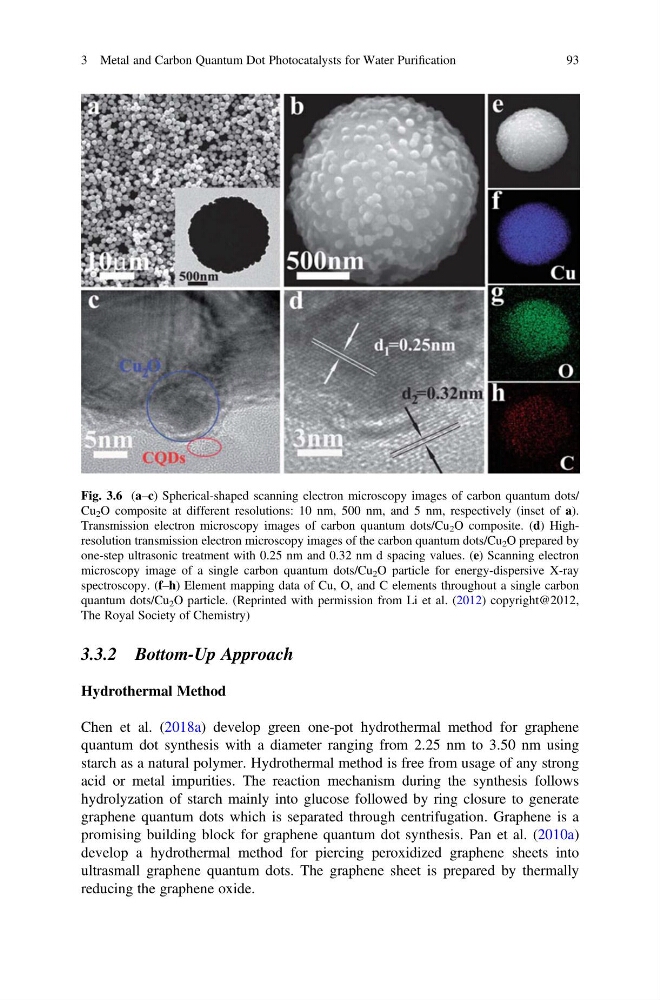
Fig. 3.6 (a–c) Spherical-shaped scanning electron microscopy images of carbon quantum dots/
Cu 2 O composite at different resolutions: 10 nm, 500 nm, and 5 nm, respectively (inset of a).
Transmission electron microscopy images of carbon quantum dots/Cu 2 O composite. (d) Highresolution transmission electron microscopy images of the carbon quantum dots/Cu 2 O prepared by
one-step ultrasonic treatment with 0.25 nm and 0.32 nm d spacing values. (e) Scanning electron
microscopy image of a single carbon quantum dots/Cu 2 O particle for energy-dispersive X-ray
spectroscopy. (f–h) Element mapping data of Cu, O, and C elements throughout a single carbon
quantum dots/Cu 2 O particle. (Reprinted with permission from Li et al. (2012) copyright@2012,
The Royal Society of Chemistry)
3 Metal and Carbon Quantum Dot Photocatalysts for Water Purification
93
Hydrothermal Method
Chen et al. (2018a) develop green one-pot hydrothermal method for graphene
quantum dot synthesis with a diameter ranging from 2.25 nm to 3.50 nm using
starch as a natural polymer. Hydrothermal method is free from usage of any strong
acid or metal impurities. The reaction mechanism during the synthesis follows
hydrolyzation of starch mainly into glucose followed by ring closure to generate
graphene quantum dots which is separated through centrifugation. Graphene is a
promising building block for graphene quantum dot synthesis. Pan et al. (2010a)
develop a hydrothermal method for piercing peroxidized graphene sheets into
ultrasmall graphene quantum dots. The graphene sheet is prepared by thermally
reducing the graphene oxide.
Fig. 3.6 (a–c) Spherical-shaped scanning electron microscopy images of carbon quantum dots/
Cu 2 O composite at different resolutions: 10 nm, 500 nm, and 5 nm, respectively (inset of a).
Transmission electron microscopy images of carbon quantum dots/Cu 2 O composite. (d) Highresolution transmission electron microscopy images of the carbon quantum dots/Cu 2 O prepared by
one-step ultrasonic treatment with 0.25 nm and 0.32 nm d spacing values. (e) Scanning electron
microscopy image of a single carbon quantum dots/Cu 2 O particle for energy-dispersive X-ray
spectroscopy. (f–h) Element mapping data of Cu, O, and C elements throughout a single carbon
quantum dots/Cu 2 O particle. (Reprinted with permission from Li et al. (2012) copyright@2012,
The Royal Society of Chemistry)
3 Metal and Carbon Quantum Dot Photocatalysts for Water Purification
93