

68
P. Sagna et al.
are in excess, of which 38 are during the wet period, and 49 years are in deficit, of
which 40 are during the dry period. It is notable that droughts still occur in Senegal.
3.2 Impacts of Rainfall Variation on Water Resources
The alignment of rainfall analyses with reality is visible by the impacts of changes
in water resources on livelihoods. It is imperative to be able to predict the supply of
and demand for water resources over a given period to be able to create and maintain
sustainable and efficient water management.
3.2.1 Impacts of Rainfall Variation on Runoff and Lakes
In Ivory Coast, an overall downward trend in water resources correlates with a
decrease in rainfall. For example, in the Sassandra River basin, Coulibaly et al.
(2018) used the Representative Concentration Pathway (RCP) 4.5 and RCP 8.5
climate models and the Regional Climate Model 4 (RegCM4) of the Abdus Salam
International Center for Theoretical Physics (ICTP) to obtain data to integrate into
the GR2M hydrologic model. By 2030, 2050, 2070, and 2090, annual flows will
decrease compared to the 1961–1980 reference period. The decline in flows follows
the same progression as the climate projections of the RegCM4 model. The RCP
models 4.5 and 8.5 also show a decline of 6.9–24.1% in flows from the Guinean
source to the Ivorian parts of the Sassandra between 2030 and 2090. According to
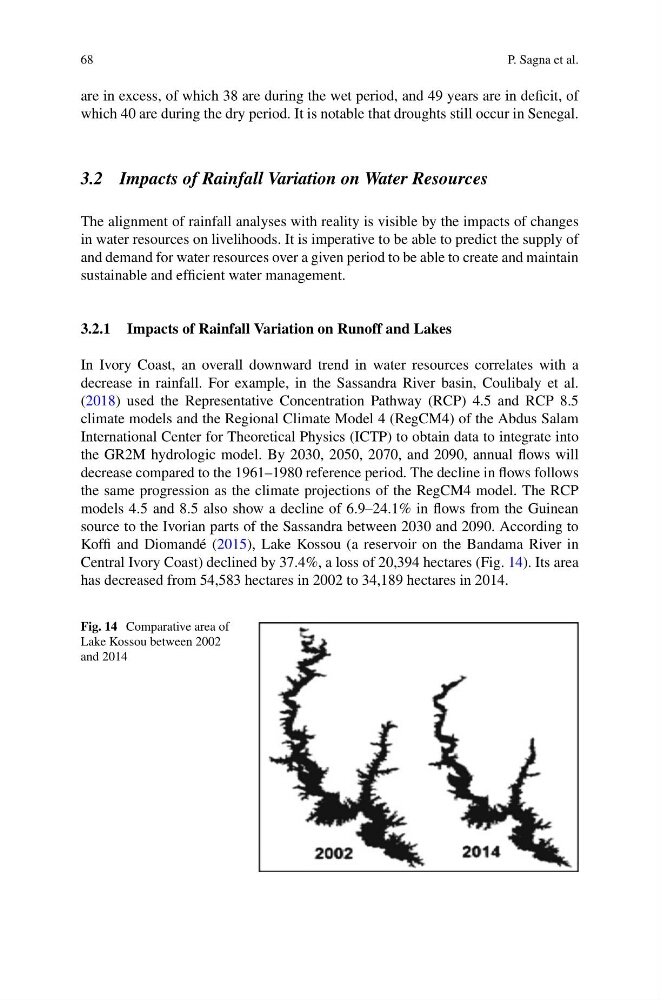
Koffi and Diomandé (2015), Lake Kossou (a reservoir on the Bandama River in
Central Ivory Coast) declined by 37.4%, a loss of 20,394 hectares (Fig. 14). Its area
has decreased from 54,583 hectares in 2002 to 34,189 hectares in 2014.
Fig. 14 Comparative area of
Lake Kossou between 2002
and 2014
P. Sagna et al.
are in excess, of which 38 are during the wet period, and 49 years are in deficit, of
which 40 are during the dry period. It is notable that droughts still occur in Senegal.
3.2 Impacts of Rainfall Variation on Water Resources
The alignment of rainfall analyses with reality is visible by the impacts of changes
in water resources on livelihoods. It is imperative to be able to predict the supply of
and demand for water resources over a given period to be able to create and maintain
sustainable and efficient water management.
3.2.1 Impacts of Rainfall Variation on Runoff and Lakes
In Ivory Coast, an overall downward trend in water resources correlates with a
decrease in rainfall. For example, in the Sassandra River basin, Coulibaly et al.
(2018) used the Representative Concentration Pathway (RCP) 4.5 and RCP 8.5
climate models and the Regional Climate Model 4 (RegCM4) of the Abdus Salam
International Center for Theoretical Physics (ICTP) to obtain data to integrate into
the GR2M hydrologic model. By 2030, 2050, 2070, and 2090, annual flows will
decrease compared to the 1961–1980 reference period. The decline in flows follows
the same progression as the climate projections of the RegCM4 model. The RCP
models 4.5 and 8.5 also show a decline of 6.9–24.1% in flows from the Guinean
source to the Ivorian parts of the Sassandra between 2030 and 2090. According to
Koffi and Diomandé (2015), Lake Kossou (a reservoir on the Bandama River in
Central Ivory Coast) declined by 37.4%, a loss of 20,394 hectares (Fig. 14). Its area
has decreased from 54,583 hectares in 2002 to 34,189 hectares in 2014.
Fig. 14 Comparative area of
Lake Kossou between 2002
and 2014