

4 Climate Change and Water Resources in West Africa …
63
Fig. 4 Evolution of Lee and
Heghinian’s test results in
Ivory Coast from 1921 to
2016
shows an average of 1139.8 mm. The difference between the two periods is 398.2 mm,
which corresponds to a drop of 25.9% in rainfall. The rainiest years are concentrated
between 1951 and 1963: 1951 with 1833.5 mm, 1954 with 1851.3 mm, 1955 with
1893.7 mm, 1957 with 1838.7 mm and 1963 with 1895 mm. The driest years, apart
from 2002 (928.2 mm), are also close to one another: 1983 with 937.3 mm, 1985 with
952.5 mm, 1986 with 911.3 mm and 1990 with 1011.4 mm. Between the wettest year
(1963) and the driest year (1986), the difference is 983.7 mm. In the entire series,
51 years are in excess and 45 years in deficit. Rainfall seems to continue to diminish.
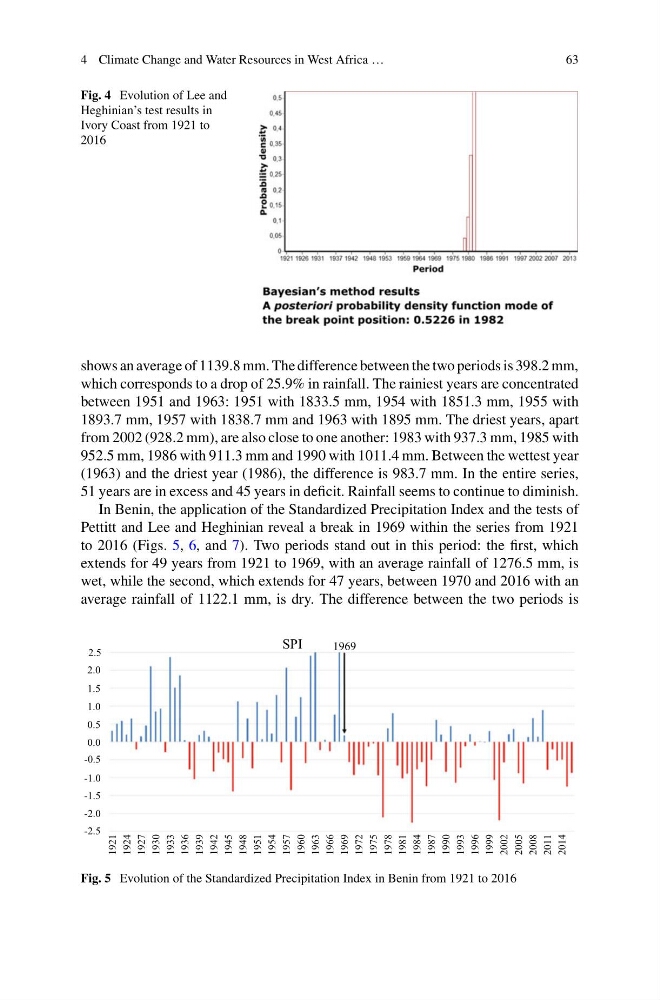
In Benin, the application of the Standardized Precipitation Index and the tests of
Pettitt and Lee and Heghinian reveal a break in 1969 within the series from 1921
to 2016 (Figs. 5, 6, and 7). Two periods stand out in this period: the first, which
extends for 49 years from 1921 to 1969, with an average rainfall of 1276.5 mm, is
wet, while the second, which extends for 47 years, between 1970 and 2016 with an
average rainfall of 1122.1 mm, is dry. The difference between the two periods is
-2.5
-2.0
-1.5
-1.0
-0.5
0.0
0.5
1.0
1.5
2.0
2.5
1921
1924
1927
1930
1933
1936
1939
1942
1945
1948
1951
1954
1957
1960
1963
1966
1969
1972
1975
1978
1981
1984
1987
1990
1993
1996
1999
2002
2005
2008
2011
2014
SPI
1969
Fig. 5 Evolution of the Standardized Precipitation Index in Benin from 1921 to 2016
63
Fig. 4 Evolution of Lee and
Heghinian’s test results in
Ivory Coast from 1921 to
2016
shows an average of 1139.8 mm. The difference between the two periods is 398.2 mm,
which corresponds to a drop of 25.9% in rainfall. The rainiest years are concentrated
between 1951 and 1963: 1951 with 1833.5 mm, 1954 with 1851.3 mm, 1955 with
1893.7 mm, 1957 with 1838.7 mm and 1963 with 1895 mm. The driest years, apart
from 2002 (928.2 mm), are also close to one another: 1983 with 937.3 mm, 1985 with
952.5 mm, 1986 with 911.3 mm and 1990 with 1011.4 mm. Between the wettest year
(1963) and the driest year (1986), the difference is 983.7 mm. In the entire series,
51 years are in excess and 45 years in deficit. Rainfall seems to continue to diminish.
In Benin, the application of the Standardized Precipitation Index and the tests of
Pettitt and Lee and Heghinian reveal a break in 1969 within the series from 1921
to 2016 (Figs. 5, 6, and 7). Two periods stand out in this period: the first, which
extends for 49 years from 1921 to 1969, with an average rainfall of 1276.5 mm, is
wet, while the second, which extends for 47 years, between 1970 and 2016 with an
average rainfall of 1122.1 mm, is dry. The difference between the two periods is
-2.5
-2.0
-1.5
-1.0
-0.5
0.0
0.5
1.0
1.5
2.0
2.5
1921
1924
1927
1930
1933
1936
1939
1942
1945
1948
1951
1954
1957
1960
1963
1966
1969
1972
1975
1978
1981
1984
1987
1990
1993
1996
1999
2002
2005
2008
2011
2014
SPI
1969
Fig. 5 Evolution of the Standardized Precipitation Index in Benin from 1921 to 2016