

452
M. C. Moseki
severity while intensity in rainfall and associated dry spells also increase. Models
indicate uncertainty in rainfall due to uncertainty in future dynamics in the intertropical convergence zone. The western parts are likely to become drier while the northeastern parts become relatively wetter. The region is further projected to become
hotter over the next 40 to 80 years.
5.2 Vulnerability and Impacts
Vulnerability varies by country depending on its infrastructure development plans and
institutional capacity. The Limpopo Region is densely populated and the rural poor in
the basin rely on climate-sensitive resources such as rain-fed agriculture, and hence
adaptive capacity is generally low. Vulnerability in the basin increases with poor
implementation of policies. The area near the Mozambique border often experiences
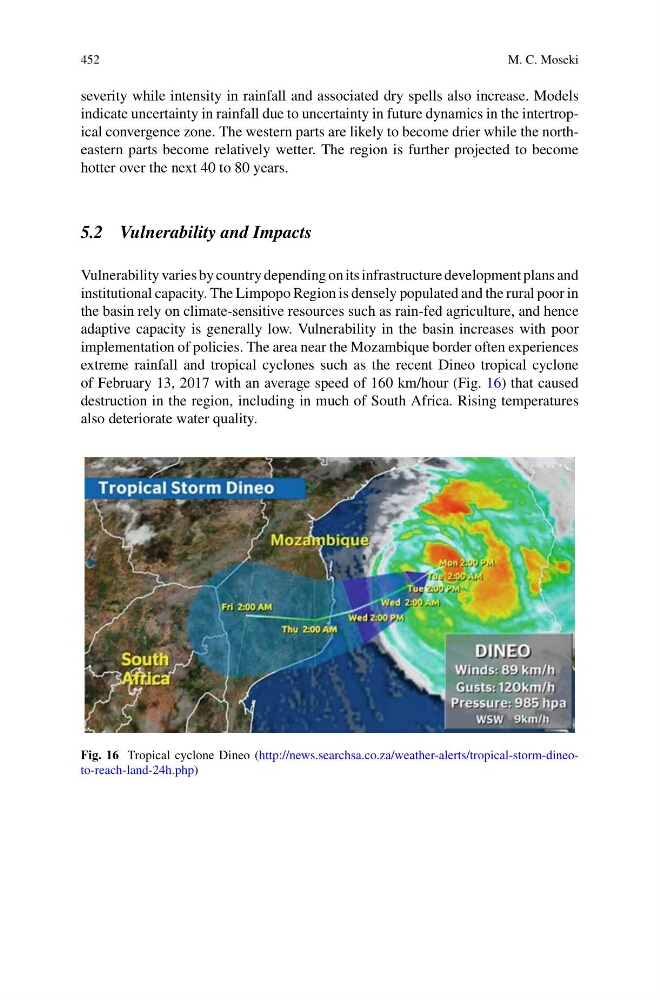
extreme rainfall and tropical cyclones such as the recent Dineo tropical cyclone
of February 13, 2017 with an average speed of 160 km/hour (Fig. 16) that caused
destruction in the region, including in much of South Africa. Rising temperatures
also deteriorate water quality.
Fig. 16 Tropical cyclone Dineo (http://news.searchsa.co.za/weather-alerts/tropical-storm-dineoto-reach-land-24h.php)
M. C. Moseki
severity while intensity in rainfall and associated dry spells also increase. Models
indicate uncertainty in rainfall due to uncertainty in future dynamics in the intertropical convergence zone. The western parts are likely to become drier while the northeastern parts become relatively wetter. The region is further projected to become
hotter over the next 40 to 80 years.
5.2 Vulnerability and Impacts
Vulnerability varies by country depending on its infrastructure development plans and
institutional capacity. The Limpopo Region is densely populated and the rural poor in
the basin rely on climate-sensitive resources such as rain-fed agriculture, and hence
adaptive capacity is generally low. Vulnerability in the basin increases with poor
implementation of policies. The area near the Mozambique border often experiences
extreme rainfall and tropical cyclones such as the recent Dineo tropical cyclone
of February 13, 2017 with an average speed of 160 km/hour (Fig. 16) that caused
destruction in the region, including in much of South Africa. Rising temperatures
also deteriorate water quality.
Fig. 16 Tropical cyclone Dineo (http://news.searchsa.co.za/weather-alerts/tropical-storm-dineoto-reach-land-24h.php)