

434
M. C. Moseki
1 Introduction
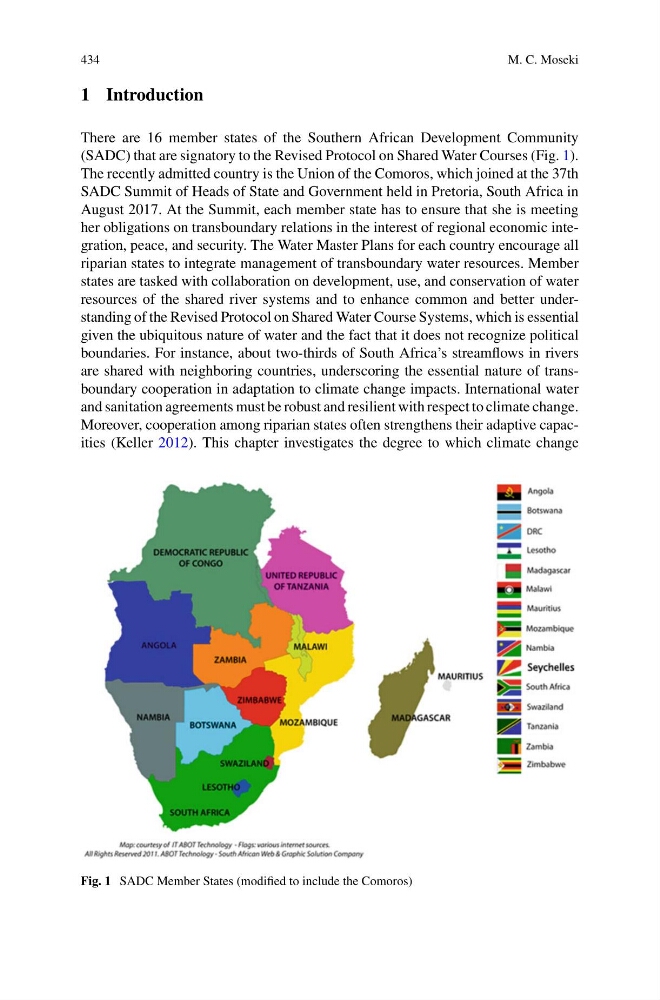
There are 16 member states of the Southern African Development Community
(SADC) that are signatory to the Revised Protocol on Shared Water Courses (Fig. 1).
The recently admitted country is the Union of the Comoros, which joined at the 37th
SADC Summit of Heads of State and Government held in Pretoria, South Africa in
August 2017. At the Summit, each member state has to ensure that she is meeting
her obligations on transboundary relations in the interest of regional economic integration, peace, and security. The Water Master Plans for each country encourage all
riparian states to integrate management of transboundary water resources. Member
states are tasked with collaboration on development, use, and conservation of water
resources of the shared river systems and to enhance common and better understanding of the Revised Protocol on Shared Water Course Systems, which is essential
given the ubiquitous nature of water and the fact that it does not recognize political
boundaries. For instance, about two-thirds of South Africa’s streamflows in rivers
are shared with neighboring countries, underscoring the essential nature of transboundary cooperation in adaptation to climate change impacts. International water
and sanitation agreements must be robust and resilient with respect to climate change.
Moreover, cooperation among riparian states often strengthens their adaptive capacities (Keller 2012). This chapter investigates the degree to which climate change
Fig. 1 SADC Member States (modified to include the Comoros)
M. C. Moseki
1 Introduction
There are 16 member states of the Southern African Development Community
(SADC) that are signatory to the Revised Protocol on Shared Water Courses (Fig. 1).
The recently admitted country is the Union of the Comoros, which joined at the 37th
SADC Summit of Heads of State and Government held in Pretoria, South Africa in
August 2017. At the Summit, each member state has to ensure that she is meeting
her obligations on transboundary relations in the interest of regional economic integration, peace, and security. The Water Master Plans for each country encourage all
riparian states to integrate management of transboundary water resources. Member
states are tasked with collaboration on development, use, and conservation of water
resources of the shared river systems and to enhance common and better understanding of the Revised Protocol on Shared Water Course Systems, which is essential
given the ubiquitous nature of water and the fact that it does not recognize political
boundaries. For instance, about two-thirds of South Africa’s streamflows in rivers
are shared with neighboring countries, underscoring the essential nature of transboundary cooperation in adaptation to climate change impacts. International water
and sanitation agreements must be robust and resilient with respect to climate change.
Moreover, cooperation among riparian states often strengthens their adaptive capacities (Keller 2012). This chapter investigates the degree to which climate change
Fig. 1 SADC Member States (modified to include the Comoros)