

18 Developing a Framework for the Water-Energy …
427
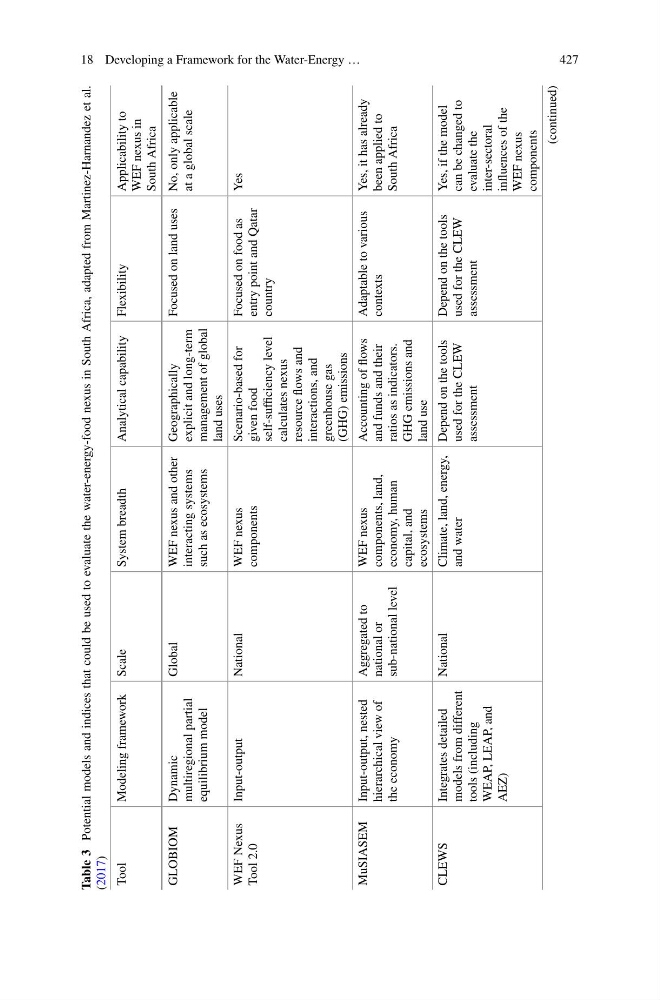
Table 3
Potential models and indices that could be used to evaluate the water-energy-food nexus in South Africa, adapted from Martinez-Harnandez et al.
(2017)
Tool
Modeling framework Scale
System breadth
Analytical capability Flexibility
Applicability to
WEF nexus in
South Africa
GLOBIOM
Dynamic
multiregional partial
equilibrium model
Global
WEF nexus and other
interacting systems
such as ecosystems
Geographically
explicit and long-term
management of global
land uses
Focused on land uses No, only applicable
at a global scale
WEF Nexus
Tool 2.0
Input-output
National
WEF nexus
components
Scenario-based for
given food
self-sufficiency level
calculates nexus
resource flows and
interactions, and
greenhouse gas
(GHG) emissions
Focused on food as
entry point and Qatar
country
Yes
MuSIASEM
Input-output, nested
hierarchical view of
the economy
Aggregated to
national or
sub-national level
WEF nexus
components, land,
economy, human
capital, and
ecosystems
Accounting of flows
and funds and their
ratios as indicators.
GHG emissions and
land use
Adaptable to various
contexts
Yes, it has already
been applied to
South Africa
CLEWS
Integrates detailed
models from different
tools (including
WEAP, LEAP, and
AEZ)
National
Climate, land, energy,
and water
Depend on the tools
used for the CLEW
assessment
Depend on the tools
used for the CLEW
assessment
Yes, if the model
can be changed to
evaluate the
inter-sectoral
influences of the
WEF nexus
components
(continued)
427
Table 3
Potential models and indices that could be used to evaluate the water-energy-food nexus in South Africa, adapted from Martinez-Harnandez et al.
(2017)
Tool
Modeling framework Scale
System breadth
Analytical capability Flexibility
Applicability to
WEF nexus in
South Africa
GLOBIOM
Dynamic
multiregional partial
equilibrium model
Global
WEF nexus and other
interacting systems
such as ecosystems
Geographically
explicit and long-term
management of global
land uses
Focused on land uses No, only applicable
at a global scale
WEF Nexus
Tool 2.0
Input-output
National
WEF nexus
components
Scenario-based for
given food
self-sufficiency level
calculates nexus
resource flows and
interactions, and
greenhouse gas
(GHG) emissions
Focused on food as
entry point and Qatar
country
Yes
MuSIASEM
Input-output, nested
hierarchical view of
the economy
Aggregated to
national or
sub-national level
WEF nexus
components, land,
economy, human
capital, and
ecosystems
Accounting of flows
and funds and their
ratios as indicators.
GHG emissions and
land use
Adaptable to various
contexts
Yes, it has already
been applied to
South Africa
CLEWS
Integrates detailed
models from different
tools (including
WEAP, LEAP, and
AEZ)
National
Climate, land, energy,
and water
Depend on the tools
used for the CLEW
assessment
Depend on the tools
used for the CLEW
assessment
Yes, if the model
can be changed to
evaluate the
inter-sectoral
influences of the
WEF nexus
components
(continued)