

18 Developing a Framework for the Water-Energy …
423
3.3.1 Tools
A number of indices, metrics, and models can be used to evaluate the WEF nexus.
The MuSIASEM (Multi-Scale Integrated Assessment of Society and Ecosystem
Metabolism) tool was developed to simulate the WEF nexus by means of depicting
the metabolic patterns of WEF in relation to ecological and socio-economic variables. It was originally developed for the energy sector, but can be adapted to the
WEF nexus by including water and food in its methodology (FAO 2013). MuSIASEM allows the simultaneous use of demographic, ecological, and social variables even if they were defined on different levels and scales, thus enabling effective analysis of the interdependencies among water, energy, and food at a national
or sub-national level. Furthermore, MuSIASEM provides feasibility, viability, and
desirability checks of each proposed scenario. It was used to generate an integrated
assessment of the contribution and convenience of Concentrated Solar Power (CSP)
and woody biomass as alternative sources for electricity production in South Africa
(LIPHE4, 2013). This case study uses quantitative data from published research
to evaluate electricity consumption in South Africa , as well as production factors
of CSP and woody biomass-based electricity. The maximum short-term potential
of CSP and woody biomass were calculated to be 3,000 GWh and 5,900 GWh,
respectively; their respective input requirements as well as the trade-offs between
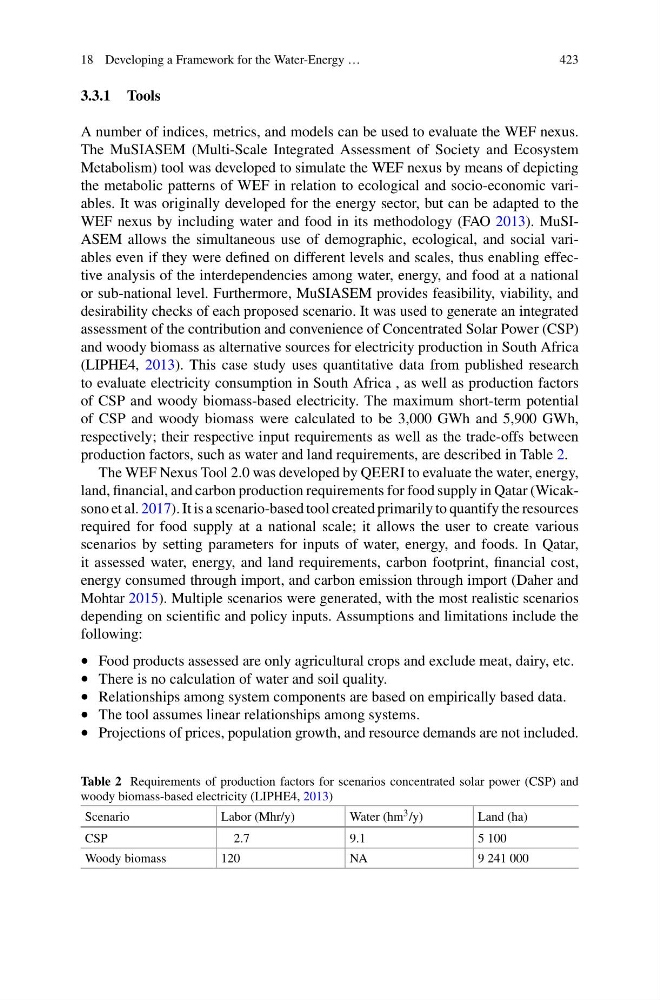
production factors, such as water and land requirements, are described in Table 2.
The WEF Nexus Tool 2.0 was developed by QEERI to evaluate the water, energy,
land, financial, and carbon production requirements for food supply in Qatar (Wicaksono et al. 2017). It is a scenario-based tool created primarily to quantify the resources
required for food supply at a national scale; it allows the user to create various
scenarios by setting parameters for inputs of water, energy, and foods. In Qatar,
it assessed water, energy, and land requirements, carbon footprint, financial cost,
energy consumed through import, and carbon emission through import (Daher and
Mohtar 2015). Multiple scenarios were generated, with the most realistic scenarios
depending on scientific and policy inputs. Assumptions and limitations include the
following:
• Food products assessed are only agricultural crops and exclude meat, dairy, etc.
• There is no calculation of water and soil quality.
• Relationships among system components are based on empirically based data.
• The tool assumes linear relationships among systems.
• Projections of prices, population growth, and resource demands are not included.
Table 2 Requirements of production factors for scenarios concentrated solar power (CSP) and
woody biomass-based electricity (LIPHE4, 2013)
Scenario
Labor (Mhr/y)
Water (hm 3 /y)
Land (ha)
CSP
2.7
9.1
5 100
Woody biomass
120
NA
9 241 000
423
3.3.1 Tools
A number of indices, metrics, and models can be used to evaluate the WEF nexus.
The MuSIASEM (Multi-Scale Integrated Assessment of Society and Ecosystem
Metabolism) tool was developed to simulate the WEF nexus by means of depicting
the metabolic patterns of WEF in relation to ecological and socio-economic variables. It was originally developed for the energy sector, but can be adapted to the
WEF nexus by including water and food in its methodology (FAO 2013). MuSIASEM allows the simultaneous use of demographic, ecological, and social variables even if they were defined on different levels and scales, thus enabling effective analysis of the interdependencies among water, energy, and food at a national
or sub-national level. Furthermore, MuSIASEM provides feasibility, viability, and
desirability checks of each proposed scenario. It was used to generate an integrated
assessment of the contribution and convenience of Concentrated Solar Power (CSP)
and woody biomass as alternative sources for electricity production in South Africa
(LIPHE4, 2013). This case study uses quantitative data from published research
to evaluate electricity consumption in South Africa , as well as production factors
of CSP and woody biomass-based electricity. The maximum short-term potential
of CSP and woody biomass were calculated to be 3,000 GWh and 5,900 GWh,
respectively; their respective input requirements as well as the trade-offs between
production factors, such as water and land requirements, are described in Table 2.
The WEF Nexus Tool 2.0 was developed by QEERI to evaluate the water, energy,
land, financial, and carbon production requirements for food supply in Qatar (Wicaksono et al. 2017). It is a scenario-based tool created primarily to quantify the resources
required for food supply at a national scale; it allows the user to create various
scenarios by setting parameters for inputs of water, energy, and foods. In Qatar,
it assessed water, energy, and land requirements, carbon footprint, financial cost,
energy consumed through import, and carbon emission through import (Daher and
Mohtar 2015). Multiple scenarios were generated, with the most realistic scenarios
depending on scientific and policy inputs. Assumptions and limitations include the
following:
• Food products assessed are only agricultural crops and exclude meat, dairy, etc.
• There is no calculation of water and soil quality.
• Relationships among system components are based on empirically based data.
• The tool assumes linear relationships among systems.
• Projections of prices, population growth, and resource demands are not included.
Table 2 Requirements of production factors for scenarios concentrated solar power (CSP) and
woody biomass-based electricity (LIPHE4, 2013)
Scenario
Labor (Mhr/y)
Water (hm 3 /y)
Land (ha)
CSP
2.7
9.1
5 100
Woody biomass
120
NA
9 241 000