

18 Developing a Framework for the Water-Energy …
411
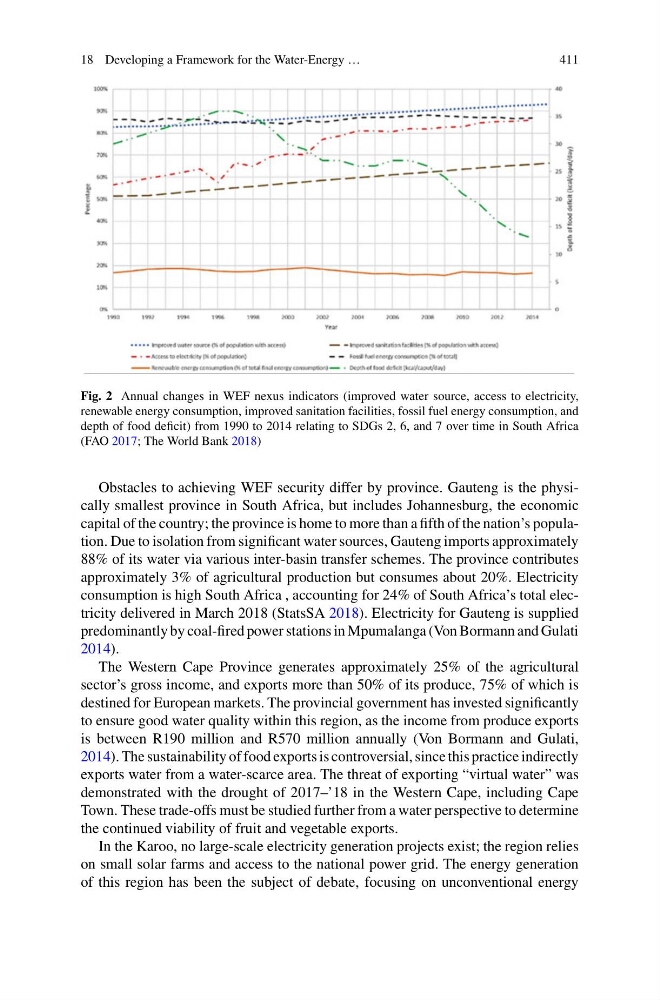
Fig. 2 Annual changes in WEF nexus indicators (improved water source, access to electricity,
renewable energy consumption, improved sanitation facilities, fossil fuel energy consumption, and
depth of food deficit) from 1990 to 2014 relating to SDGs 2, 6, and 7 over time in South Africa
(FAO 2017; The World Bank 2018)
Obstacles to achieving WEF security differ by province. Gauteng is the physically smallest province in South Africa, but includes Johannesburg, the economic
capital of the country; the province is home to more than a fifth of the nation’s population. Due to isolation from significant water sources, Gauteng imports approximately
88% of its water via various inter-basin transfer schemes. The province contributes
approximately 3% of agricultural production but consumes about 20%. Electricity
consumption is high South Africa , accounting for 24% of South Africa’s total electricity delivered in March 2018 (StatsSA 2018). Electricity for Gauteng is supplied
predominantly by coal-fired power stations in Mpumalanga (Von Bormann and Gulati
2014).
The Western Cape Province generates approximately 25% of the agricultural
sector’s gross income, and exports more than 50% of its produce, 75% of which is
destined for European markets. The provincial government has invested significantly
to ensure good water quality within this region, as the income from produce exports
is between R190 million and R570 million annually (Von Bormann and Gulati,
2014). The sustainability of food exports is controversial, since this practice indirectly
exports water from a water-scarce area. The threat of exporting “virtual water” was
demonstrated with the drought of 2017–’18 in the Western Cape, including Cape
Town. These trade-offs must be studied further from a water perspective to determine
the continued viability of fruit and vegetable exports.
In the Karoo, no large-scale electricity generation projects exist; the region relies
on small solar farms and access to the national power grid. The energy generation
of this region has been the subject of debate, focusing on unconventional energy
411
Fig. 2 Annual changes in WEF nexus indicators (improved water source, access to electricity,
renewable energy consumption, improved sanitation facilities, fossil fuel energy consumption, and
depth of food deficit) from 1990 to 2014 relating to SDGs 2, 6, and 7 over time in South Africa
(FAO 2017; The World Bank 2018)
Obstacles to achieving WEF security differ by province. Gauteng is the physically smallest province in South Africa, but includes Johannesburg, the economic
capital of the country; the province is home to more than a fifth of the nation’s population. Due to isolation from significant water sources, Gauteng imports approximately
88% of its water via various inter-basin transfer schemes. The province contributes
approximately 3% of agricultural production but consumes about 20%. Electricity
consumption is high South Africa , accounting for 24% of South Africa’s total electricity delivered in March 2018 (StatsSA 2018). Electricity for Gauteng is supplied
predominantly by coal-fired power stations in Mpumalanga (Von Bormann and Gulati
2014).
The Western Cape Province generates approximately 25% of the agricultural
sector’s gross income, and exports more than 50% of its produce, 75% of which is
destined for European markets. The provincial government has invested significantly
to ensure good water quality within this region, as the income from produce exports
is between R190 million and R570 million annually (Von Bormann and Gulati,
2014). The sustainability of food exports is controversial, since this practice indirectly
exports water from a water-scarce area. The threat of exporting “virtual water” was
demonstrated with the drought of 2017–’18 in the Western Cape, including Cape
Town. These trade-offs must be studied further from a water perspective to determine
the continued viability of fruit and vegetable exports.
In the Karoo, no large-scale electricity generation projects exist; the region relies
on small solar farms and access to the national power grid. The energy generation
of this region has been the subject of debate, focusing on unconventional energy