

410
T. Mabhaudhi et al.
was the case in the adoption of the Millennium Development Goals (MDGs), which
often lacked harmonization and thus failed to deliver as effectively as it otherwise
could have.
In 2014, the Worldwide Fund/South Africa (WWF-SA) published a series of
documents, funded by the British High Commission in Pretoria, entitled Understanding the Food Energy Water Nexus (Carter and Gulati 2014). The framework for
approaching the WEF nexus was through the relationship of climate change, waste
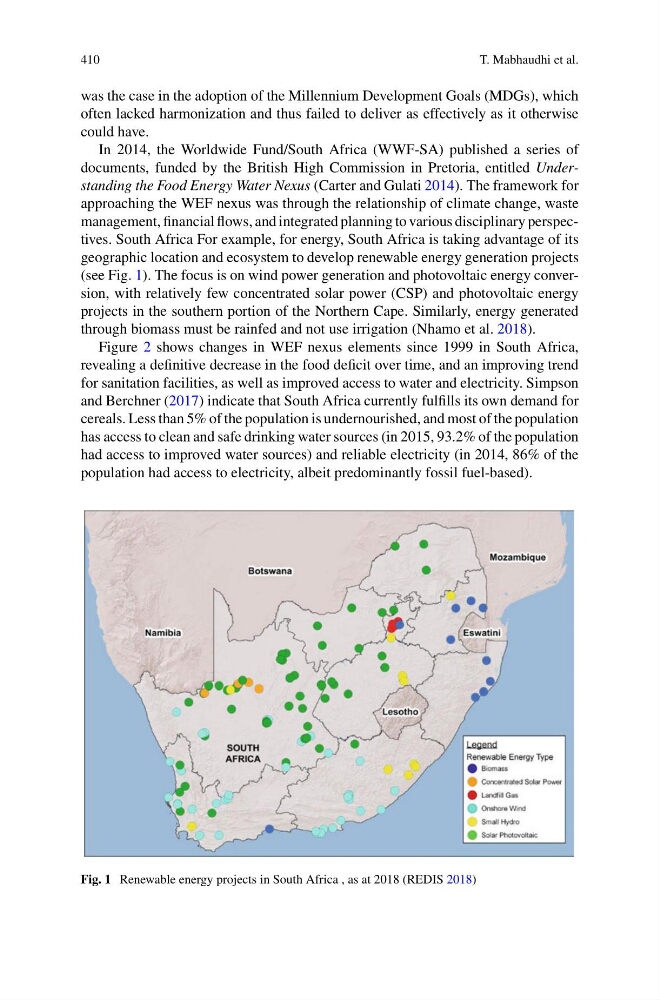
management, financial flows, and integrated planning to various disciplinary perspectives. South Africa For example, for energy, South Africa is taking advantage of its
geographic location and ecosystem to develop renewable energy generation projects
(see Fig. 1). The focus is on wind power generation and photovoltaic energy conversion, with relatively few concentrated solar power (CSP) and photovoltaic energy
projects in the southern portion of the Northern Cape. Similarly, energy generated
through biomass must be rainfed and not use irrigation (Nhamo et al. 2018).
Figure 2 shows changes in WEF nexus elements since 1999 in South Africa,
revealing a definitive decrease in the food deficit over time, and an improving trend
for sanitation facilities, as well as improved access to water and electricity. Simpson
and Berchner (2017) indicate that South Africa currently fulfills its own demand for
cereals. Less than 5% of the population is undernourished, and most of the population
has access to clean and safe drinking water sources (in 2015, 93.2% of the population
had access to improved water sources) and reliable electricity (in 2014, 86% of the
population had access to electricity, albeit predominantly fossil fuel-based).
Fig. 1 Renewable energy projects in South Africa , as at 2018 (REDIS 2018)
T. Mabhaudhi et al.
was the case in the adoption of the Millennium Development Goals (MDGs), which
often lacked harmonization and thus failed to deliver as effectively as it otherwise
could have.
In 2014, the Worldwide Fund/South Africa (WWF-SA) published a series of
documents, funded by the British High Commission in Pretoria, entitled Understanding the Food Energy Water Nexus (Carter and Gulati 2014). The framework for
approaching the WEF nexus was through the relationship of climate change, waste
management, financial flows, and integrated planning to various disciplinary perspectives. South Africa For example, for energy, South Africa is taking advantage of its
geographic location and ecosystem to develop renewable energy generation projects
(see Fig. 1). The focus is on wind power generation and photovoltaic energy conversion, with relatively few concentrated solar power (CSP) and photovoltaic energy
projects in the southern portion of the Northern Cape. Similarly, energy generated
through biomass must be rainfed and not use irrigation (Nhamo et al. 2018).
Figure 2 shows changes in WEF nexus elements since 1999 in South Africa,
revealing a definitive decrease in the food deficit over time, and an improving trend
for sanitation facilities, as well as improved access to water and electricity. Simpson
and Berchner (2017) indicate that South Africa currently fulfills its own demand for
cereals. Less than 5% of the population is undernourished, and most of the population
has access to clean and safe drinking water sources (in 2015, 93.2% of the population
had access to improved water sources) and reliable electricity (in 2014, 86% of the
population had access to electricity, albeit predominantly fossil fuel-based).
Fig. 1 Renewable energy projects in South Africa , as at 2018 (REDIS 2018)