

17 Strengthening Flood and Drought Risk Management Tools …
401
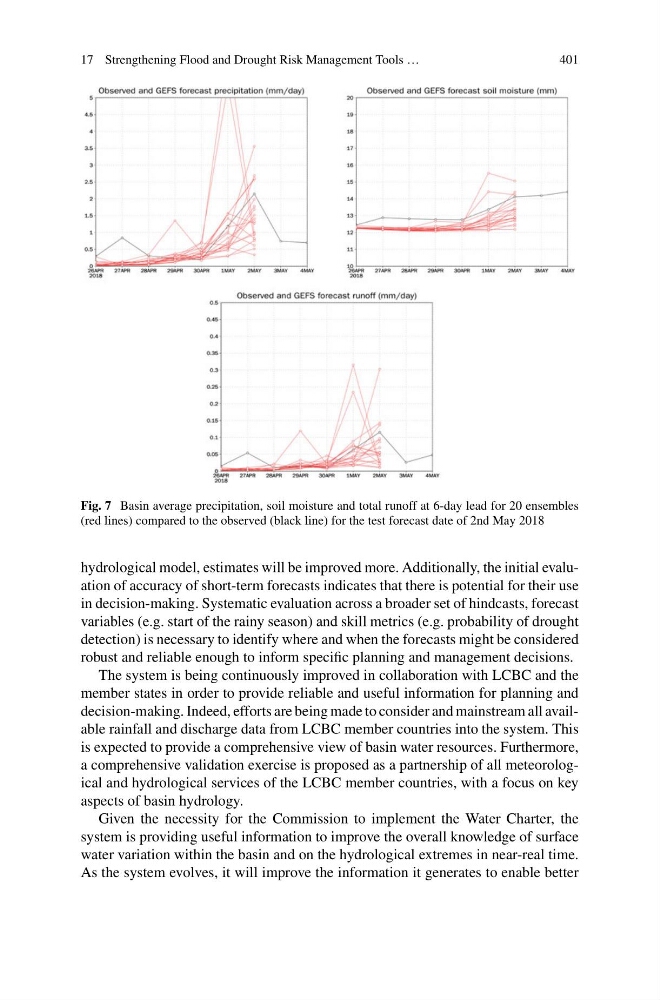
Fig. 7 Basin average precipitation, soil moisture and total runoff at 6-day lead for 20 ensembles
(red lines) compared to the observed (black line) for the test forecast date of 2nd May 2018
hydrological model, estimates will be improved more. Additionally, the initial evaluation of accuracy of short-term forecasts indicates that there is potential for their use
in decision-making. Systematic evaluation across a broader set of hindcasts, forecast
variables (e.g. start of the rainy season) and skill metrics (e.g. probability of drought
detection) is necessary to identify where and when the forecasts might be considered
robust and reliable enough to inform specific planning and management decisions.
The system is being continuously improved in collaboration with LCBC and the
member states in order to provide reliable and useful information for planning and
decision-making. Indeed, efforts are being made to consider and mainstream all available rainfall and discharge data from LCBC member countries into the system. This
is expected to provide a comprehensive view of basin water resources. Furthermore,
a comprehensive validation exercise is proposed as a partnership of all meteorological and hydrological services of the LCBC member countries, with a focus on key
aspects of basin hydrology.
Given the necessity for the Commission to implement the Water Charter, the
system is providing useful information to improve the overall knowledge of surface
water variation within the basin and on the hydrological extremes in near-real time.
As the system evolves, it will improve the information it generates to enable better
401
Fig. 7 Basin average precipitation, soil moisture and total runoff at 6-day lead for 20 ensembles
(red lines) compared to the observed (black line) for the test forecast date of 2nd May 2018
hydrological model, estimates will be improved more. Additionally, the initial evaluation of accuracy of short-term forecasts indicates that there is potential for their use
in decision-making. Systematic evaluation across a broader set of hindcasts, forecast
variables (e.g. start of the rainy season) and skill metrics (e.g. probability of drought
detection) is necessary to identify where and when the forecasts might be considered
robust and reliable enough to inform specific planning and management decisions.
The system is being continuously improved in collaboration with LCBC and the
member states in order to provide reliable and useful information for planning and
decision-making. Indeed, efforts are being made to consider and mainstream all available rainfall and discharge data from LCBC member countries into the system. This
is expected to provide a comprehensive view of basin water resources. Furthermore,
a comprehensive validation exercise is proposed as a partnership of all meteorological and hydrological services of the LCBC member countries, with a focus on key
aspects of basin hydrology.
Given the necessity for the Commission to implement the Water Charter, the
system is providing useful information to improve the overall knowledge of surface
water variation within the basin and on the hydrological extremes in near-real time.
As the system evolves, it will improve the information it generates to enable better