

2 Africa-Wide Trends in Development and Water …
15
needed for development and growth. As economic development and the expected
growth in urban population takes place, the demand on water for drinking, energy
and food will continue to increase. In parallel, impacts on the freshwater habitats of
Africa (WWF and SAB 2018) will grow. According to the FAO (2010), overall water
withdrawals, in particular the blue water footprint, for agriculture represents 81% of
all water withdrawals in Africa, with the industrial sector at 4% and domestic water
use at 15%. With growth projections in Africa, these withdrawals are likely to shift
towards increasing industrial and domestic water use.
Water availability across Africa varies enormously. The North and South ends
of the continent and the Horn of Africa are arid, while the middle third of the continent
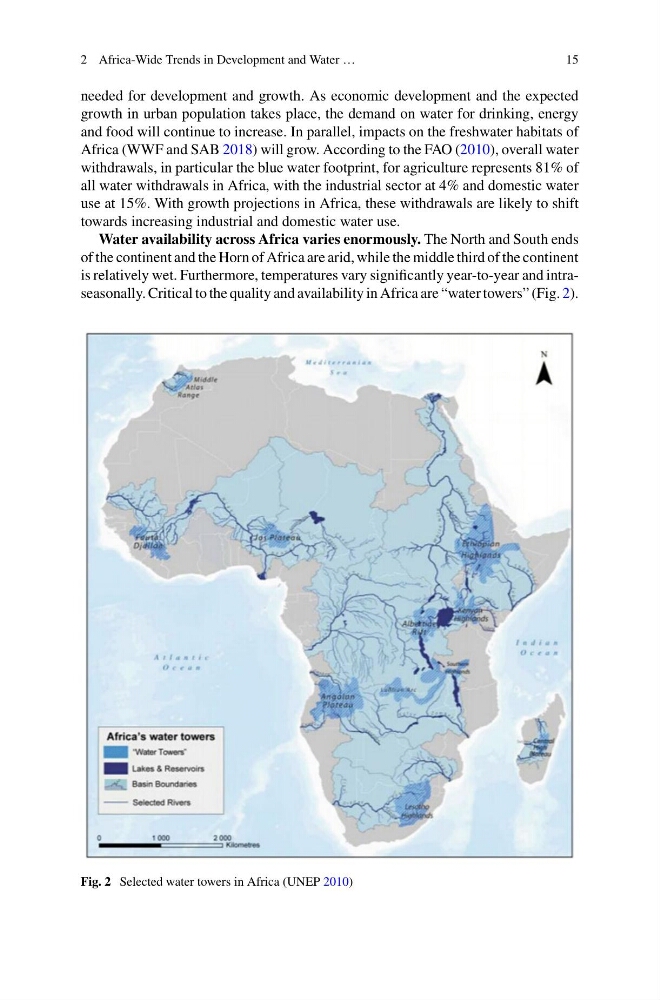
is relatively wet. Furthermore, temperatures vary significantly year-to-year and intraseasonally. Critical to the quality and availability in Africa are “water towers” (Fig. 2).
Fig. 2 Selected water towers in Africa (UNEP 2010)
15
needed for development and growth. As economic development and the expected
growth in urban population takes place, the demand on water for drinking, energy
and food will continue to increase. In parallel, impacts on the freshwater habitats of
Africa (WWF and SAB 2018) will grow. According to the FAO (2010), overall water
withdrawals, in particular the blue water footprint, for agriculture represents 81% of
all water withdrawals in Africa, with the industrial sector at 4% and domestic water
use at 15%. With growth projections in Africa, these withdrawals are likely to shift
towards increasing industrial and domestic water use.
Water availability across Africa varies enormously. The North and South ends
of the continent and the Horn of Africa are arid, while the middle third of the continent
is relatively wet. Furthermore, temperatures vary significantly year-to-year and intraseasonally. Critical to the quality and availability in Africa are “water towers” (Fig. 2).
Fig. 2 Selected water towers in Africa (UNEP 2010)