

14
H. Baleta et al.
to manage trade-offs at a national level. Trade-offs for water use among different
sectors, such as agriculture, energy, urban growth and manufacturing, will become
increasingly urgent. It is imperative that decisions regarding water resources across
Africa that are made now and in the near future take into account the impact of the
water, energy and food nexus within each country and across the continent. In particular, healthy, free-flowing rivers and freshwater habitats are critical to ensure the
sustainability of Africa’s water, energy and food in the face of the growing demands
that are aggravated by climate risk.
Keywords Water-energy-food (WEF) nexus · Green water · Blue water · Grey
water · Climate change · Development · Water infrastructure · Water institutions
1 Africa’s Economy and Water Use
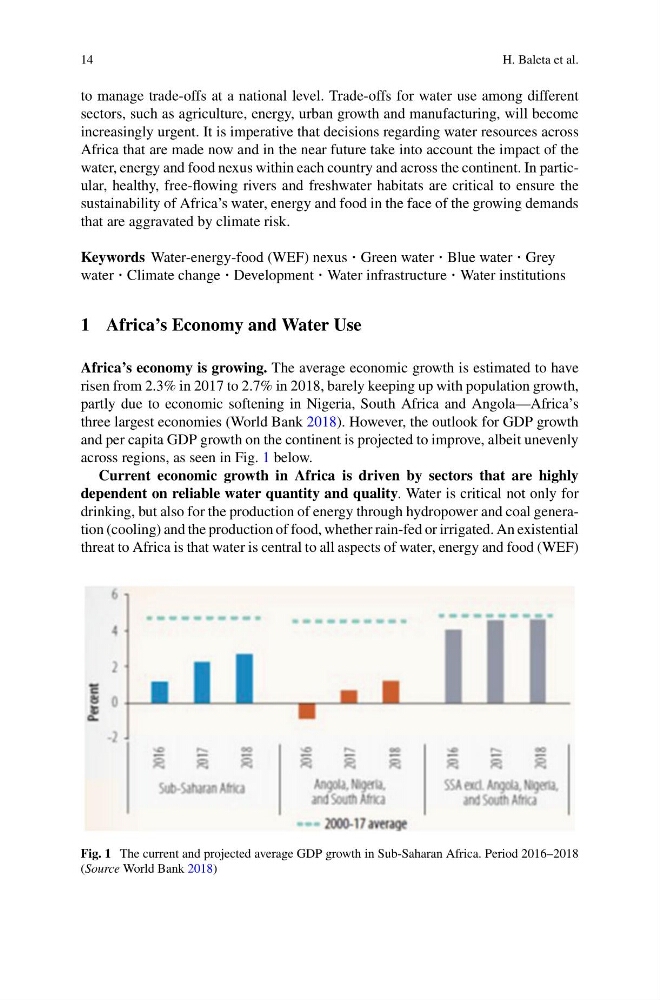
Africa’s economy is growing. The average economic growth is estimated to have
risen from 2.3% in 2017 to 2.7% in 2018, barely keeping up with population growth,
partly due to economic softening in Nigeria, South Africa and Angola—Africa’s
three largest economies (World Bank 2018). However, the outlook for GDP growth
and per capita GDP growth on the continent is projected to improve, albeit unevenly
across regions, as seen in Fig. 1 below.
Current economic growth in Africa is driven by sectors that are highly
dependent on reliable water quantity and quality. Water is critical not only for
drinking, but also for the production of energy through hydropower and coal generation (cooling) and the production of food, whether rain-fed or irrigated. An existential
threat to Africa is that water is central to all aspects of water, energy and food (WEF)
Fig. 1 The current and projected average GDP growth in Sub-Saharan Africa. Period 2016–2018
(Source World Bank 2018)
H. Baleta et al.
to manage trade-offs at a national level. Trade-offs for water use among different
sectors, such as agriculture, energy, urban growth and manufacturing, will become
increasingly urgent. It is imperative that decisions regarding water resources across
Africa that are made now and in the near future take into account the impact of the
water, energy and food nexus within each country and across the continent. In particular, healthy, free-flowing rivers and freshwater habitats are critical to ensure the
sustainability of Africa’s water, energy and food in the face of the growing demands
that are aggravated by climate risk.
Keywords Water-energy-food (WEF) nexus · Green water · Blue water · Grey
water · Climate change · Development · Water infrastructure · Water institutions
1 Africa’s Economy and Water Use
Africa’s economy is growing. The average economic growth is estimated to have
risen from 2.3% in 2017 to 2.7% in 2018, barely keeping up with population growth,
partly due to economic softening in Nigeria, South Africa and Angola—Africa’s
three largest economies (World Bank 2018). However, the outlook for GDP growth
and per capita GDP growth on the continent is projected to improve, albeit unevenly
across regions, as seen in Fig. 1 below.
Current economic growth in Africa is driven by sectors that are highly
dependent on reliable water quantity and quality. Water is critical not only for
drinking, but also for the production of energy through hydropower and coal generation (cooling) and the production of food, whether rain-fed or irrigated. An existential
threat to Africa is that water is central to all aspects of water, energy and food (WEF)
Fig. 1 The current and projected average GDP growth in Sub-Saharan Africa. Period 2016–2018
(Source World Bank 2018)