

360
K. M. AbuZeid
1 The Nile River Basin and the Blue Nile Basin Climate
Variability
The Nile Basin in Ethiopia receives about 450 BCM of rain per year out of a total
of 970 BCM falling on Ethiopian lands. Ethiopia has several aquifers and river
basins other than the Blue Nile, Sobat, and Atbara Basins associated with the Nile
Basin in Ethiopia (AbuZeid 2016). Ethiopia, with the largest livestock production
in Africa, depends on rainfed natural pasture lands for feeding. The geographical
climate variability and the distribution of rainfall on the Nile Basin countries created
the dependence of Egypt and Northern Sudan on the river’s water and Ethiopia’s
reliance on direct rainfall, which contributes to vast areas of forests, pasture, and
rainfed agriculture in Ethiopia, as well as recharging a vast reservoir of renewable
groundwater. It is therefore expected that upstream countries such as Ethiopia rely
on “rainwater” in the Nile Basin, whereas downstream countries such as Egypt and
Sudan rely on “running water” from the Nile River itself. Egypt and large areas of
Sudan are considered arid and hyper-arid areas where there is practically no rainfall.
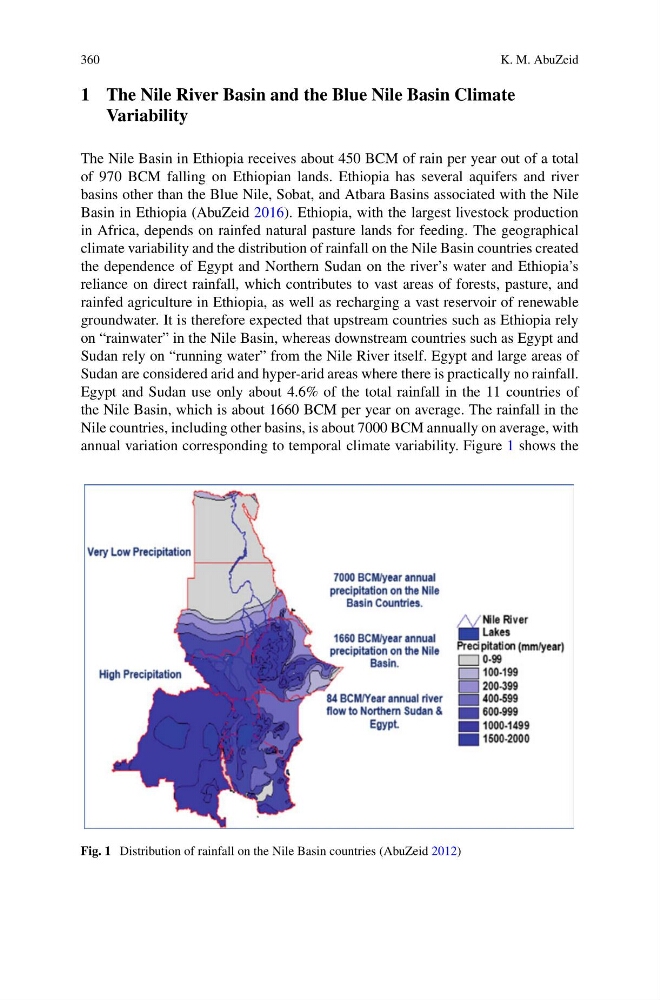
Egypt and Sudan use only about 4.6% of the total rainfall in the 11 countries of
the Nile Basin, which is about 1660 BCM per year on average. The rainfall in the
Nile countries, including other basins, is about 7000 BCM annually on average, with
annual variation corresponding to temporal climate variability. Figure 1 shows the
Fig. 1 Distribution of rainfall on the Nile Basin countries (AbuZeid 2012)
K. M. AbuZeid
1 The Nile River Basin and the Blue Nile Basin Climate
Variability
The Nile Basin in Ethiopia receives about 450 BCM of rain per year out of a total
of 970 BCM falling on Ethiopian lands. Ethiopia has several aquifers and river
basins other than the Blue Nile, Sobat, and Atbara Basins associated with the Nile
Basin in Ethiopia (AbuZeid 2016). Ethiopia, with the largest livestock production
in Africa, depends on rainfed natural pasture lands for feeding. The geographical
climate variability and the distribution of rainfall on the Nile Basin countries created
the dependence of Egypt and Northern Sudan on the river’s water and Ethiopia’s
reliance on direct rainfall, which contributes to vast areas of forests, pasture, and
rainfed agriculture in Ethiopia, as well as recharging a vast reservoir of renewable
groundwater. It is therefore expected that upstream countries such as Ethiopia rely
on “rainwater” in the Nile Basin, whereas downstream countries such as Egypt and
Sudan rely on “running water” from the Nile River itself. Egypt and large areas of
Sudan are considered arid and hyper-arid areas where there is practically no rainfall.
Egypt and Sudan use only about 4.6% of the total rainfall in the 11 countries of
the Nile Basin, which is about 1660 BCM per year on average. The rainfall in the
Nile countries, including other basins, is about 7000 BCM annually on average, with
annual variation corresponding to temporal climate variability. Figure 1 shows the
Fig. 1 Distribution of rainfall on the Nile Basin countries (AbuZeid 2012)