

322
B. Lèye et al.
capacity to reduce flow velocity. On degraded soils, they can create new fields of
crops through sedimentation. However, these permeable rock dams do not maintain
soil moisture during long dry spells.
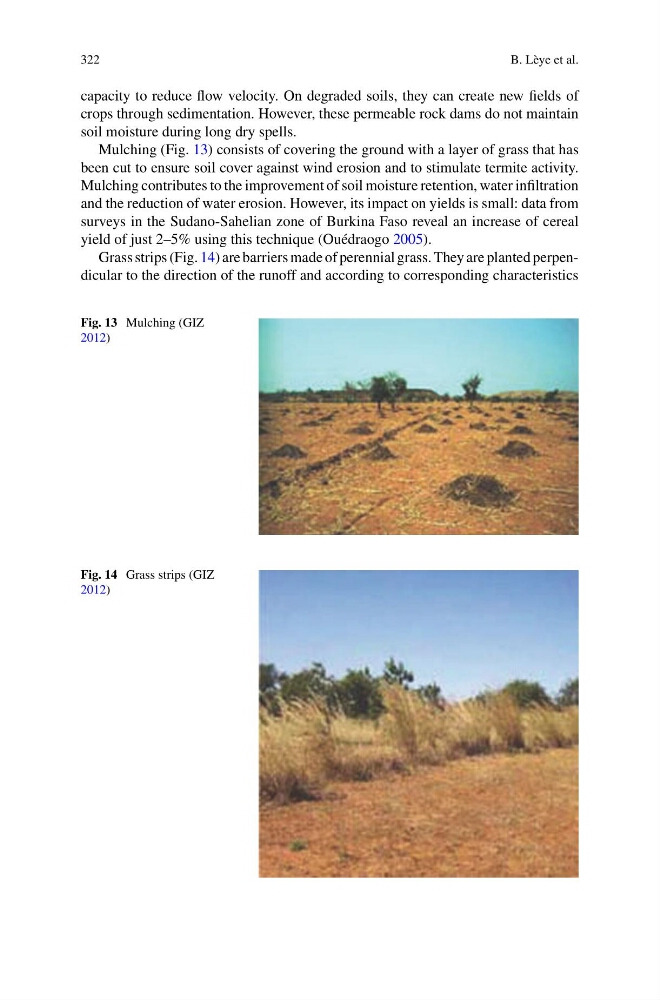
Mulching (Fig. 13) consists of covering the ground with a layer of grass that has
been cut to ensure soil cover against wind erosion and to stimulate termite activity.
Mulching contributes to the improvement of soil moisture retention, water infiltration
and the reduction of water erosion. However, its impact on yields is small: data from
surveys in the Sudano-Sahelian zone of Burkina Faso reveal an increase of cereal
yield of just 2–5% using this technique (Ouédraogo 2005).
Grass strips (Fig. 14) are barriers made of perennial grass. They are planted perpendicular to the direction of the runoff and according to corresponding characteristics
Fig. 13 Mulching (GIZ
2012)
Fig. 14 Grass strips (GIZ
2012)
B. Lèye et al.
capacity to reduce flow velocity. On degraded soils, they can create new fields of
crops through sedimentation. However, these permeable rock dams do not maintain
soil moisture during long dry spells.
Mulching (Fig. 13) consists of covering the ground with a layer of grass that has
been cut to ensure soil cover against wind erosion and to stimulate termite activity.
Mulching contributes to the improvement of soil moisture retention, water infiltration
and the reduction of water erosion. However, its impact on yields is small: data from
surveys in the Sudano-Sahelian zone of Burkina Faso reveal an increase of cereal
yield of just 2–5% using this technique (Ouédraogo 2005).
Grass strips (Fig. 14) are barriers made of perennial grass. They are planted perpendicular to the direction of the runoff and according to corresponding characteristics
Fig. 13 Mulching (GIZ
2012)
Fig. 14 Grass strips (GIZ
2012)