

320
B. Lèye et al.
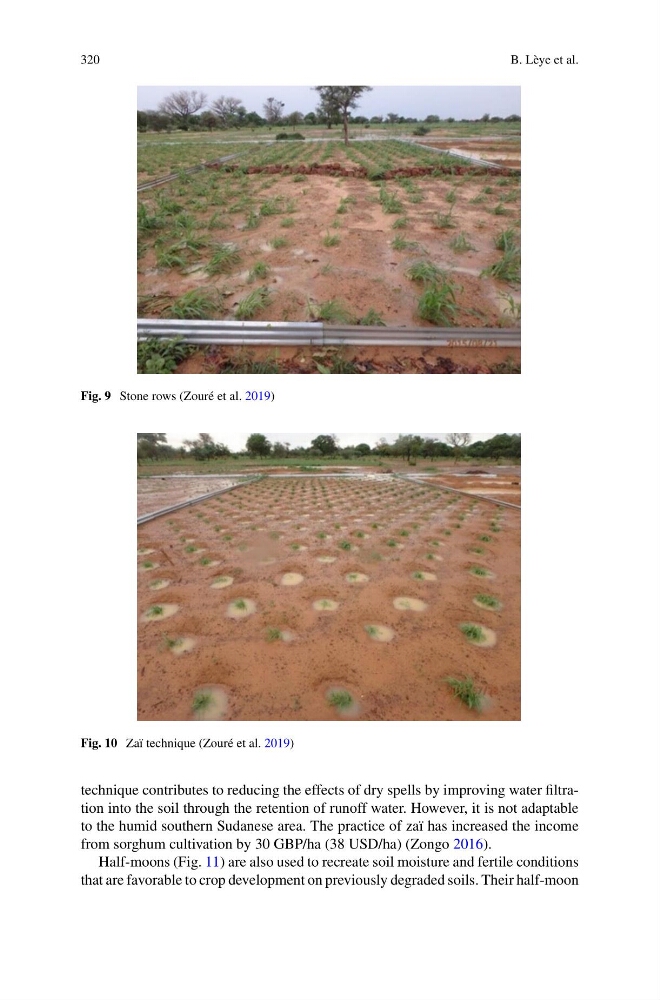
Fig. 9 Stone rows (Zouré et al. 2019)
Fig. 10 Zaï technique (Zouré et al. 2019)
technique contributes to reducing the effects of dry spells by improving water filtration into the soil through the retention of runoff water. However, it is not adaptable
to the humid southern Sudanese area. The practice of zaï has increased the income
from sorghum cultivation by 30 GBP/ha (38 USD/ha) (Zongo 2016).
Half-moons (Fig. 11) are also used to recreate soil moisture and fertile conditions
that are favorable to crop development on previously degraded soils. Their half-moon
B. Lèye et al.
Fig. 9 Stone rows (Zouré et al. 2019)
Fig. 10 Zaï technique (Zouré et al. 2019)
technique contributes to reducing the effects of dry spells by improving water filtration into the soil through the retention of runoff water. However, it is not adaptable
to the humid southern Sudanese area. The practice of zaï has increased the income
from sorghum cultivation by 30 GBP/ha (38 USD/ha) (Zongo 2016).
Half-moons (Fig. 11) are also used to recreate soil moisture and fertile conditions
that are favorable to crop development on previously degraded soils. Their half-moon