

260
C. Faye et al.
consistent criteria for each parameter measured to ensure the duration of available
information and data quality.
3.1.3 Standardized Precipitation and Flow Rates Indices
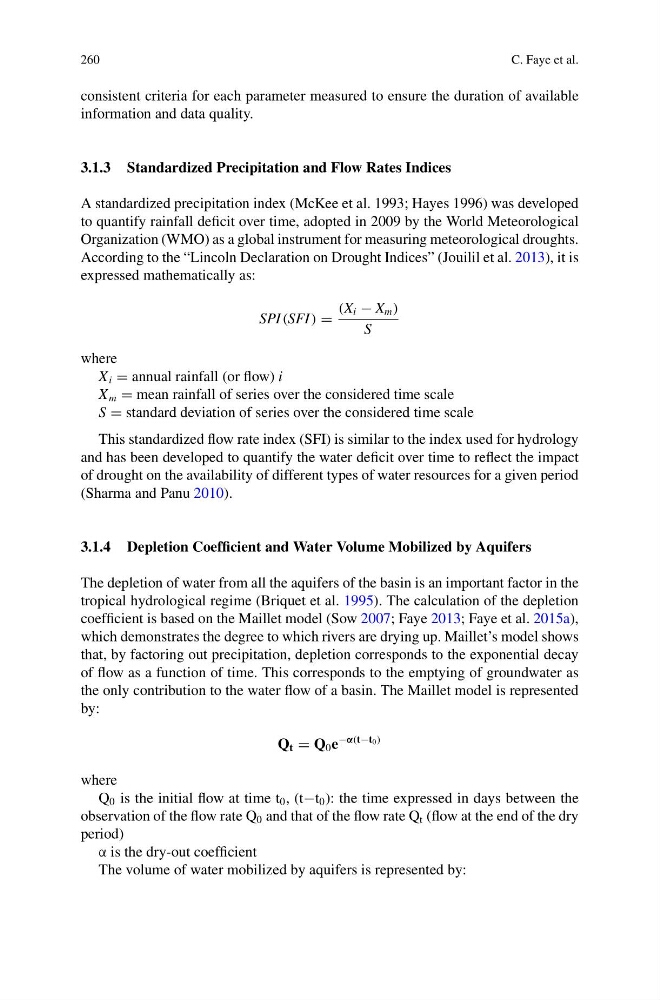
A standardized precipitation index (McKee et al. 1993; Hayes 1996) was developed
to quantify rainfall deficit over time, adopted in 2009 by the World Meteorological
Organization (WMO) as a global instrument for measuring meteorological droughts.
According to the “Lincoln Declaration on Drought Indices” (Jouilil et al. 2013), it is
expressed mathematically as:
SPI (SFI ) =
(X i − X m )
S
where
X i = annual rainfall (or flow) i
X m = mean rainfall of series over the considered time scale
S = standard deviation of series over the considered time scale
This standardized flow rate index (SFI) is similar to the index used for hydrology
and has been developed to quantify the water deficit over time to reflect the impact
of drought on the availability of different types of water resources for a given period
(Sharma and Panu 2010).
3.1.4 Depletion Coefficient and Water Volume Mobilized by Aquifers
The depletion of water from all the aquifers of the basin is an important factor in the
tropical hydrological regime (Briquet et al. 1995). The calculation of the depletion
coefficient is based on the Maillet model (Sow 2007; Faye 2013; Faye et al. 2015a),
which demonstrates the degree to which rivers are drying up. Maillet’s model shows
that, by factoring out precipitation, depletion corresponds to the exponential decay
of flow as a function of time. This corresponds to the emptying of groundwater as
the only contribution to the water flow of a basin. The Maillet model is represented
by:
Q t = Q 0 e
−α(t−t 0 )
where
Q 0 is the initial flow at time t 0 , (t−t 0 ): the time expressed in days between the
observation of the flow rate Q 0 and that of the flow rate Q t (flow at the end of the dry
period)
α is the dry-out coefficient
The volume of water mobilized by aquifers is represented by:
C. Faye et al.
consistent criteria for each parameter measured to ensure the duration of available
information and data quality.
3.1.3 Standardized Precipitation and Flow Rates Indices
A standardized precipitation index (McKee et al. 1993; Hayes 1996) was developed
to quantify rainfall deficit over time, adopted in 2009 by the World Meteorological
Organization (WMO) as a global instrument for measuring meteorological droughts.
According to the “Lincoln Declaration on Drought Indices” (Jouilil et al. 2013), it is
expressed mathematically as:
SPI (SFI ) =
(X i − X m )
S
where
X i = annual rainfall (or flow) i
X m = mean rainfall of series over the considered time scale
S = standard deviation of series over the considered time scale
This standardized flow rate index (SFI) is similar to the index used for hydrology
and has been developed to quantify the water deficit over time to reflect the impact
of drought on the availability of different types of water resources for a given period
(Sharma and Panu 2010).
3.1.4 Depletion Coefficient and Water Volume Mobilized by Aquifers
The depletion of water from all the aquifers of the basin is an important factor in the
tropical hydrological regime (Briquet et al. 1995). The calculation of the depletion
coefficient is based on the Maillet model (Sow 2007; Faye 2013; Faye et al. 2015a),
which demonstrates the degree to which rivers are drying up. Maillet’s model shows
that, by factoring out precipitation, depletion corresponds to the exponential decay
of flow as a function of time. This corresponds to the emptying of groundwater as
the only contribution to the water flow of a basin. The Maillet model is represented
by:
Q t = Q 0 e
−α(t−t 0 )
where
Q 0 is the initial flow at time t 0 , (t−t 0 ): the time expressed in days between the
observation of the flow rate Q 0 and that of the flow rate Q t (flow at the end of the dry
period)
α is the dry-out coefficient
The volume of water mobilized by aquifers is represented by: