

188
M. O. Eduvie and I. F. Oseke
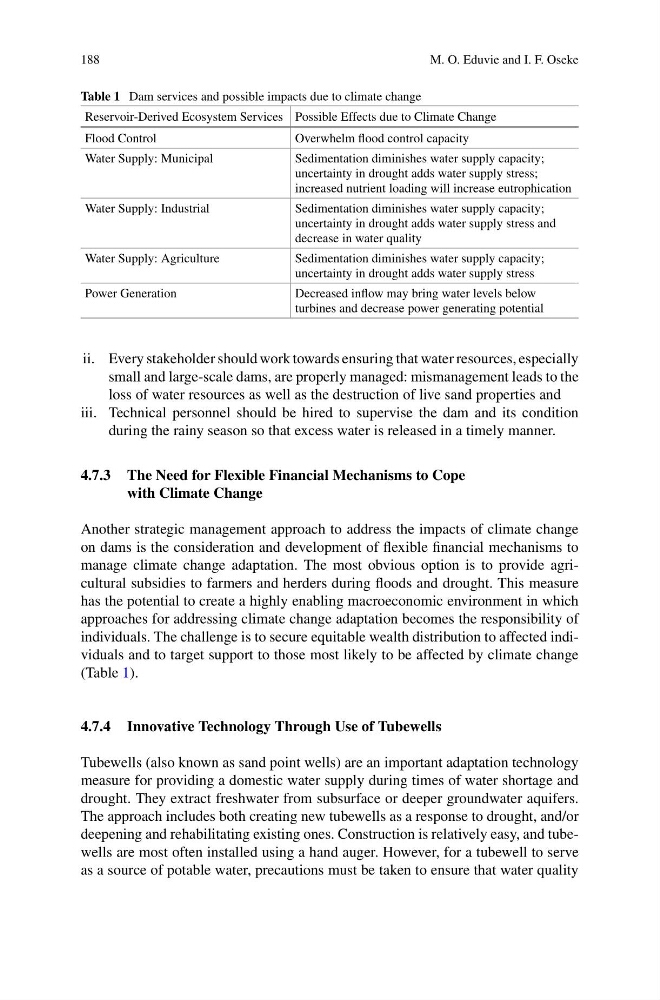
Table 1 Dam services and possible impacts due to climate change
Reservoir-Derived Ecosystem Services Possible Effects due to Climate Change
Flood Control
Overwhelm flood control capacity
Water Supply: Municipal
Sedimentation diminishes water supply capacity;
uncertainty in drought adds water supply stress;
increased nutrient loading will increase eutrophication
Water Supply: Industrial
Sedimentation diminishes water supply capacity;
uncertainty in drought adds water supply stress and
decrease in water quality
Water Supply: Agriculture
Sedimentation diminishes water supply capacity;
uncertainty in drought adds water supply stress
Power Generation
Decreased inflow may bring water levels below
turbines and decrease power generating potential
ii. Every stakeholder should work towards ensuring that water resources, especially
small and large-scale dams, are properly managed: mismanagement leads to the
loss of water resources as well as the destruction of live sand properties and
iii. Technical personnel should be hired to supervise the dam and its condition
during the rainy season so that excess water is released in a timely manner.
4.7.3 The Need for Flexible Financial Mechanisms to Cope
with Climate Change
Another strategic management approach to address the impacts of climate change
on dams is the consideration and development of flexible financial mechanisms to
manage climate change adaptation. The most obvious option is to provide agricultural subsidies to farmers and herders during floods and drought. This measure
has the potential to create a highly enabling macroeconomic environment in which
approaches for addressing climate change adaptation becomes the responsibility of
individuals. The challenge is to secure equitable wealth distribution to affected individuals and to target support to those most likely to be affected by climate change
(Table 1).
4.7.4 Innovative Technology Through Use of Tubewells
Tubewells (also known as sand point wells) are an important adaptation technology
measure for providing a domestic water supply during times of water shortage and
drought. They extract freshwater from subsurface or deeper groundwater aquifers.
The approach includes both creating new tubewells as a response to drought, and/or
deepening and rehabilitating existing ones. Construction is relatively easy, and tubewells are most often installed using a hand auger. However, for a tubewell to serve
as a source of potable water, precautions must be taken to ensure that water quality
M. O. Eduvie and I. F. Oseke
Table 1 Dam services and possible impacts due to climate change
Reservoir-Derived Ecosystem Services Possible Effects due to Climate Change
Flood Control
Overwhelm flood control capacity
Water Supply: Municipal
Sedimentation diminishes water supply capacity;
uncertainty in drought adds water supply stress;
increased nutrient loading will increase eutrophication
Water Supply: Industrial
Sedimentation diminishes water supply capacity;
uncertainty in drought adds water supply stress and
decrease in water quality
Water Supply: Agriculture
Sedimentation diminishes water supply capacity;
uncertainty in drought adds water supply stress
Power Generation
Decreased inflow may bring water levels below
turbines and decrease power generating potential
ii. Every stakeholder should work towards ensuring that water resources, especially
small and large-scale dams, are properly managed: mismanagement leads to the
loss of water resources as well as the destruction of live sand properties and
iii. Technical personnel should be hired to supervise the dam and its condition
during the rainy season so that excess water is released in a timely manner.
4.7.3 The Need for Flexible Financial Mechanisms to Cope
with Climate Change
Another strategic management approach to address the impacts of climate change
on dams is the consideration and development of flexible financial mechanisms to
manage climate change adaptation. The most obvious option is to provide agricultural subsidies to farmers and herders during floods and drought. This measure
has the potential to create a highly enabling macroeconomic environment in which
approaches for addressing climate change adaptation becomes the responsibility of
individuals. The challenge is to secure equitable wealth distribution to affected individuals and to target support to those most likely to be affected by climate change
(Table 1).
4.7.4 Innovative Technology Through Use of Tubewells
Tubewells (also known as sand point wells) are an important adaptation technology
measure for providing a domestic water supply during times of water shortage and
drought. They extract freshwater from subsurface or deeper groundwater aquifers.
The approach includes both creating new tubewells as a response to drought, and/or
deepening and rehabilitating existing ones. Construction is relatively easy, and tubewells are most often installed using a hand auger. However, for a tubewell to serve
as a source of potable water, precautions must be taken to ensure that water quality