

7 A Framework for IWRM in the Water-Energy-Food …
165
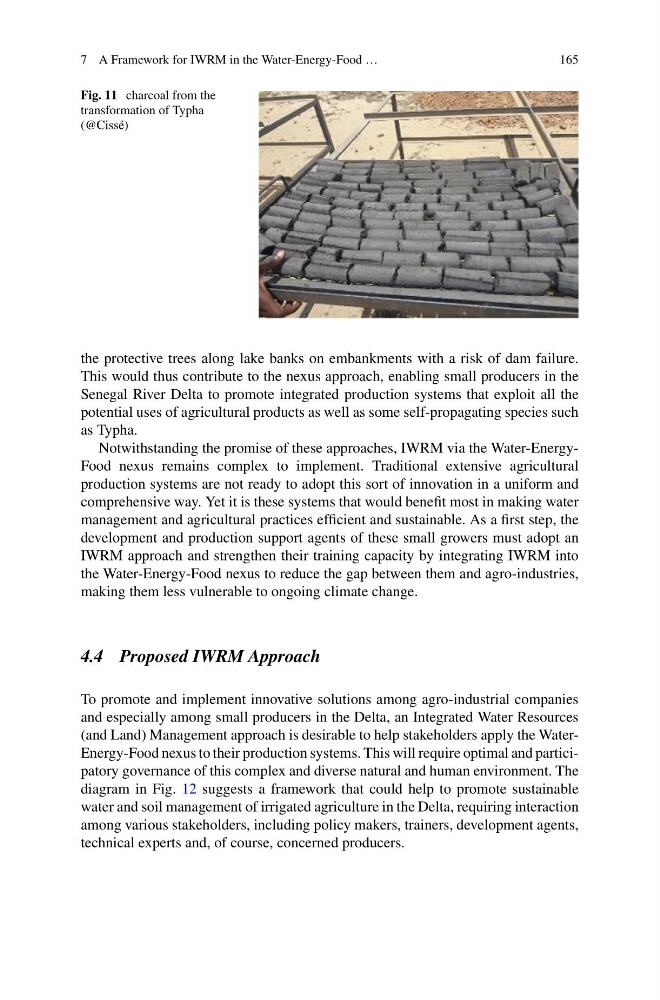
Fig. 11 charcoal from the
transformation of Typha
(@Cissé)
the protective trees along lake banks on embankments with a risk of dam failure.
This would thus contribute to the nexus approach, enabling small producers in the
Senegal River Delta to promote integrated production systems that exploit all the
potential uses of agricultural products as well as some self-propagating species such
as Typha.
Notwithstanding the promise of these approaches, IWRM via the Water-EnergyFood nexus remains complex to implement. Traditional extensive agricultural
production systems are not ready to adopt this sort of innovation in a uniform and
comprehensive way. Yet it is these systems that would benefit most in making water
management and agricultural practices efficient and sustainable. As a first step, the
development and production support agents of these small growers must adopt an
IWRM approach and strengthen their training capacity by integrating IWRM into
the Water-Energy-Food nexus to reduce the gap between them and agro-industries,
making them less vulnerable to ongoing climate change.
4.4 Proposed IWRM Approach
To promote and implement innovative solutions among agro-industrial companies
and especially among small producers in the Delta, an Integrated Water Resources
(and Land) Management approach is desirable to help stakeholders apply the WaterEnergy-Food nexus to their production systems. This will require optimal and participatory governance of this complex and diverse natural and human environment. The
diagram in Fig. 12 suggests a framework that could help to promote sustainable
water and soil management of irrigated agriculture in the Delta, requiring interaction
among various stakeholders, including policy makers, trainers, development agents,
technical experts and, of course, concerned producers.
165
Fig. 11 charcoal from the
transformation of Typha
(@Cissé)
the protective trees along lake banks on embankments with a risk of dam failure.
This would thus contribute to the nexus approach, enabling small producers in the
Senegal River Delta to promote integrated production systems that exploit all the
potential uses of agricultural products as well as some self-propagating species such
as Typha.
Notwithstanding the promise of these approaches, IWRM via the Water-EnergyFood nexus remains complex to implement. Traditional extensive agricultural
production systems are not ready to adopt this sort of innovation in a uniform and
comprehensive way. Yet it is these systems that would benefit most in making water
management and agricultural practices efficient and sustainable. As a first step, the
development and production support agents of these small growers must adopt an
IWRM approach and strengthen their training capacity by integrating IWRM into
the Water-Energy-Food nexus to reduce the gap between them and agro-industries,
making them less vulnerable to ongoing climate change.
4.4 Proposed IWRM Approach
To promote and implement innovative solutions among agro-industrial companies
and especially among small producers in the Delta, an Integrated Water Resources
(and Land) Management approach is desirable to help stakeholders apply the WaterEnergy-Food nexus to their production systems. This will require optimal and participatory governance of this complex and diverse natural and human environment. The
diagram in Fig. 12 suggests a framework that could help to promote sustainable
water and soil management of irrigated agriculture in the Delta, requiring interaction
among various stakeholders, including policy makers, trainers, development agents,
technical experts and, of course, concerned producers.