

5 Climate Change Impact on Hydrological Regimes …
117
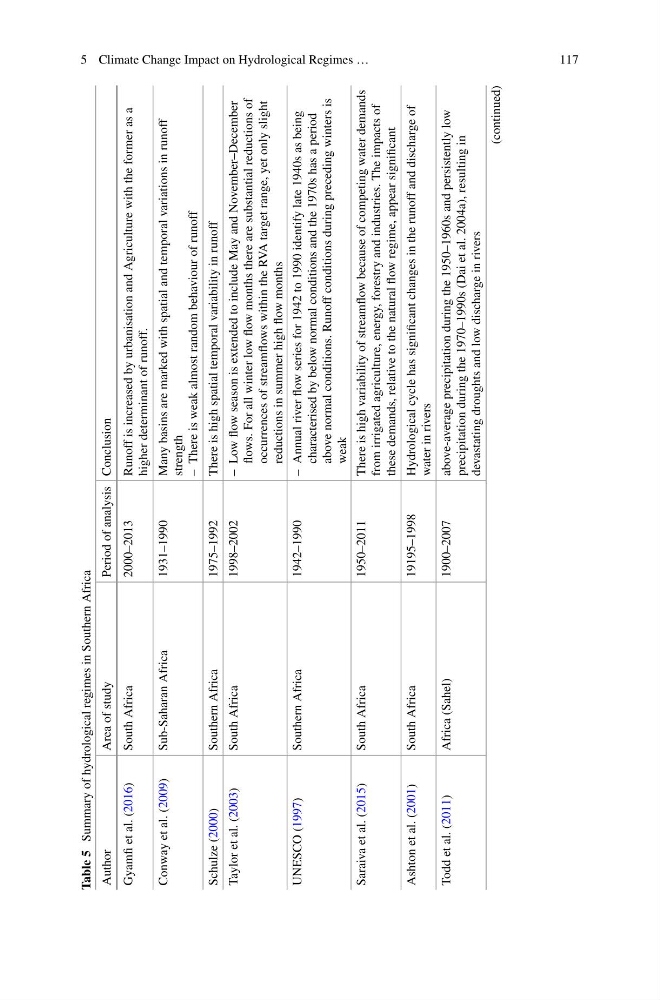
Table 5
Summary of hydrological regimes in Southern Africa
Author
Area of study
Period of analysis Conclusion
Gyamfi et al. (2016)
South Africa
2000–2013
Runoff is increased by urbanisation and Agriculture with the former as a
higher determinant of runoff.
Conway et al. (2009)
Sub-Saharan Africa
1931–1990
Many basins are marked with spatial and temporal variations in runoff
strength
– There is weak almost random behaviour of runoff
Schulze (2000)
Southern Africa
1975–1992
There is high spatial temporal variability in runoff
Taylor et al. (2003)
South Africa
1998–2002
– Low flow season is extended to include May and November–December
flows. For all winter low flow months there are substantial reductions of
occurrences of streamflows within the RVA target range, yet only slight
reductions in summer high flow months
UNESCO (1997)
Southern Africa
1942–1990
– Annual river flow series for 1942 to 1990 identify late 1940s as being
characterised by below normal conditions and the 1970s has a period
above normal conditions. Runoff conditions during preceding winters is
weak
Saraiva et al. (2015)
South Africa
1950–2011
There is high variability of streamflow because of competing water demands
from irrigated agriculture, energy, forestry and industries. The impacts of
these demands, relative to the natural flow regime, appear significant
Ashton et al. (2001)
South Africa
19195–1998
Hydrological cycle has significant changes in the runoff and discharge of
water in rivers
Todd et al. (2011)
Africa (Sahel)
1900–2007
above-average precipitation during the 1950–1960s and persistently low
precipitation during the 1970–1990s (Dai et al. 2004a), resulting in
devastating droughts and low discharge in rivers
(continued)
117
Table 5
Summary of hydrological regimes in Southern Africa
Author
Area of study
Period of analysis Conclusion
Gyamfi et al. (2016)
South Africa
2000–2013
Runoff is increased by urbanisation and Agriculture with the former as a
higher determinant of runoff.
Conway et al. (2009)
Sub-Saharan Africa
1931–1990
Many basins are marked with spatial and temporal variations in runoff
strength
– There is weak almost random behaviour of runoff
Schulze (2000)
Southern Africa
1975–1992
There is high spatial temporal variability in runoff
Taylor et al. (2003)
South Africa
1998–2002
– Low flow season is extended to include May and November–December
flows. For all winter low flow months there are substantial reductions of
occurrences of streamflows within the RVA target range, yet only slight
reductions in summer high flow months
UNESCO (1997)
Southern Africa
1942–1990
– Annual river flow series for 1942 to 1990 identify late 1940s as being
characterised by below normal conditions and the 1970s has a period
above normal conditions. Runoff conditions during preceding winters is
weak
Saraiva et al. (2015)
South Africa
1950–2011
There is high variability of streamflow because of competing water demands
from irrigated agriculture, energy, forestry and industries. The impacts of
these demands, relative to the natural flow regime, appear significant
Ashton et al. (2001)
South Africa
19195–1998
Hydrological cycle has significant changes in the runoff and discharge of
water in rivers
Todd et al. (2011)
Africa (Sahel)
1900–2007
above-average precipitation during the 1950–1960s and persistently low
precipitation during the 1970–1990s (Dai et al. 2004a), resulting in
devastating droughts and low discharge in rivers
(continued)