

108
S. Kusangaya et al.
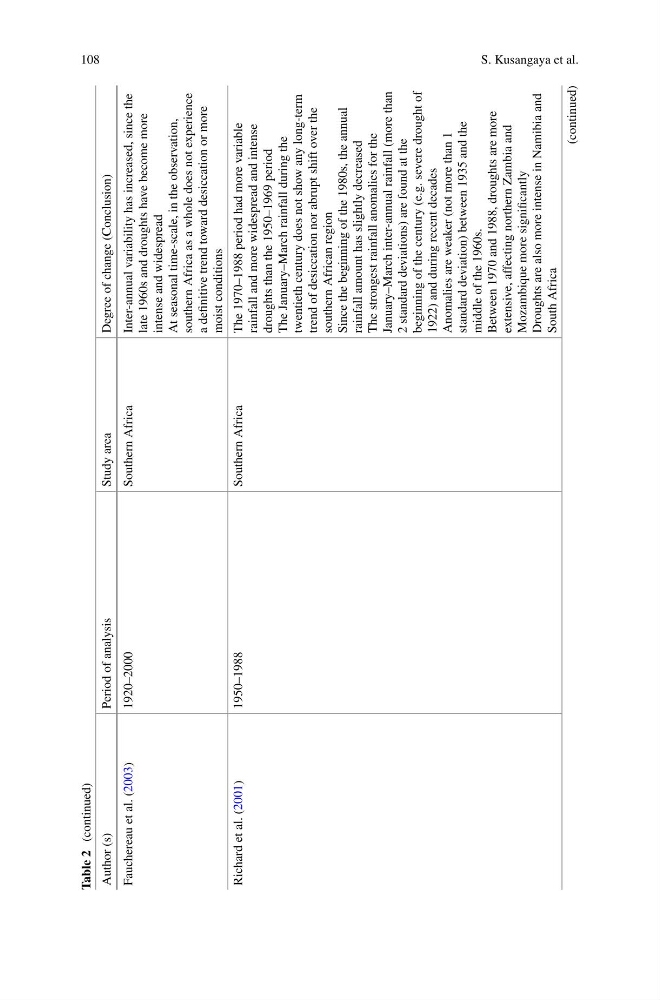
Table 2
(continued)
Author (s)
Period of analysis
Study area
Degree of change (Conclusion)
Fauchereau et al. (2003)
1920–2000
Southern Africa
Inter-annual variability has increased, since the
late 1960s and droughts have become more
intense and widespread
At seasonal time-scale, in the observation,
southern Africa as a whole does not experience
a definitive trend toward desiccation or more
moist conditions
Richard et al. (2001)
1950–1988
Southern Africa
The 1970–1988 period had more variable
rainfall and more widespread and intense
droughts than the 1950–1969 period
The January–March rainfall during the
twentieth century does not show any long-term
trend of desiccation nor abrupt shift over the
southern African region
Since the beginning of the 1980s, the annual
rainfall amount has slightly decreased
The strongest rainfall anomalies for the
January–March inter-annual rainfall (more than
2 standard deviations) are found at the
beginning of the century (e.g. severe drought of
1922) and during recent decades
Anomalies are weaker (not more than 1
standard deviation) between 1935 and the
middle of the 1960s.
Between 1970 and 1988, droughts are more
extensive, affecting northern Zambia and
Mozambique more significantly
Droughts are also more intense in Namibia and
South Africa
(continued)
S. Kusangaya et al.
Table 2
(continued)
Author (s)
Period of analysis
Study area
Degree of change (Conclusion)
Fauchereau et al. (2003)
1920–2000
Southern Africa
Inter-annual variability has increased, since the
late 1960s and droughts have become more
intense and widespread
At seasonal time-scale, in the observation,
southern Africa as a whole does not experience
a definitive trend toward desiccation or more
moist conditions
Richard et al. (2001)
1950–1988
Southern Africa
The 1970–1988 period had more variable
rainfall and more widespread and intense
droughts than the 1950–1969 period
The January–March rainfall during the
twentieth century does not show any long-term
trend of desiccation nor abrupt shift over the
southern African region
Since the beginning of the 1980s, the annual
rainfall amount has slightly decreased
The strongest rainfall anomalies for the
January–March inter-annual rainfall (more than
2 standard deviations) are found at the
beginning of the century (e.g. severe drought of
1922) and during recent decades
Anomalies are weaker (not more than 1
standard deviation) between 1935 and the
middle of the 1960s.
Between 1970 and 1988, droughts are more
extensive, affecting northern Zambia and
Mozambique more significantly
Droughts are also more intense in Namibia and
South Africa
(continued)