

5 Climate Change Impact on Hydrological Regimes …
107
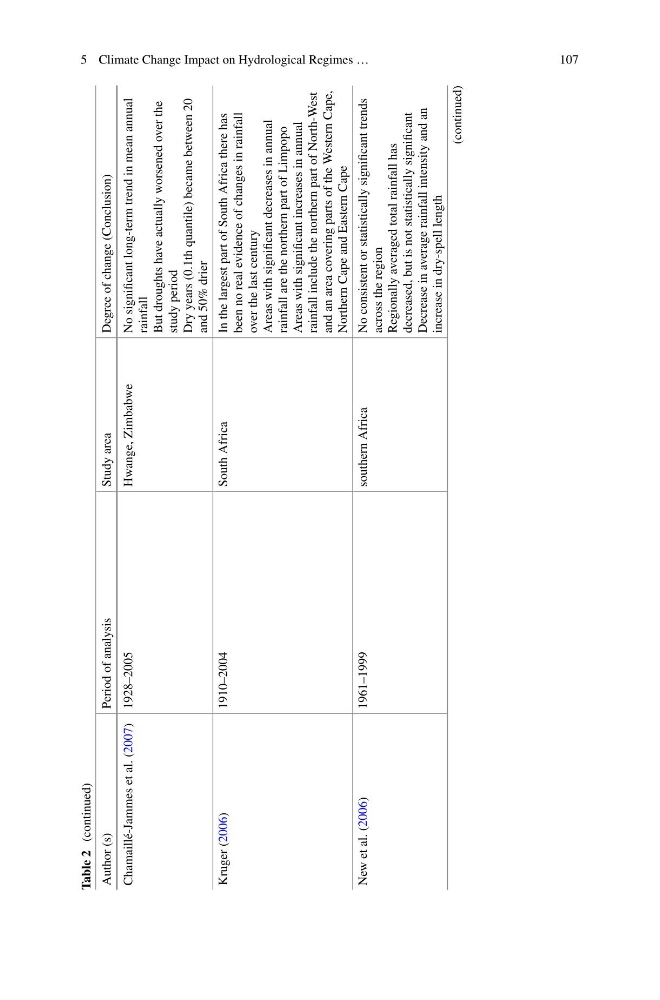
Table 2
(continued)
Author (s)
Period of analysis
Study area
Degree of change (Conclusion)
Chamaillé-Jammes et al. (2007) 1928–2005
Hwange, Zimbabwe
No significant long-term trend in mean annual
rainfall
But droughts have actually worsened over the
study period
Dry years (0.1th quantile) became between 20
and 50% drier
Kruger (2006)
1910–2004
South Africa
In the largest part of South Africa there has
been no real evidence of changes in rainfall
over the last century
Areas with significant decreases in annual
rainfall are the northern part of Limpopo
Areas with significant increases in annual
rainfall include the northern part of North-West
and an area covering parts of the Western Cape,
Northern Cape and Eastern Cape
New et al. (2006)
1961–1999
southern Africa
No consistent or statistically significant trends
across the region
Regionally averaged total rainfall has
decreased, but is not statistically significant
Decrease in average rainfall intensity and an
increase in dry-spell length
(continued)
107
Table 2
(continued)
Author (s)
Period of analysis
Study area
Degree of change (Conclusion)
Chamaillé-Jammes et al. (2007) 1928–2005
Hwange, Zimbabwe
No significant long-term trend in mean annual
rainfall
But droughts have actually worsened over the
study period
Dry years (0.1th quantile) became between 20
and 50% drier
Kruger (2006)
1910–2004
South Africa
In the largest part of South Africa there has
been no real evidence of changes in rainfall
over the last century
Areas with significant decreases in annual
rainfall are the northern part of Limpopo
Areas with significant increases in annual
rainfall include the northern part of North-West
and an area covering parts of the Western Cape,
Northern Cape and Eastern Cape
New et al. (2006)
1961–1999
southern Africa
No consistent or statistically significant trends
across the region
Regionally averaged total rainfall has
decreased, but is not statistically significant
Decrease in average rainfall intensity and an
increase in dry-spell length
(continued)