

76
P. Sagna et al.
8004 millet varieties ripen in 75 and 95 days, respectively. The 55-437 and fleur-11
varieties of groundnut can complete their cycles in 90 days (MA 2012).
3.4.2 Changes in Farming Practices
In Ivory Coast, several changes in farming practices have been implemented because
of irregular rainfall. We will consider two major events that resulted in changes in the
cropping calendar and the reorientation of farming lands in the region of Bouaké in the
heart of the savannah. New farming techniques, in addition to schedule modifications,
have included staking fruit trees and mulching mounds. The farming calendar had
usually begun in March with the clearing and removal of grass in new plots. This
practice has become obsolete due to evolution of the temporal distribution of rainfall
in the region. A one-month delay at the beginning of the rainy season has shifted
this process from March to April. New agro-climatic conditions compel farmers
to reorient toward increasingly colonized lowlands and to rice-growing and market
gardening.
Farming changes have also been made in Benin in order to maintain good harvests.
Crop association is a system that consists of growing on small farms with several
crops in the same plot, generally in very fertile backyard gardens. This system allows
farmers to diversify production and avoid repeated weeding. The crop associations
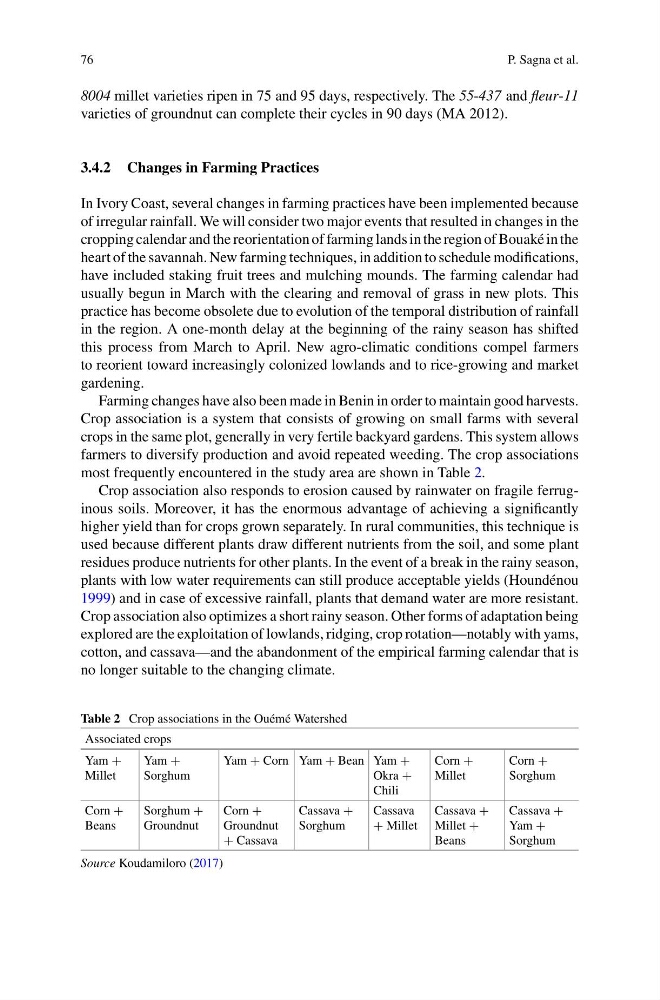
most frequently encountered in the study area are shown in Table 2.
Crop association also responds to erosion caused by rainwater on fragile ferruginous soils. Moreover, it has the enormous advantage of achieving a significantly
higher yield than for crops grown separately. In rural communities, this technique is
used because different plants draw different nutrients from the soil, and some plant
residues produce nutrients for other plants. In the event of a break in the rainy season,
plants with low water requirements can still produce acceptable yields (Houndénou
1999) and in case of excessive rainfall, plants that demand water are more resistant.
Crop association also optimizes a short rainy season. Other forms of adaptation being
explored are the exploitation of lowlands, ridging, crop rotation—notably with yams,
cotton, and cassava—and the abandonment of the empirical farming calendar that is
no longer suitable to the changing climate.
Table 2 Crop associations in the Ouémé Watershed
Associated crops
Yam +
Millet
Yam +
Sorghum
Yam + Corn Yam + Bean Yam +
Okra +
Chili
Corn +
Millet
Corn +
Sorghum
Corn +
Beans
Sorghum +
Groundnut
Corn +
Groundnut
+ Cassava
Cassava +
Sorghum
Cassava
+ Millet
Cassava +
Millet +
Beans
Cassava +
Yam +
Sorghum
Source Koudamiloro (2017)
P. Sagna et al.
8004 millet varieties ripen in 75 and 95 days, respectively. The 55-437 and fleur-11
varieties of groundnut can complete their cycles in 90 days (MA 2012).
3.4.2 Changes in Farming Practices
In Ivory Coast, several changes in farming practices have been implemented because
of irregular rainfall. We will consider two major events that resulted in changes in the
cropping calendar and the reorientation of farming lands in the region of Bouaké in the
heart of the savannah. New farming techniques, in addition to schedule modifications,
have included staking fruit trees and mulching mounds. The farming calendar had
usually begun in March with the clearing and removal of grass in new plots. This
practice has become obsolete due to evolution of the temporal distribution of rainfall
in the region. A one-month delay at the beginning of the rainy season has shifted
this process from March to April. New agro-climatic conditions compel farmers
to reorient toward increasingly colonized lowlands and to rice-growing and market
gardening.
Farming changes have also been made in Benin in order to maintain good harvests.
Crop association is a system that consists of growing on small farms with several
crops in the same plot, generally in very fertile backyard gardens. This system allows
farmers to diversify production and avoid repeated weeding. The crop associations
most frequently encountered in the study area are shown in Table 2.
Crop association also responds to erosion caused by rainwater on fragile ferruginous soils. Moreover, it has the enormous advantage of achieving a significantly
higher yield than for crops grown separately. In rural communities, this technique is
used because different plants draw different nutrients from the soil, and some plant
residues produce nutrients for other plants. In the event of a break in the rainy season,
plants with low water requirements can still produce acceptable yields (Houndénou
1999) and in case of excessive rainfall, plants that demand water are more resistant.
Crop association also optimizes a short rainy season. Other forms of adaptation being
explored are the exploitation of lowlands, ridging, crop rotation—notably with yams,
cotton, and cassava—and the abandonment of the empirical farming calendar that is
no longer suitable to the changing climate.
Table 2 Crop associations in the Ouémé Watershed
Associated crops
Yam +
Millet
Yam +
Sorghum
Yam + Corn Yam + Bean Yam +
Okra +
Chili
Corn +
Millet
Corn +
Sorghum
Corn +
Beans
Sorghum +
Groundnut
Corn +
Groundnut
+ Cassava
Cassava +
Sorghum
Cassava
+ Millet
Cassava +
Millet +
Beans
Cassava +
Yam +
Sorghum
Source Koudamiloro (2017)