

54
2.4.1.2 Fossil Malaria Parasites
There are numerous types of malaria today in a wide range of vertebrates and
vectored by a wide range of arthropods, however very few species have left a fossil
record. Malaria is the most notorious protozoan disease of humans today and continues to cause immense suffering and deaths worldwide.
The oldest record of malaria vectored by a biting midge involved a Protoculicoides
sp. in Early Cretaceous Myanmar amber (Poinar and Telford 2005) (Fig. 2.41).
Developing oocysts and sporozoites of the malarial parasite, Paleohaemoproteus
burmacis, were inside the abdomen of the biting midge (Fig. 2.42). The development of Paleohaemoproteus burmacis was probably very similar to species of the
extant genus Haemoproteus that are vectored by biting midges to birds and reptiles
today (Garnham 1966).
Discovering oocysts, sporozoites, ookinetes and microgametocytes of
Plasmodium dominicana in the Dominican amber mosquito, Culex malariager
(Fig. 2.43) showed that Plasmodium malaria was established in the Americas some
20–30 million years ago (Poinar 2005a, b). Two of the oocysts had ruptured
(Fig. 2.44) and were releasing sporozoites (Fig. 2.45), some of which had reached
the salivary glands before the mosquito was entrapped. Based on the structure of
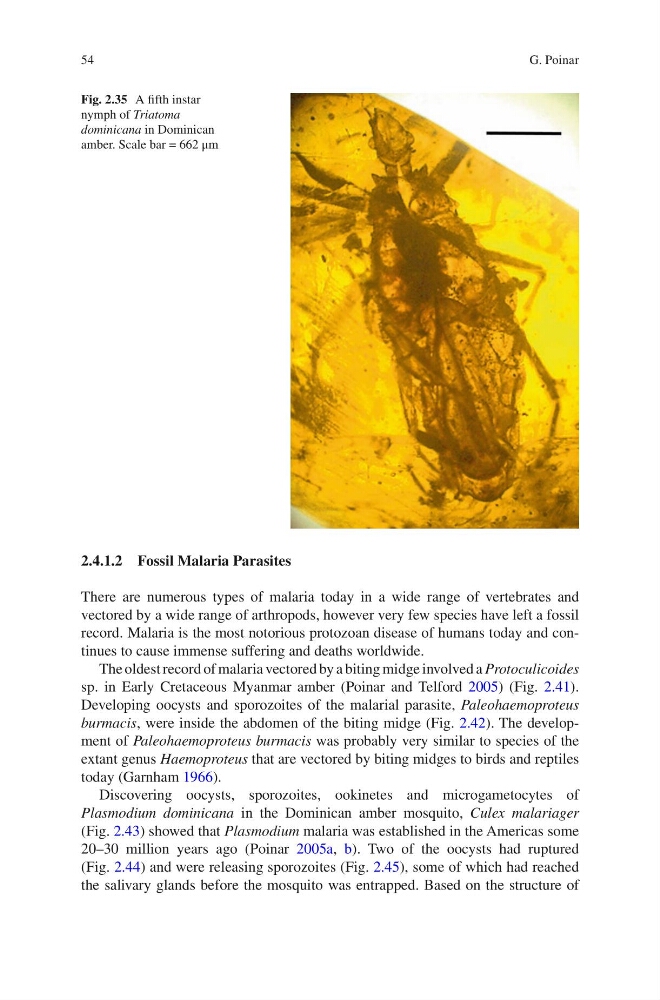
Fig. 2.35 A fifth instar
nymph of Triatoma
dominicana in Dominican
amber. Scale bar = 662 μm
G. Poinar
2.4.1.2 Fossil Malaria Parasites
There are numerous types of malaria today in a wide range of vertebrates and
vectored by a wide range of arthropods, however very few species have left a fossil
record. Malaria is the most notorious protozoan disease of humans today and continues to cause immense suffering and deaths worldwide.
The oldest record of malaria vectored by a biting midge involved a Protoculicoides
sp. in Early Cretaceous Myanmar amber (Poinar and Telford 2005) (Fig. 2.41).
Developing oocysts and sporozoites of the malarial parasite, Paleohaemoproteus
burmacis, were inside the abdomen of the biting midge (Fig. 2.42). The development of Paleohaemoproteus burmacis was probably very similar to species of the
extant genus Haemoproteus that are vectored by biting midges to birds and reptiles
today (Garnham 1966).
Discovering oocysts, sporozoites, ookinetes and microgametocytes of
Plasmodium dominicana in the Dominican amber mosquito, Culex malariager
(Fig. 2.43) showed that Plasmodium malaria was established in the Americas some
20–30 million years ago (Poinar 2005a, b). Two of the oocysts had ruptured
(Fig. 2.44) and were releasing sporozoites (Fig. 2.45), some of which had reached
the salivary glands before the mosquito was entrapped. Based on the structure of
Fig. 2.35 A fifth instar
nymph of Triatoma
dominicana in Dominican
amber. Scale bar = 662 μm
G. Poinar