

53
cruzi) in the American tropics. A fifth instar nymph of Triatoma dominicana in
Dominican amber (Fig. 2.35) was adjacent to fecal droplets that contained metatrypanosomes of Trypanosoma antiquus (Fig. 2.36). Mammalian hairs adjacent to the
fecal droplets indicate that the vertebrate host was a bat. Extant triatomines are
known to vector trypanosomes to New World bats (Hoare 1972).
Other types of flagellates have been discovered in fossil triatomines. Epimastigotes
of a Blastocrithidia sp. were detected in an anal droplet of Panstrongylus hispaniolae in Dominican amber (Figs. 2.37 and 2.38) (Poinar 2013b). The fossil flagellates
are similar in size and shape to the epimastigotes of Blastocrithidia triatomae that
were described from the intestine of Triatoma infestans (Cerisola et al. 1971).
Blastocrithidia can be pathogenic in triatomes when populations built up in the
midgut (Schaub 1994).
The primitive mid-Cretaceous triatomine, Paleotriatoma metaxytaxa (Fig. 2.39)
in Burmese amber is considered a transitional species bridging the gap between the
invertebrate feeding Reduviinae and the vertebrate feeding Triatominae (Poinar
2018). This Cretaceous triatomine was carrying trypomastigote stages of a trypanosome in its hindgut lumen (Fig. 2.40). These stages correspond to those that normally occur in the blood stream of infected vertebrates today, suggesting that the
trypanosomes in Paleotriatoma were digenetic forms vectored to vertebrates.
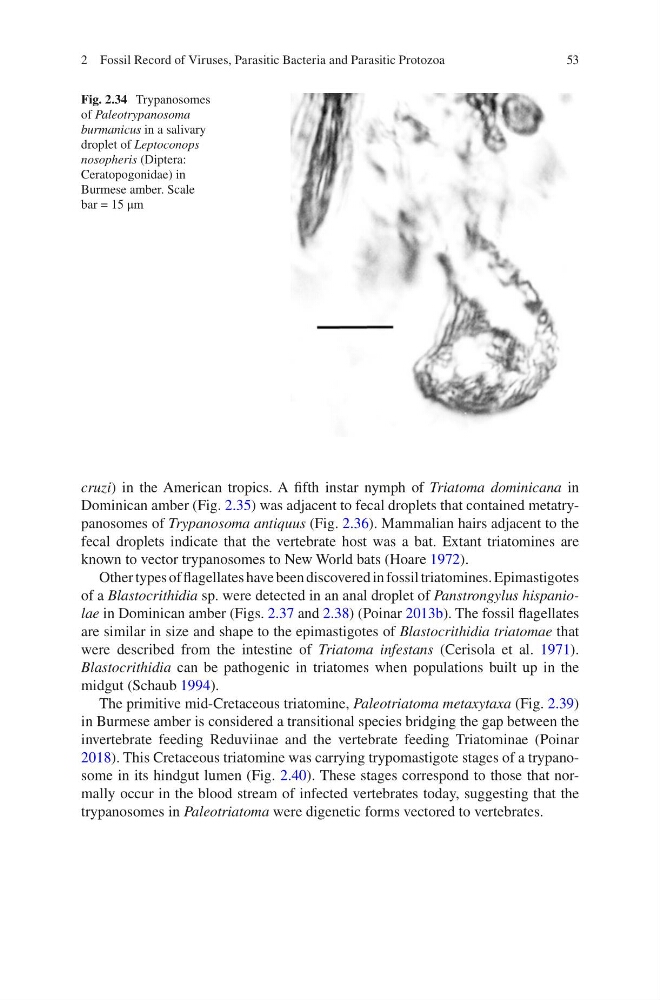
Fig. 2.34 Trypanosomes
of Paleotrypanosoma
burmanicus in a salivary
droplet of Leptoconops
nosopheris (Diptera:
Ceratopogonidae) in
Burmese amber. Scale
bar = 15 μm
2 Fossil Record of Viruses, Parasitic Bacteria and Parasitic Protozoa
cruzi) in the American tropics. A fifth instar nymph of Triatoma dominicana in
Dominican amber (Fig. 2.35) was adjacent to fecal droplets that contained metatrypanosomes of Trypanosoma antiquus (Fig. 2.36). Mammalian hairs adjacent to the
fecal droplets indicate that the vertebrate host was a bat. Extant triatomines are
known to vector trypanosomes to New World bats (Hoare 1972).
Other types of flagellates have been discovered in fossil triatomines. Epimastigotes
of a Blastocrithidia sp. were detected in an anal droplet of Panstrongylus hispaniolae in Dominican amber (Figs. 2.37 and 2.38) (Poinar 2013b). The fossil flagellates
are similar in size and shape to the epimastigotes of Blastocrithidia triatomae that
were described from the intestine of Triatoma infestans (Cerisola et al. 1971).
Blastocrithidia can be pathogenic in triatomes when populations built up in the
midgut (Schaub 1994).
The primitive mid-Cretaceous triatomine, Paleotriatoma metaxytaxa (Fig. 2.39)
in Burmese amber is considered a transitional species bridging the gap between the
invertebrate feeding Reduviinae and the vertebrate feeding Triatominae (Poinar
2018). This Cretaceous triatomine was carrying trypomastigote stages of a trypanosome in its hindgut lumen (Fig. 2.40). These stages correspond to those that normally occur in the blood stream of infected vertebrates today, suggesting that the
trypanosomes in Paleotriatoma were digenetic forms vectored to vertebrates.
Fig. 2.34 Trypanosomes
of Paleotrypanosoma
burmanicus in a salivary
droplet of Leptoconops
nosopheris (Diptera:
Ceratopogonidae) in
Burmese amber. Scale
bar = 15 μm
2 Fossil Record of Viruses, Parasitic Bacteria and Parasitic Protozoa