

494
but a substantial decrease is documented for the Cenozoic. Evaniidae currently are
evolutionary relicts. The two, other extant families of Gasteruptiidae and Aulacidae
are first documented, respectively, during the Early Cretaceous and Late Cretaceous,
both of which persist to the present also as evolutionary relicts. Based on these patterns of species and genera richness through time, there are four families with more
than four species occurrences within an epoch that have a distinct pattern of occurrence during the MMPR (phases 1 and 2) and continuing to the post MMPR (phases
3 and 4). Praeaulacidae and Anomopterellidae dominate phases 1 and 2; Baissidae
and Evaniidae have elevated occurrences during phases 2 and 3; and Aulacidae has
the greatest number of occurrences in Phase 4 (Fig. 11.19). This suggests that
Evanioidea, as non-proctotrupomorph Hymenoptera (Fig. 11.19), was one of the
earliest participants in the MMPR, and was the greatest contributor of Hymenoptera
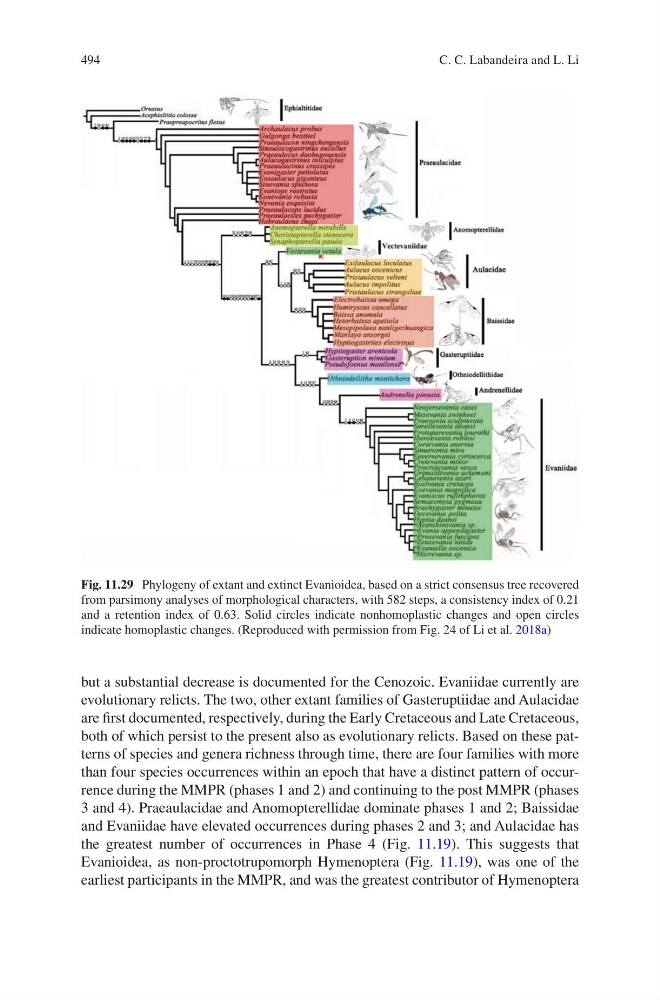
Fig. 11.29 Phylogeny of extant and extinct Evanioidea, based on a strict consensus tree recovered
from parsimony analyses of morphological characters, with 582 steps, a consistency index of 0.21
and a retention index of 0.63. Solid circles indicate nonhomoplastic changes and open circles
indicate homoplastic changes. (Reproduced with permission from Fig. 24 of Li et al. 2018a)
C. C. Labandeira and L. Li
but a substantial decrease is documented for the Cenozoic. Evaniidae currently are
evolutionary relicts. The two, other extant families of Gasteruptiidae and Aulacidae
are first documented, respectively, during the Early Cretaceous and Late Cretaceous,
both of which persist to the present also as evolutionary relicts. Based on these patterns of species and genera richness through time, there are four families with more
than four species occurrences within an epoch that have a distinct pattern of occurrence during the MMPR (phases 1 and 2) and continuing to the post MMPR (phases
3 and 4). Praeaulacidae and Anomopterellidae dominate phases 1 and 2; Baissidae
and Evaniidae have elevated occurrences during phases 2 and 3; and Aulacidae has
the greatest number of occurrences in Phase 4 (Fig. 11.19). This suggests that
Evanioidea, as non-proctotrupomorph Hymenoptera (Fig. 11.19), was one of the
earliest participants in the MMPR, and was the greatest contributor of Hymenoptera
Fig. 11.29 Phylogeny of extant and extinct Evanioidea, based on a strict consensus tree recovered
from parsimony analyses of morphological characters, with 582 steps, a consistency index of 0.21
and a retention index of 0.63. Solid circles indicate nonhomoplastic changes and open circles
indicate homoplastic changes. (Reproduced with permission from Fig. 24 of Li et al. 2018a)
C. C. Labandeira and L. Li