

489
relationships among genera within Stephanidae were presented in a geochronological context consistent with their localities and paleogeographic distributions plotted
along a strict consensus tree (Fig. 11.27a). As the two earliest amber stephanids are
represented by Kronostephanus in the basal subfamily Schlettereriinae and the more
derived Lagenostephanus in the subfamily Stephaninae, there has been the suggestion that Stephanidae likely were more diverse during the Late Cretaceous (Li et al.
2017b). The earliest Late Cretaceous occurrences and diversification events imply
that the origin of Stephanidae occurred geochronologically earlier, perhaps significantly so, than earliest Late Cretaceous. It is notable that in the more basal subfamily Schlettereriinae, the amber genus Kronostephanus belongs to a Eurasian
distributed clade, and the other amber genus, Archaeostephanus from New Jersey
amber, occurs in North America during the Late Cretaceous, a biogeographical pattern exhibiting a cosmopolitan distribution for the earliest occurring lineages. The
other amber genus, Lagenostephanus, also originates from Myanmar. Two middle
Eocene amber genera, Electrostephanus and Denaeostephanus come from the
Baltic Region, while a compression fossil genus of late Eocene age, Protostephanus,
is from Florissant, Colorado, and has a North American Eocene provenance. As
shown (Fig. 11.27b), extant stephanid genera are biogeographically widely distributed. An extant basal genus, Schlettererius, is distributed in the Palearctic and
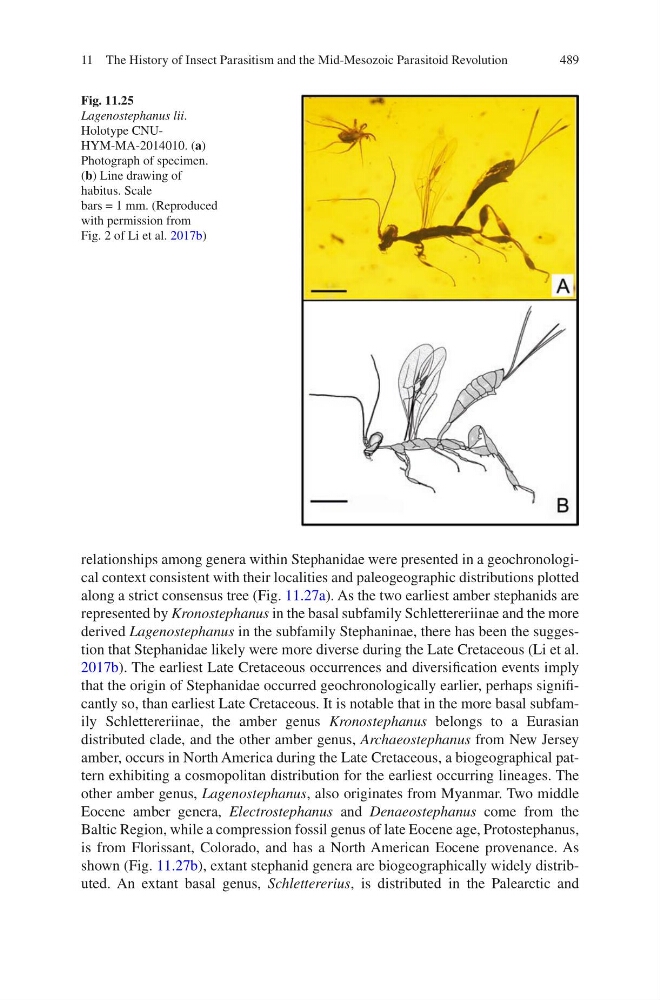
Fig. 11.25
Lagenostephanus lii.
Holotype CNUHYM- MA-2014010. (a)
Photograph of specimen.
(b) Line drawing of
habitus. Scale
bars = 1 mm. (Reproduced
with permission from
Fig. 2 of Li et al. 2017b)
11 The History of Insect Parasitism and the Mid-Mesozoic Parasitoid Revolution
relationships among genera within Stephanidae were presented in a geochronological context consistent with their localities and paleogeographic distributions plotted
along a strict consensus tree (Fig. 11.27a). As the two earliest amber stephanids are
represented by Kronostephanus in the basal subfamily Schlettereriinae and the more
derived Lagenostephanus in the subfamily Stephaninae, there has been the suggestion that Stephanidae likely were more diverse during the Late Cretaceous (Li et al.
2017b). The earliest Late Cretaceous occurrences and diversification events imply
that the origin of Stephanidae occurred geochronologically earlier, perhaps significantly so, than earliest Late Cretaceous. It is notable that in the more basal subfamily Schlettereriinae, the amber genus Kronostephanus belongs to a Eurasian
distributed clade, and the other amber genus, Archaeostephanus from New Jersey
amber, occurs in North America during the Late Cretaceous, a biogeographical pattern exhibiting a cosmopolitan distribution for the earliest occurring lineages. The
other amber genus, Lagenostephanus, also originates from Myanmar. Two middle
Eocene amber genera, Electrostephanus and Denaeostephanus come from the
Baltic Region, while a compression fossil genus of late Eocene age, Protostephanus,
is from Florissant, Colorado, and has a North American Eocene provenance. As
shown (Fig. 11.27b), extant stephanid genera are biogeographically widely distributed. An extant basal genus, Schlettererius, is distributed in the Palearctic and
Fig. 11.25
Lagenostephanus lii.
Holotype CNUHYM- MA-2014010. (a)
Photograph of specimen.
(b) Line drawing of
habitus. Scale
bars = 1 mm. (Reproduced
with permission from
Fig. 2 of Li et al. 2017b)
11 The History of Insect Parasitism and the Mid-Mesozoic Parasitoid Revolution