

487
11.7 Parasitoid Clade Diversification in the Early
Mid- Mesozoic Parasitoid Revolution
The beginning of the MMPR was mentioned informally as long ago as the mid
twentieth century by Carpenter (1954) who recognized the significance of Middle
Jurassic wasps with very long ovipositors. The Mid-Mesozoic Parasitoid Revolution
(MMPR) is defined as consisting of phases 1 and 2, from the Early Jurassic (Toarcian
Stage) to the Early Cretaceous (Albian Stage), which constituted the core of the
parasitoid expansion. This period is the MMPR. Phases 3 and 4, from the
Cenomanian Stage to the present, is considered the subsequent, post-MMPR expansion, whose diversities for some clades or groups remained flat (Hymenoptera–
Aculeata, non-proctotrupomorph Hymenoptera, non-eremoneuran Diptera) whereas
for others there were substantial diversity increases (Hymenoptera–
Proctotrupomorpha, Diptera–Eremoneura, Coleoptera, Strepsiptera) (Fig. 11.19).
This latter period is the post-MMPR expansion. (Another major biological event is
the Mesozoic Marine Revolution (Vermeij 1977). This event also had an initial
pulse and a subsequent period of expansion.)
Four major insect lineages participated in the MMPR: Hymenoptera, representing 63% of fossil and modern family-level occurrences, Diptera (15.8%), Strepsiptera
(11.6%) and Coleoptera (6.8%), and the other lineages of Neuroptera, Trichoptera
and Lepidoptera having minor effects (2.8%) (Table 11.2). However, subclades of
these lineages played different roles chronologically during the four phases of the
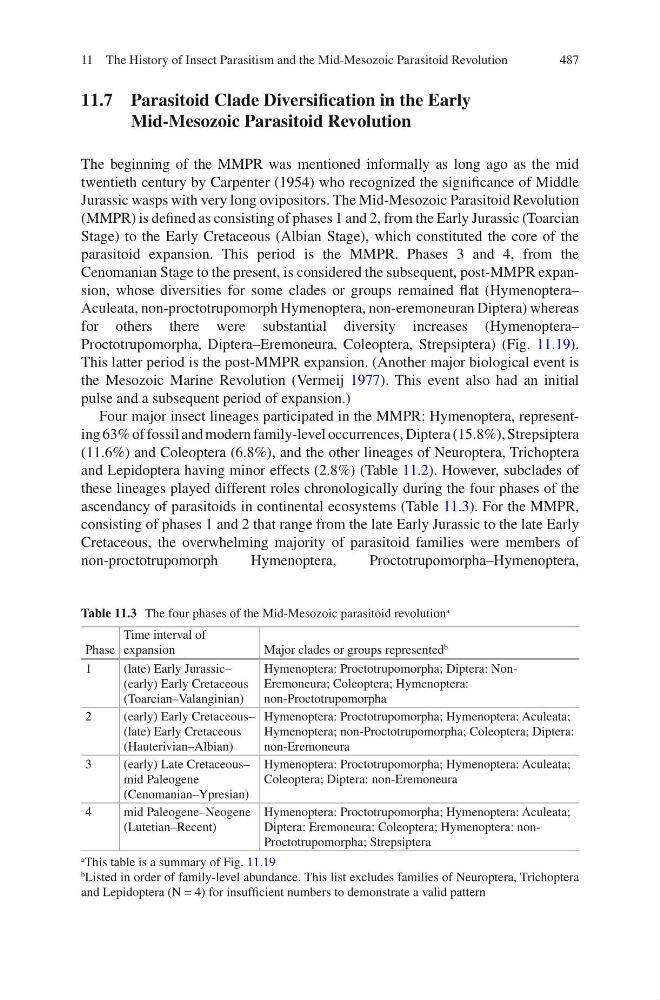
ascendancy of parasitoids in continental ecosystems (Table 11.3). For the MMPR,
consisting of phases 1 and 2 that range from the late Early Jurassic to the late Early
Cretaceous, the overwhelming majority of parasitoid families were members of
non-proctotrupomorph
Hymenoptera,
Proctotrupomorpha–Hymenoptera,
Table 11.3 The four phases of the Mid-Mesozoic parasitoid revolution
a
Phase
Time interval of
expansion
Major clades or groups represented
b
1
(late) Early Jurassic–
(early) Early Cretaceous
(Toarcian–Valanginian)
Hymenoptera: Proctotrupomorpha; Diptera: NonEremoneura; Coleoptera; Hymenoptera:
non-Proctotrupomorpha
2
(early) Early Cretaceous–
(late) Early Cretaceous
(Hauterivian–Albian)
Hymenoptera: Proctotrupomorpha; Hymenoptera: Aculeata;
Hymenoptera; non-Proctotrupomorpha; Coleoptera; Diptera:
non-Eremoneura
3
(early) Late Cretaceous–
mid Paleogene
(Cenomanian–Ypresian)
Hymenoptera: Proctotrupomorpha; Hymenoptera: Aculeata;
Coleoptera; Diptera: non-Eremoneura
4
mid Paleogene–Neogene
(Lutetian–Recent)
Hymenoptera: Proctotrupomorpha; Hymenoptera: Aculeata;
Diptera: Eremoneura; Coleoptera; Hymenoptera: nonProctotrupomorpha; Strepsiptera
a This table is a summary of Fig. 11.19
b
Listed in order of family-level abundance. This list excludes families of Neuroptera, Trichoptera
and Lepidoptera (N = 4) for insufficient numbers to demonstrate a valid pattern
11 The History of Insect Parasitism and the Mid-Mesozoic Parasitoid Revolution
11.7 Parasitoid Clade Diversification in the Early
Mid- Mesozoic Parasitoid Revolution
The beginning of the MMPR was mentioned informally as long ago as the mid
twentieth century by Carpenter (1954) who recognized the significance of Middle
Jurassic wasps with very long ovipositors. The Mid-Mesozoic Parasitoid Revolution
(MMPR) is defined as consisting of phases 1 and 2, from the Early Jurassic (Toarcian
Stage) to the Early Cretaceous (Albian Stage), which constituted the core of the
parasitoid expansion. This period is the MMPR. Phases 3 and 4, from the
Cenomanian Stage to the present, is considered the subsequent, post-MMPR expansion, whose diversities for some clades or groups remained flat (Hymenoptera–
Aculeata, non-proctotrupomorph Hymenoptera, non-eremoneuran Diptera) whereas
for others there were substantial diversity increases (Hymenoptera–
Proctotrupomorpha, Diptera–Eremoneura, Coleoptera, Strepsiptera) (Fig. 11.19).
This latter period is the post-MMPR expansion. (Another major biological event is
the Mesozoic Marine Revolution (Vermeij 1977). This event also had an initial
pulse and a subsequent period of expansion.)
Four major insect lineages participated in the MMPR: Hymenoptera, representing 63% of fossil and modern family-level occurrences, Diptera (15.8%), Strepsiptera
(11.6%) and Coleoptera (6.8%), and the other lineages of Neuroptera, Trichoptera
and Lepidoptera having minor effects (2.8%) (Table 11.2). However, subclades of
these lineages played different roles chronologically during the four phases of the
ascendancy of parasitoids in continental ecosystems (Table 11.3). For the MMPR,
consisting of phases 1 and 2 that range from the late Early Jurassic to the late Early
Cretaceous, the overwhelming majority of parasitoid families were members of
non-proctotrupomorph
Hymenoptera,
Proctotrupomorpha–Hymenoptera,
Table 11.3 The four phases of the Mid-Mesozoic parasitoid revolution
a
Phase
Time interval of
expansion
Major clades or groups represented
b
1
(late) Early Jurassic–
(early) Early Cretaceous
(Toarcian–Valanginian)
Hymenoptera: Proctotrupomorpha; Diptera: NonEremoneura; Coleoptera; Hymenoptera:
non-Proctotrupomorpha
2
(early) Early Cretaceous–
(late) Early Cretaceous
(Hauterivian–Albian)
Hymenoptera: Proctotrupomorpha; Hymenoptera: Aculeata;
Hymenoptera; non-Proctotrupomorpha; Coleoptera; Diptera:
non-Eremoneura
3
(early) Late Cretaceous–
mid Paleogene
(Cenomanian–Ypresian)
Hymenoptera: Proctotrupomorpha; Hymenoptera: Aculeata;
Coleoptera; Diptera: non-Eremoneura
4
mid Paleogene–Neogene
(Lutetian–Recent)
Hymenoptera: Proctotrupomorpha; Hymenoptera: Aculeata;
Diptera: Eremoneura; Coleoptera; Hymenoptera: nonProctotrupomorpha; Strepsiptera
a This table is a summary of Fig. 11.19
b
Listed in order of family-level abundance. This list excludes families of Neuroptera, Trichoptera
and Lepidoptera (N = 4) for insufficient numbers to demonstrate a valid pattern
11 The History of Insect Parasitism and the Mid-Mesozoic Parasitoid Revolution