

38
2.2.2.3 Iridoviridae
Members of this family of double-stranded DNA viruses have icosahedral virions
that are usually arranged in paracrystalline arrays in the host tissue. Such a viral
configuration often imparts an iridescent color to the tissues of infected hosts.
Iridoviruses are widespread in both vertebrates and invertebrates and among the latter group are terrestrial isopods (Hess and Poinar 1985). When such infections
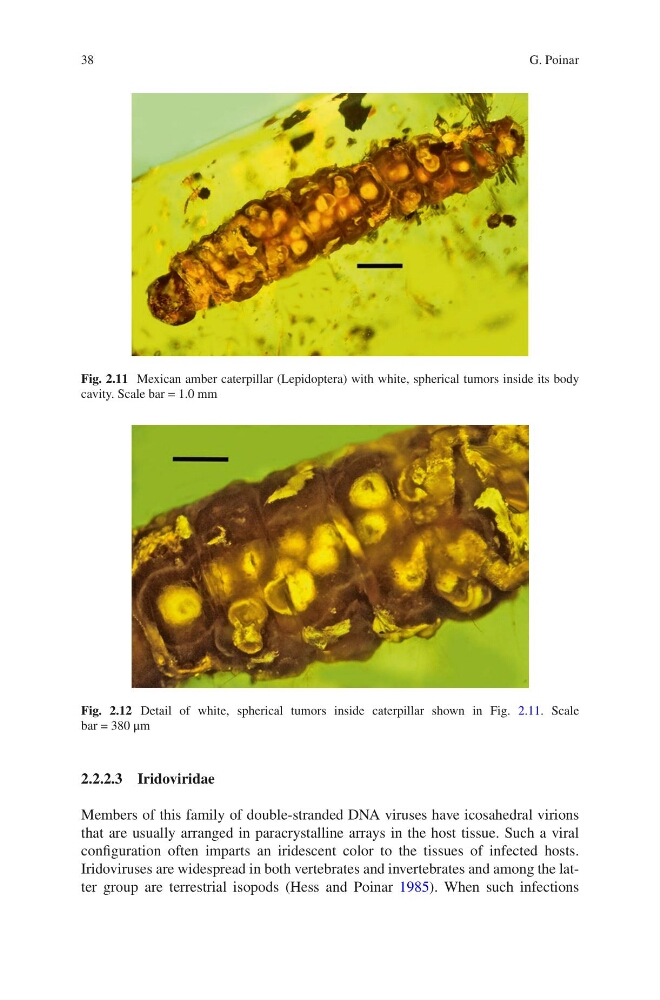
Fig. 2.11 Mexican amber caterpillar (Lepidoptera) with white, spherical tumors inside its body
cavity. Scale bar = 1.0 mm
Fig. 2.12 Detail of white, spherical tumors inside caterpillar shown in Fig. 2.11. Scale
bar = 380 μm
G. Poinar
2.2.2.3 Iridoviridae
Members of this family of double-stranded DNA viruses have icosahedral virions
that are usually arranged in paracrystalline arrays in the host tissue. Such a viral
configuration often imparts an iridescent color to the tissues of infected hosts.
Iridoviruses are widespread in both vertebrates and invertebrates and among the latter group are terrestrial isopods (Hess and Poinar 1985). When such infections
Fig. 2.11 Mexican amber caterpillar (Lepidoptera) with white, spherical tumors inside its body
cavity. Scale bar = 1.0 mm
Fig. 2.12 Detail of white, spherical tumors inside caterpillar shown in Fig. 2.11. Scale
bar = 380 μm
G. Poinar