

460
developmental stages of hemipteran, beetle, fly caddisfly and wasp hosts (Eggleton
and Belshaw 1992). Aschizan associations with this varied repertoire of hosts likely
originated in the Late Cretaceous and continued throughout the Cenozoic.
Schizophora, constituting the Acalyptratae and Calyptratae clades, are endoparasitoids, rarely ectoparasitoids or cleptoparasitoids, of the immature and adult stages of
eight, major, non-insectan lineages of invertebrates and vertebrates. These lineages
are pulmonate gastropods, freshwater bivalves, oligochaetes, centipedes and millipedes, scorpions, isopod crustaceans, nymphs of cockroaches, termites, orthopterans, mantids, webspinners, earwigs, sternorrhynchan hemipterans, bugs, beetles,
moths, sawflies, larvae of aculeate wasps, puparia of calyptrate flies, and mammalian vertebrates (Feener and Brown 1997). The Acalyptratae in particular developed
interactions with the most diverse host spectrum of any insect parasitoid clade, and
represent relatively recent Cenozoic events compared to phylogenetically more
basal, dipteran parasitoid groups. Schizophora parasitoid interactions originated
during the Cenozoic initially from a pattern of generalized parasitoid lineages, but
continually gave rise to specialized lineages (Stireman III et al. 2006).
The origins of parasitoidism in Diptera have been the most diverse of any order
of insects (Eggleton and Belshaw 1992, 1993; Fig. 11.4b). The most common route
to parasitoidism in Diptera is from saprophagy, which evolved 13 times at the family level, often in association with social insects. Parasitoidism via saprophagy has
been inferred to occur in Phoridae (scuttle flies), Pipunculidae (bigheaded flies),
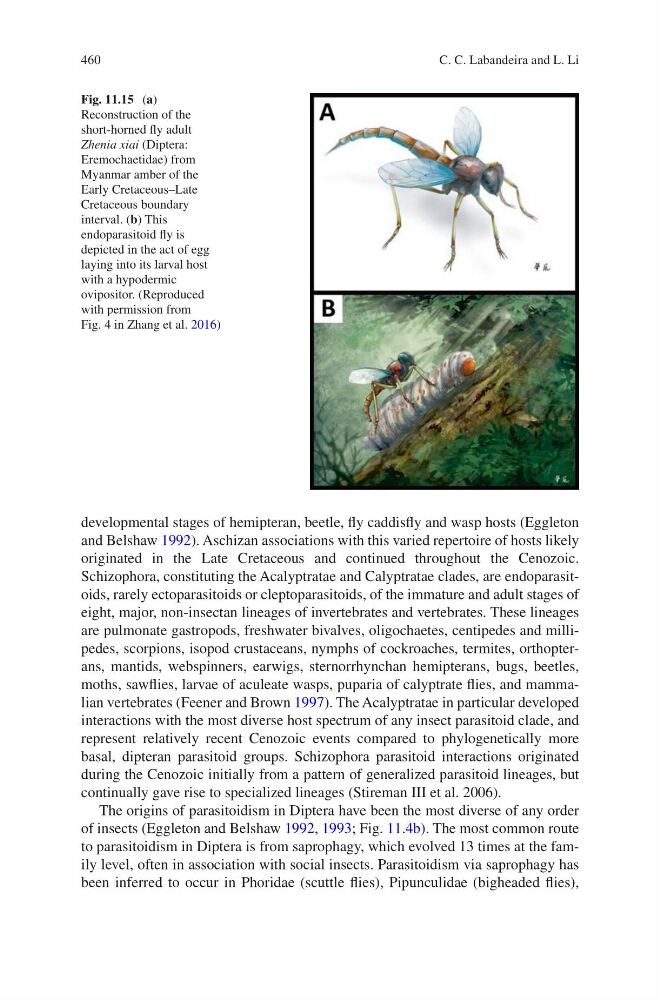
Fig. 11.15 (a)
Reconstruction of the
short-horned fly adult
Zhenia xiai (Diptera:
Eremochaetidae) from
Myanmar amber of the
Early Cretaceous–Late
Cretaceous boundary
interval. (b) This
endoparasitoid fly is
depicted in the act of egg
laying into its larval host
with a hypodermic
ovipositor. (Reproduced
with permission from
Fig. 4 in Zhang et al. 2016)
C. C. Labandeira and L. Li
developmental stages of hemipteran, beetle, fly caddisfly and wasp hosts (Eggleton
and Belshaw 1992). Aschizan associations with this varied repertoire of hosts likely
originated in the Late Cretaceous and continued throughout the Cenozoic.
Schizophora, constituting the Acalyptratae and Calyptratae clades, are endoparasitoids, rarely ectoparasitoids or cleptoparasitoids, of the immature and adult stages of
eight, major, non-insectan lineages of invertebrates and vertebrates. These lineages
are pulmonate gastropods, freshwater bivalves, oligochaetes, centipedes and millipedes, scorpions, isopod crustaceans, nymphs of cockroaches, termites, orthopterans, mantids, webspinners, earwigs, sternorrhynchan hemipterans, bugs, beetles,
moths, sawflies, larvae of aculeate wasps, puparia of calyptrate flies, and mammalian vertebrates (Feener and Brown 1997). The Acalyptratae in particular developed
interactions with the most diverse host spectrum of any insect parasitoid clade, and
represent relatively recent Cenozoic events compared to phylogenetically more
basal, dipteran parasitoid groups. Schizophora parasitoid interactions originated
during the Cenozoic initially from a pattern of generalized parasitoid lineages, but
continually gave rise to specialized lineages (Stireman III et al. 2006).
The origins of parasitoidism in Diptera have been the most diverse of any order
of insects (Eggleton and Belshaw 1992, 1993; Fig. 11.4b). The most common route
to parasitoidism in Diptera is from saprophagy, which evolved 13 times at the family level, often in association with social insects. Parasitoidism via saprophagy has
been inferred to occur in Phoridae (scuttle flies), Pipunculidae (bigheaded flies),
Fig. 11.15 (a)
Reconstruction of the
short-horned fly adult
Zhenia xiai (Diptera:
Eremochaetidae) from
Myanmar amber of the
Early Cretaceous–Late
Cretaceous boundary
interval. (b) This
endoparasitoid fly is
depicted in the act of egg
laying into its larval host
with a hypodermic
ovipositor. (Reproduced
with permission from
Fig. 4 in Zhang et al. 2016)
C. C. Labandeira and L. Li