

449
11.5.2 Parasitoid Taxa
The parasitoid life style and feeding mode is confined to seven insect orders, all of
which have holometabolous development (Table 11.1). Parasitoids occur in
Coleoptera (beetles), Strepsiptera (twisted-wing parasites), Diptera (flies) and
Hymenoptera (wasps), and with small numbers in Neuroptera (mantidflies),
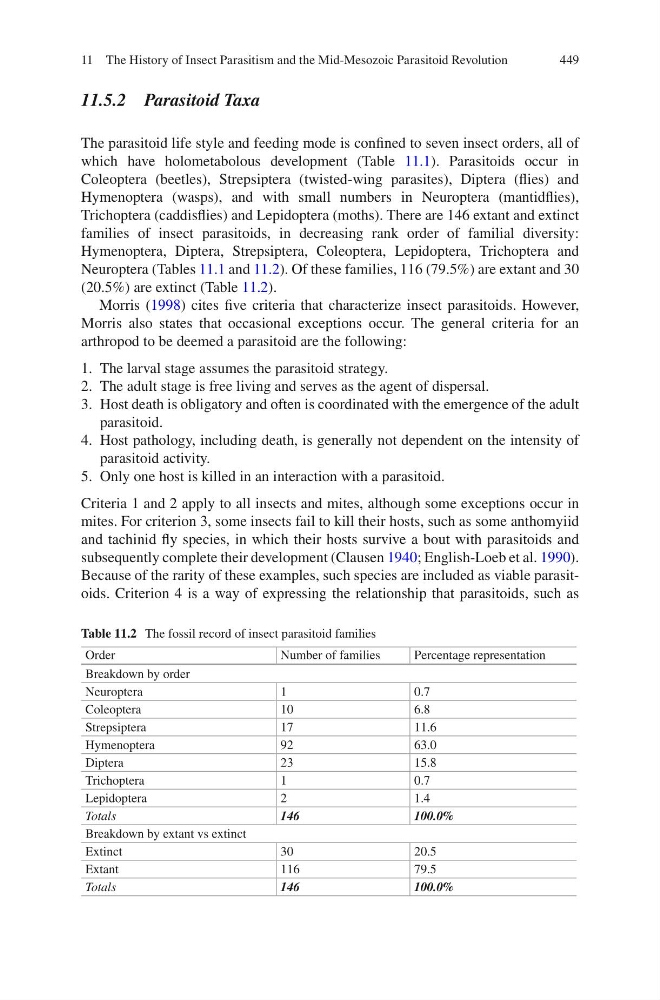
Trichoptera (caddisflies) and Lepidoptera (moths). There are 146 extant and extinct
families of insect parasitoids, in decreasing rank order of familial diversity:
Hymenoptera, Diptera, Strepsiptera, Coleoptera, Lepidoptera, Trichoptera and
Neuroptera (Tables 11.1 and 11.2). Of these families, 116 (79.5%) are extant and 30
(20.5%) are extinct (Table 11.2).
Morris (1998) cites five criteria that characterize insect parasitoids. However,
Morris also states that occasional exceptions occur. The general criteria for an
arthropod to be deemed a parasitoid are the following:
1. The larval stage assumes the parasitoid strategy.
2. The adult stage is free living and serves as the agent of dispersal.
3. Host death is obligatory and often is coordinated with the emergence of the adult
parasitoid.
4. Host pathology, including death, is generally not dependent on the intensity of
parasitoid activity.
5. Only one host is killed in an interaction with a parasitoid.
Criteria 1 and 2 apply to all insects and mites, although some exceptions occur in
mites. For criterion 3, some insects fail to kill their hosts, such as some anthomyiid
and tachinid fly species, in which their hosts survive a bout with parasitoids and
subsequently complete their development (Clausen 1940; English-Loeb et al. 1990).
Because of the rarity of these examples, such species are included as viable parasitoids. Criterion 4 is a way of expressing the relationship that parasitoids, such as
Table 11.2 The fossil record of insect parasitoid families
Order
Number of families
Percentage representation
Breakdown by order
Neuroptera
1
0.7
Coleoptera
10
6.8
Strepsiptera
17
11.6
Hymenoptera
92
63.0
Diptera
23
15.8
Trichoptera
1
0.7
Lepidoptera
2
1.4
Totals
146
100.0%
Breakdown by extant vs extinct
Extinct
30
20.5
Extant
116
79.5
Totals
146
100.0%
11 The History of Insect Parasitism and the Mid-Mesozoic Parasitoid Revolution
11.5.2 Parasitoid Taxa
The parasitoid life style and feeding mode is confined to seven insect orders, all of
which have holometabolous development (Table 11.1). Parasitoids occur in
Coleoptera (beetles), Strepsiptera (twisted-wing parasites), Diptera (flies) and
Hymenoptera (wasps), and with small numbers in Neuroptera (mantidflies),
Trichoptera (caddisflies) and Lepidoptera (moths). There are 146 extant and extinct
families of insect parasitoids, in decreasing rank order of familial diversity:
Hymenoptera, Diptera, Strepsiptera, Coleoptera, Lepidoptera, Trichoptera and
Neuroptera (Tables 11.1 and 11.2). Of these families, 116 (79.5%) are extant and 30
(20.5%) are extinct (Table 11.2).
Morris (1998) cites five criteria that characterize insect parasitoids. However,
Morris also states that occasional exceptions occur. The general criteria for an
arthropod to be deemed a parasitoid are the following:
1. The larval stage assumes the parasitoid strategy.
2. The adult stage is free living and serves as the agent of dispersal.
3. Host death is obligatory and often is coordinated with the emergence of the adult
parasitoid.
4. Host pathology, including death, is generally not dependent on the intensity of
parasitoid activity.
5. Only one host is killed in an interaction with a parasitoid.
Criteria 1 and 2 apply to all insects and mites, although some exceptions occur in
mites. For criterion 3, some insects fail to kill their hosts, such as some anthomyiid
and tachinid fly species, in which their hosts survive a bout with parasitoids and
subsequently complete their development (Clausen 1940; English-Loeb et al. 1990).
Because of the rarity of these examples, such species are included as viable parasitoids. Criterion 4 is a way of expressing the relationship that parasitoids, such as
Table 11.2 The fossil record of insect parasitoid families
Order
Number of families
Percentage representation
Breakdown by order
Neuroptera
1
0.7
Coleoptera
10
6.8
Strepsiptera
17
11.6
Hymenoptera
92
63.0
Diptera
23
15.8
Trichoptera
1
0.7
Lepidoptera
2
1.4
Totals
146
100.0%
Breakdown by extant vs extinct
Extinct
30
20.5
Extant
116
79.5
Totals
146
100.0%
11 The History of Insect Parasitism and the Mid-Mesozoic Parasitoid Revolution