

408
with their larger size and massive mouthparts may not have had dinosaurs such as
theropods for hosts (Dittmar et al. 2016). Many features described for mid- Mesozoic
giant “fleas” (Gao et al. 2012; Huang et al. 2013a) are not found on modern fleas
that are known blood-feeding parasites of mammals and birds. The relationship that
large parasite size is reflective of large host size has never been tested empirically
(Dittmar et al. 2016).
There are three principal lineages of mid-Mesozoic fleas: Pseudopulicidae,
Tarwiniidae and Saurophthiridae (Ponomarenko 1976; Huang et al. 2013a). The
Pseudopulicidae are latest Middle Jurassic in age and from East Asia. Pseudopulicidae
are large bodied, robust, flea-like insects that have a cylindrically shaped body, lack
pronotal and genal ctenidial combs as well as saltatorial hind legs, and have an
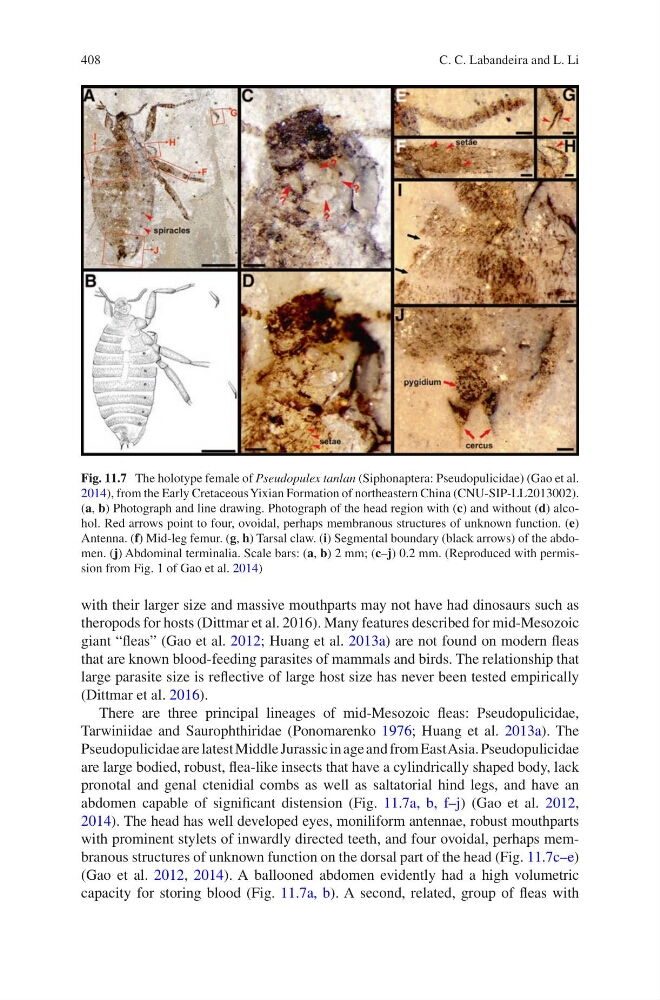
abdomen capable of significant distension (Fig. 11.7a, b, f–j) (Gao et al. 2012,
2014). The head has well developed eyes, moniliform antennae, robust mouthparts
with prominent stylets of inwardly directed teeth, and four ovoidal, perhaps membranous structures of unknown function on the dorsal part of the head (Fig. 11.7c–e)
(Gao et al. 2012, 2014). A ballooned abdomen evidently had a high volumetric
capacity for storing blood (Fig. 11.7a, b). A second, related, group of fleas with
Fig. 11.7 The holotype female of Pseudopulex tanlan (Siphonaptera: Pseudopulicidae) (Gao et al.
2014), from the Early Cretaceous Yixian Formation of northeastern China (CNU-SIP-LL2013002).
(a, b) Photograph and line drawing. Photograph of the head region with (c) and without (d) alcohol. Red arrows point to four, ovoidal, perhaps membranous structures of unknown function. (e)
Antenna. (f) Mid-leg femur. (g, h) Tarsal claw. (i) Segmental boundary (black arrows) of the abdomen. (j) Abdominal terminalia. Scale bars: (a, b) 2 mm; (c–j) 0.2 mm. (Reproduced with permission from Fig. 1 of Gao et al. 2014)
C. C. Labandeira and L. Li
with their larger size and massive mouthparts may not have had dinosaurs such as
theropods for hosts (Dittmar et al. 2016). Many features described for mid- Mesozoic
giant “fleas” (Gao et al. 2012; Huang et al. 2013a) are not found on modern fleas
that are known blood-feeding parasites of mammals and birds. The relationship that
large parasite size is reflective of large host size has never been tested empirically
(Dittmar et al. 2016).
There are three principal lineages of mid-Mesozoic fleas: Pseudopulicidae,
Tarwiniidae and Saurophthiridae (Ponomarenko 1976; Huang et al. 2013a). The
Pseudopulicidae are latest Middle Jurassic in age and from East Asia. Pseudopulicidae
are large bodied, robust, flea-like insects that have a cylindrically shaped body, lack
pronotal and genal ctenidial combs as well as saltatorial hind legs, and have an
abdomen capable of significant distension (Fig. 11.7a, b, f–j) (Gao et al. 2012,
2014). The head has well developed eyes, moniliform antennae, robust mouthparts
with prominent stylets of inwardly directed teeth, and four ovoidal, perhaps membranous structures of unknown function on the dorsal part of the head (Fig. 11.7c–e)
(Gao et al. 2012, 2014). A ballooned abdomen evidently had a high volumetric
capacity for storing blood (Fig. 11.7a, b). A second, related, group of fleas with
Fig. 11.7 The holotype female of Pseudopulex tanlan (Siphonaptera: Pseudopulicidae) (Gao et al.
2014), from the Early Cretaceous Yixian Formation of northeastern China (CNU-SIP-LL2013002).
(a, b) Photograph and line drawing. Photograph of the head region with (c) and without (d) alcohol. Red arrows point to four, ovoidal, perhaps membranous structures of unknown function. (e)
Antenna. (f) Mid-leg femur. (g, h) Tarsal claw. (i) Segmental boundary (black arrows) of the abdomen. (j) Abdominal terminalia. Scale bars: (a, b) 2 mm; (c–j) 0.2 mm. (Reproduced with permission from Fig. 1 of Gao et al. 2014)
C. C. Labandeira and L. Li