

399
11.5.1 Parasite Taxa
The parasite life style and feeding mode is confined to ten insect orders. The
Blattodea, Dermaptera, Psocoptera, Phthiraptera and Hemiptera undergo incomplete metamorphosis, or hemimetabolous development, in which an egg develops
into multiple immature developmental stages (instars) that are termed nymphs if
terrestrial and naiads if aquatic, ending with a reproductively viable adult insect.
The other parasite orders, Coleoptera, Siphonaptera, Diptera, Lepidoptera and
Hymenoptera undergo complete metamorphosis, or holometabolous development,
in which the egg develops into multiple developmental instars of the distinctive
larva stage, followed by another distinctive stage, the pupa, in turn followed by
emergence of the adult from the pupa. Whereas parasites occur in insect orders that
are hemimetabolous and holometabolous in development, parasitoids occur only in
orders with holometabolous development.
11.5.1.1 Blattodea (Cockroaches)
Blattodea (Cockroaches) are not considered as having parasitic members; typically,
they are considered on the receiving end of any parasitic interaction (Askew 1971).
Currently, no cockroach is known to be a parasite or parasitoid of another species
(Bell et al. 2007), the probable occurrence of cockroach parasites in the fossil record
is noteworthy (Vršanský et al. 2019). From 99 million-year-old Late Cretaceous
(Cenomanian) Myanmar Amber, two cockroaches, Spinka fussa and Bimodala
ohmkuhnlei of the Blattidae (American cockroaches) have been described as
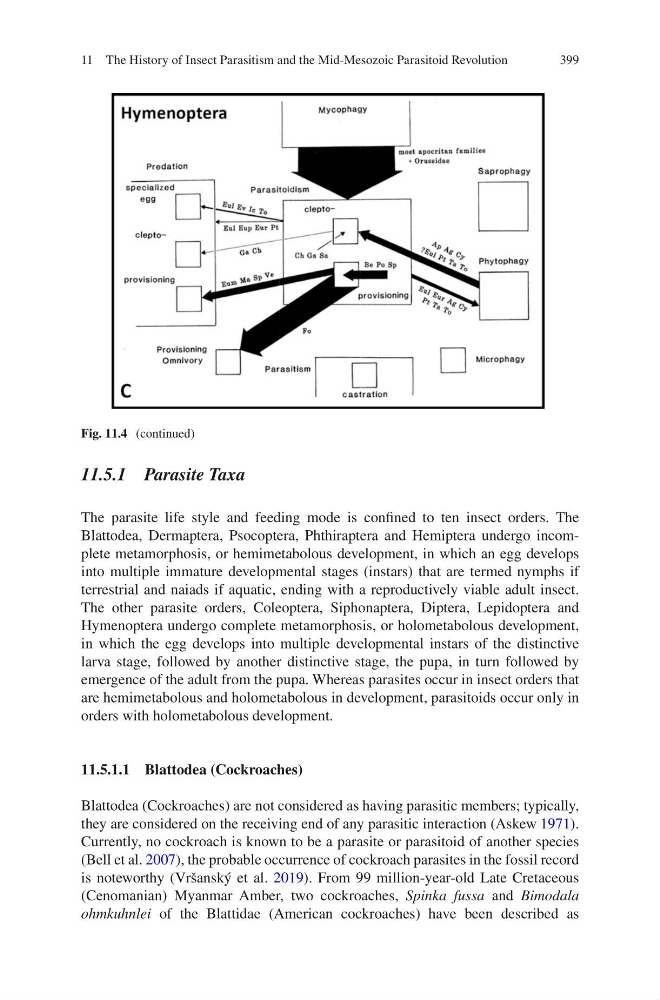
Fig. 11.4 (continued)
11 The History of Insect Parasitism and the Mid-Mesozoic Parasitoid Revolution
11.5.1 Parasite Taxa
The parasite life style and feeding mode is confined to ten insect orders. The
Blattodea, Dermaptera, Psocoptera, Phthiraptera and Hemiptera undergo incomplete metamorphosis, or hemimetabolous development, in which an egg develops
into multiple immature developmental stages (instars) that are termed nymphs if
terrestrial and naiads if aquatic, ending with a reproductively viable adult insect.
The other parasite orders, Coleoptera, Siphonaptera, Diptera, Lepidoptera and
Hymenoptera undergo complete metamorphosis, or holometabolous development,
in which the egg develops into multiple developmental instars of the distinctive
larva stage, followed by another distinctive stage, the pupa, in turn followed by
emergence of the adult from the pupa. Whereas parasites occur in insect orders that
are hemimetabolous and holometabolous in development, parasitoids occur only in
orders with holometabolous development.
11.5.1.1 Blattodea (Cockroaches)
Blattodea (Cockroaches) are not considered as having parasitic members; typically,
they are considered on the receiving end of any parasitic interaction (Askew 1971).
Currently, no cockroach is known to be a parasite or parasitoid of another species
(Bell et al. 2007), the probable occurrence of cockroach parasites in the fossil record
is noteworthy (Vršanský et al. 2019). From 99 million-year-old Late Cretaceous
(Cenomanian) Myanmar Amber, two cockroaches, Spinka fussa and Bimodala
ohmkuhnlei of the Blattidae (American cockroaches) have been described as
Fig. 11.4 (continued)
11 The History of Insect Parasitism and the Mid-Mesozoic Parasitoid Revolution