

356
10.3.3 Fossil Representatives
The fossil record for isopods in general is sparse and even poorer for Cymothoida
(Smit et al. 2014; partly probably due to the limited preservation potential, see
Klompmaker et al. 2017) except for the group Cirolanidae (at least numerous fossils
have been interpreted as representatives of Cirolanidae; Wieder and Feldmann
1992; Hyžný et al. 2013; Etter 2014; Smit et al. 2014; Robin et al. 2019). This might
be partly caused by often ambiguous identification of fossils related with their preservation (Maguire et al. 2018; Vega et al. 2019) and their interpretation as representatives of a specific group (Bowman 1971; Maguire et al. 2018).
The oldest fossil representatives of Cirolanidae suggesting directly (associated
with their hosts) their scavenging lifestyle have been reported from the Jurassic
(150 mya), associated with a water bug (Polz 2004) and from the Cretaceous
(100 mya), associated with a fish carcass (Wilson et al. 2011). Feldmann (2009;
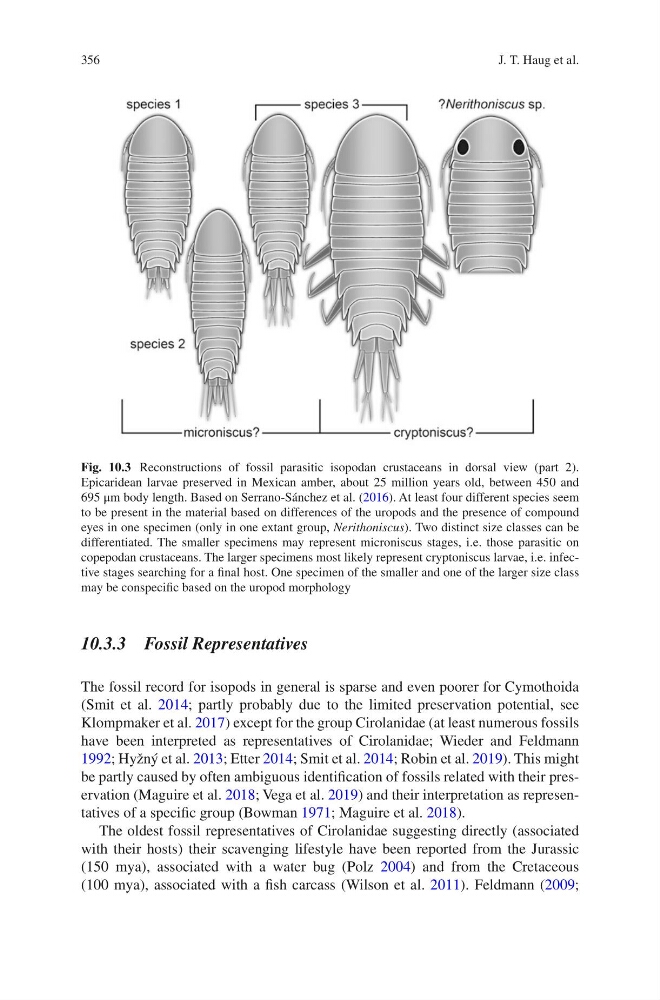
Fig. 10.3 Reconstructions of fossil parasitic isopodan crustaceans in dorsal view (part 2).
Epicaridean larvae preserved in Mexican amber, about 25 million years old, between 450 and
695 μm body length. Based on Serrano-Sánchez et al. (2016). At least four different species seem
to be present in the material based on differences of the uropods and the presence of compound
eyes in one specimen (only in one extant group, Nerithoniscus). Two distinct size classes can be
differentiated. The smaller specimens may represent microniscus stages, i.e. those parasitic on
copepodan crustaceans. The larger specimens most likely represent cryptoniscus larvae, i.e. infective stages searching for a final host. One specimen of the smaller and one of the larger size class
may be conspecific based on the uropod morphology
J. T. Haug et al.
10.3.3 Fossil Representatives
The fossil record for isopods in general is sparse and even poorer for Cymothoida
(Smit et al. 2014; partly probably due to the limited preservation potential, see
Klompmaker et al. 2017) except for the group Cirolanidae (at least numerous fossils
have been interpreted as representatives of Cirolanidae; Wieder and Feldmann
1992; Hyžný et al. 2013; Etter 2014; Smit et al. 2014; Robin et al. 2019). This might
be partly caused by often ambiguous identification of fossils related with their preservation (Maguire et al. 2018; Vega et al. 2019) and their interpretation as representatives of a specific group (Bowman 1971; Maguire et al. 2018).
The oldest fossil representatives of Cirolanidae suggesting directly (associated
with their hosts) their scavenging lifestyle have been reported from the Jurassic
(150 mya), associated with a water bug (Polz 2004) and from the Cretaceous
(100 mya), associated with a fish carcass (Wilson et al. 2011). Feldmann (2009;
Fig. 10.3 Reconstructions of fossil parasitic isopodan crustaceans in dorsal view (part 2).
Epicaridean larvae preserved in Mexican amber, about 25 million years old, between 450 and
695 μm body length. Based on Serrano-Sánchez et al. (2016). At least four different species seem
to be present in the material based on differences of the uropods and the presence of compound
eyes in one specimen (only in one extant group, Nerithoniscus). Two distinct size classes can be
differentiated. The smaller specimens may represent microniscus stages, i.e. those parasitic on
copepodan crustaceans. The larger specimens most likely represent cryptoniscus larvae, i.e. infective stages searching for a final host. One specimen of the smaller and one of the larger size class
may be conspecific based on the uropod morphology
J. T. Haug et al.