

355
or directly to Gnathiidae (Nagler et al. 2017a). The exact relationship between
Gnathiidae, Epicaridea and Urda cannot be resolved with the currently available
data, especially as the mouthparts of Urda are not fully understood yet (Nagler et al.
2017a). Furthermore, it will be necessary to investigate all different fossil forms
currently attributed to Urda to evaluate the monophyly of this group.
Epicarideans parasitizing other crustaceans evolved from fish-parasitizing ancestors (Dreyer and Wägele 2001, 2002). Due to fossil findings of cryptoniscus larvae
in amber, this host change must have occurred at the latest in the Cretaceous
(Fig. 10.3; Serrano-Sánchez et al. 2016; Néraudeau et al. 2017). The evolutionary
origin of Epicaridea has been suggested to be in the Jurassic (180 mya) parasitizing
squat lobsters (though the oldest possible occurrence is on an erymidan lobster;
Soergel 1913 after Klompmaker et al. 2014) because of the large abundance of their
decapod hosts (e.g., Klompmaker et al. 2013), fossil findings of pathologically
transformed hosts (Wienberg Rasmussen et al. 2008; Klompmaker et al. 2014,
2021) and based on a molecular phylogeny (Markham 1986; Boyko et al. 2012,
2013). Finally, it has been suggested that the highly specialized parasitic lifestyle,
mainly on fishes, and the diverse morphology of modern representatives within the
parasitic ingroup of Cymothoida originated stepwise from non-parasitic cirolaniidlike ancestors with a scavenging life style on fishes (Nagler et al. 2017a).
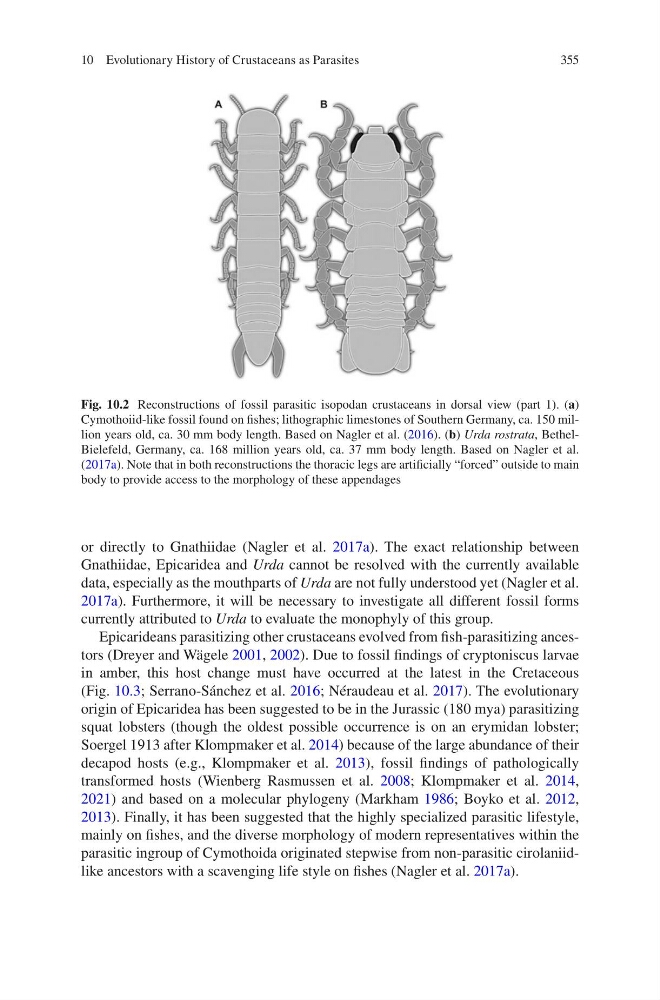
Fig. 10.2 Reconstructions of fossil parasitic isopodan crustaceans in dorsal view (part 1). (a)
Cymothoiid-like fossil found on fishes; lithographic limestones of Southern Germany, ca. 150 million years old, ca. 30 mm body length. Based on Nagler et al. (2016). (b) Urda rostrata, BethelBielefeld, Germany, ca. 168 million years old, ca. 37 mm body length. Based on Nagler et al.
(2017a). Note that in both reconstructions the thoracic legs are artificially “forced” outside to main
body to provide access to the morphology of these appendages
10 Evolutionary History of Crustaceans as Parasites
or directly to Gnathiidae (Nagler et al. 2017a). The exact relationship between
Gnathiidae, Epicaridea and Urda cannot be resolved with the currently available
data, especially as the mouthparts of Urda are not fully understood yet (Nagler et al.
2017a). Furthermore, it will be necessary to investigate all different fossil forms
currently attributed to Urda to evaluate the monophyly of this group.
Epicarideans parasitizing other crustaceans evolved from fish-parasitizing ancestors (Dreyer and Wägele 2001, 2002). Due to fossil findings of cryptoniscus larvae
in amber, this host change must have occurred at the latest in the Cretaceous
(Fig. 10.3; Serrano-Sánchez et al. 2016; Néraudeau et al. 2017). The evolutionary
origin of Epicaridea has been suggested to be in the Jurassic (180 mya) parasitizing
squat lobsters (though the oldest possible occurrence is on an erymidan lobster;
Soergel 1913 after Klompmaker et al. 2014) because of the large abundance of their
decapod hosts (e.g., Klompmaker et al. 2013), fossil findings of pathologically
transformed hosts (Wienberg Rasmussen et al. 2008; Klompmaker et al. 2014,
2021) and based on a molecular phylogeny (Markham 1986; Boyko et al. 2012,
2013). Finally, it has been suggested that the highly specialized parasitic lifestyle,
mainly on fishes, and the diverse morphology of modern representatives within the
parasitic ingroup of Cymothoida originated stepwise from non-parasitic cirolaniidlike ancestors with a scavenging life style on fishes (Nagler et al. 2017a).
Fig. 10.2 Reconstructions of fossil parasitic isopodan crustaceans in dorsal view (part 1). (a)
Cymothoiid-like fossil found on fishes; lithographic limestones of Southern Germany, ca. 150 million years old, ca. 30 mm body length. Based on Nagler et al. (2016). (b) Urda rostrata, BethelBielefeld, Germany, ca. 168 million years old, ca. 37 mm body length. Based on Nagler et al.
(2017a). Note that in both reconstructions the thoracic legs are artificially “forced” outside to main
body to provide access to the morphology of these appendages
10 Evolutionary History of Crustaceans as Parasites