

320
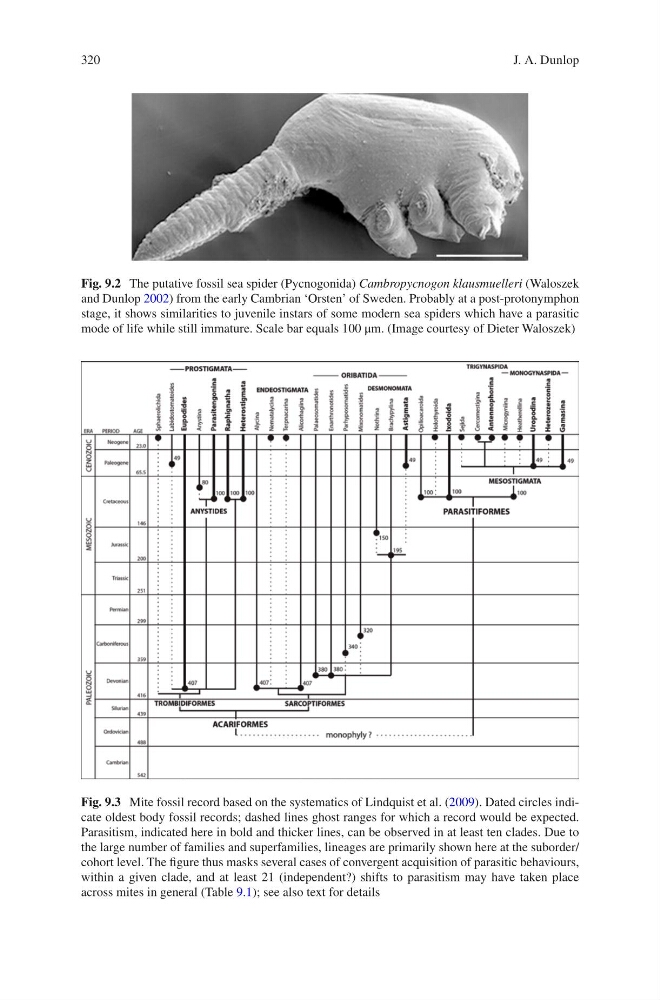
Fig. 9.3 Mite fossil record based on the systematics of Lindquist et al. (2009). Dated circles indicate oldest body fossil records; dashed lines ghost ranges for which a record would be expected.
Parasitism, indicated here in bold and thicker lines, can be observed in at least ten clades. Due to
the large number of families and superfamilies, lineages are primarily shown here at the suborder/
cohort level. The figure thus masks several cases of convergent acquisition of parasitic behaviours,
within a given clade, and at least 21 (independent?) shifts to parasitism may have taken place
across mites in general (Table 9.1); see also text for details
Fig. 9.2 The putative fossil sea spider (Pycnogonida) Cambropycnogon klausmuelleri (Waloszek
and Dunlop 2002) from the early Cambrian ‘Orsten’ of Sweden. Probably at a post-protonymphon
stage, it shows similarities to juvenile instars of some modern sea spiders which have a parasitic
mode of life while still immature. Scale bar equals 100 μm. (Image courtesy of Dieter Waloszek)
J. A. Dunlop
Fig. 9.3 Mite fossil record based on the systematics of Lindquist et al. (2009). Dated circles indicate oldest body fossil records; dashed lines ghost ranges for which a record would be expected.
Parasitism, indicated here in bold and thicker lines, can be observed in at least ten clades. Due to
the large number of families and superfamilies, lineages are primarily shown here at the suborder/
cohort level. The figure thus masks several cases of convergent acquisition of parasitic behaviours,
within a given clade, and at least 21 (independent?) shifts to parasitism may have taken place
across mites in general (Table 9.1); see also text for details
Fig. 9.2 The putative fossil sea spider (Pycnogonida) Cambropycnogon klausmuelleri (Waloszek
and Dunlop 2002) from the early Cambrian ‘Orsten’ of Sweden. Probably at a post-protonymphon
stage, it shows similarities to juvenile instars of some modern sea spiders which have a parasitic
mode of life while still immature. Scale bar equals 100 μm. (Image courtesy of Dieter Waloszek)
J. A. Dunlop