

288
8.3.3 Copulatory Cap
Besides hooks and eggs, there is another structure, for which preservation seems to
be in the range of the possible, and this structure has to do with acanthocephalan
reproduction: In the course of mating, the male worm encloses the female hind end
with the everted copulatory bursa (Fig. 8.3b), and introduces spermatozoa through
a penile structure into the female genital tract. Before the male detaches from the
female, it seals the female genital pore with the proteinaceous secretion from one
or more so-called cement glands (Fig. 8.3b) (Dezfuli et al. 2001). Obviously, the
female is hindered from additional copulations as long as the copulatory cap is
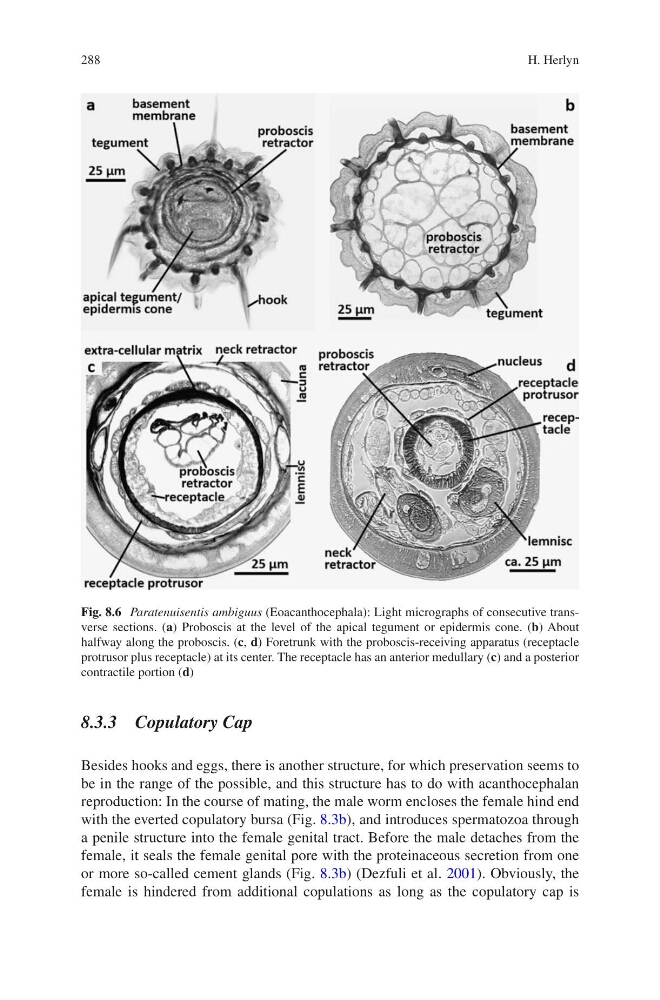
Fig. 8.6 Paratenuisentis ambiguus (Eoacanthocephala): Light micrographs of consecutive transverse sections. (a) Proboscis at the level of the apical tegument or epidermis cone. (b) About
halfway along the proboscis. (c, d) Foretrunk with the proboscis-receiving apparatus (receptacle
protrusor plus receptacle) at its center. The receptacle has an anterior medullary (c) and a posterior
contractile portion (d)
H. Herlyn
8.3.3 Copulatory Cap
Besides hooks and eggs, there is another structure, for which preservation seems to
be in the range of the possible, and this structure has to do with acanthocephalan
reproduction: In the course of mating, the male worm encloses the female hind end
with the everted copulatory bursa (Fig. 8.3b), and introduces spermatozoa through
a penile structure into the female genital tract. Before the male detaches from the
female, it seals the female genital pore with the proteinaceous secretion from one
or more so-called cement glands (Fig. 8.3b) (Dezfuli et al. 2001). Obviously, the
female is hindered from additional copulations as long as the copulatory cap is
Fig. 8.6 Paratenuisentis ambiguus (Eoacanthocephala): Light micrographs of consecutive transverse sections. (a) Proboscis at the level of the apical tegument or epidermis cone. (b) About
halfway along the proboscis. (c, d) Foretrunk with the proboscis-receiving apparatus (receptacle
protrusor plus receptacle) at its center. The receptacle has an anterior medullary (c) and a posterior
contractile portion (d)
H. Herlyn