

287
even “worse”, inside the alimentary canal. Probably, acanthocephalans do so since
they exploit gnathostomes as hosts (see evolutionary scenario below). For this reason, fossilization would require that acanthocephalan hooks first withstand autolysis of the bowels upon the death of a host, and then encounter excellent preservation
conditions.
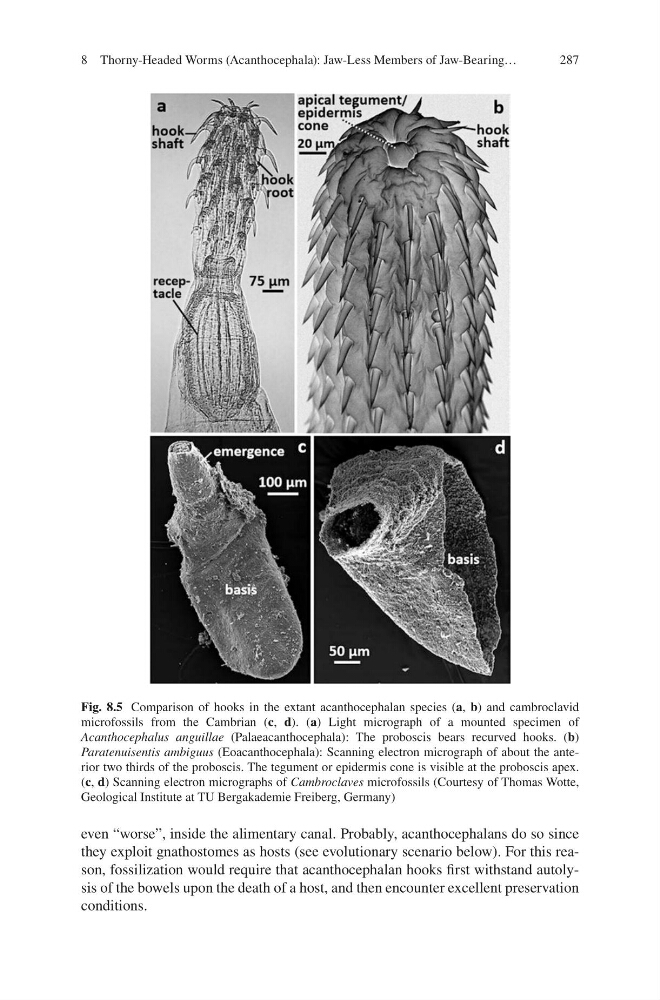
Fig. 8.5 Comparison of hooks in the extant acanthocephalan species (a, b) and cambroclavid
microfossils from the Cambrian (c, d). (a) Light micrograph of a mounted specimen of
Acanthocephalus anguillae (Palaeacanthocephala): The proboscis bears recurved hooks. (b)
Paratenuisentis ambiguus (Eoacanthocephala): Scanning electron micrograph of about the anterior two thirds of the proboscis. The tegument or epidermis cone is visible at the proboscis apex.
(c, d) Scanning electron micrographs of Cambroclaves microfossils (Courtesy of Thomas Wotte,
Geological Institute at TU Bergakademie Freiberg, Germany)
8 Thorny-Headed Worms (Acanthocephala): Jaw-Less Members of Jaw-Bearing…
even “worse”, inside the alimentary canal. Probably, acanthocephalans do so since
they exploit gnathostomes as hosts (see evolutionary scenario below). For this reason, fossilization would require that acanthocephalan hooks first withstand autolysis of the bowels upon the death of a host, and then encounter excellent preservation
conditions.
Fig. 8.5 Comparison of hooks in the extant acanthocephalan species (a, b) and cambroclavid
microfossils from the Cambrian (c, d). (a) Light micrograph of a mounted specimen of
Acanthocephalus anguillae (Palaeacanthocephala): The proboscis bears recurved hooks. (b)
Paratenuisentis ambiguus (Eoacanthocephala): Scanning electron micrograph of about the anterior two thirds of the proboscis. The tegument or epidermis cone is visible at the proboscis apex.
(c, d) Scanning electron micrographs of Cambroclaves microfossils (Courtesy of Thomas Wotte,
Geological Institute at TU Bergakademie Freiberg, Germany)
8 Thorny-Headed Worms (Acanthocephala): Jaw-Less Members of Jaw-Bearing…