

275
should increase the chance that a single male or female eventually meets a worm of
the opposite sex so that they can mate and reproduce (Parker et al. 2015). However,
the requirement for subsequent infection of two hosts lowers the chances of maintaining the life cycle. Acanthocephalans defy this adversity with two strategies. In
particular, there is evidence that acanthocephalans manipulate the behavior of the
intermediate host in such a way that the probability of host-transfer is increased
(Bakker et al. 2017). Yet, while only some acanthocephalan species might be able to
do so, the adults of all of them have increased fecundity (see Parker et al. 2015). In
fact, males and females appear to be adapted to the production of high quantities of
gametes and offspring (see below). In both respects, acanthocephalans resemble
other endoparasites with complex life cycles such as tapeworms (Platyhelminthes,
Cestoda) or trematodes (Platyhelminthes, Trematoda) (e.g., Goater et al. 2014).
In extension of the obligatory two-host cycle, at least some of the extant acanthocephalan species can continue their life in a second definitive host. This can
happen when a higher-level predator feeds on a first definitive host (post-cyclic
transmission). It also occurs that acanthocephalans survive but do not mature in a
first gnathostome host (paratenic host), and complete their development in a definitive host that had preyed on the paratenic host (e.g., Hernández-Orts et al. 2019). In
addition, acanthocephalans can end up in an accidental host inside which the
worms survive without having the ability to reproduce, but also without a (realistic)
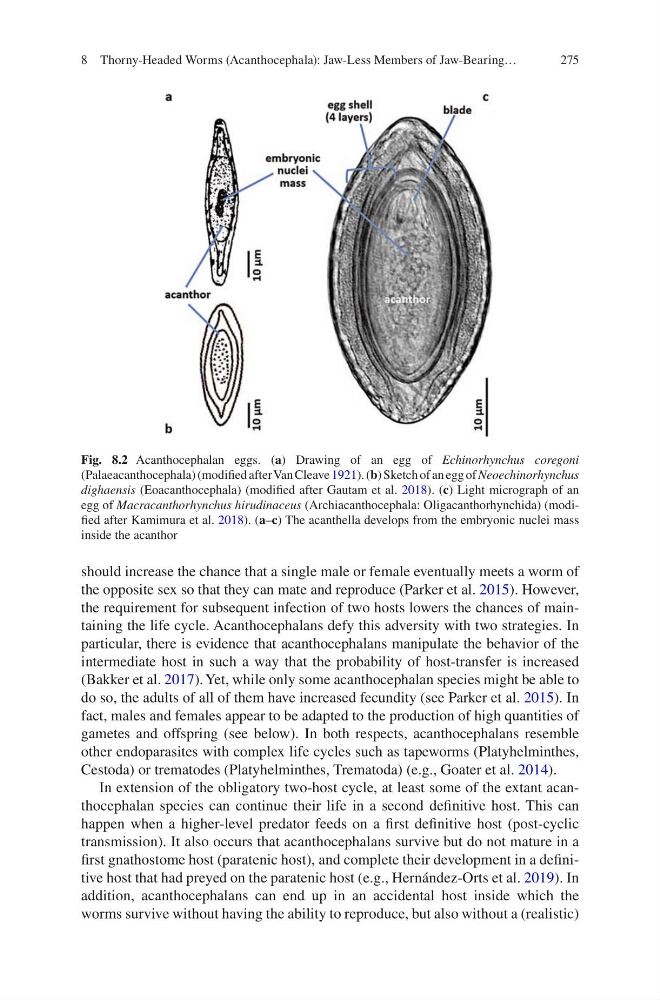
Fig. 8.2 Acanthocephalan eggs. (a) Drawing of an egg of Echinorhynchus coregoni
(Palaeacanthocephala) (modified after Van Cleave 1921). (b) Sketch of an egg of Neoechinorhynchus
dighaensis (Eoacanthocephala) (modified after Gautam et al. 2018). (c) Light micrograph of an
egg of Macracanthorhynchus hirudinaceus (Archiacanthocephala: Oligacanthorhynchida) (modified after Kamimura et al. 2018). (a–c) The acanthella develops from the embryonic nuclei mass
inside the acanthor
8 Thorny-Headed Worms (Acanthocephala): Jaw-Less Members of Jaw-Bearing…
should increase the chance that a single male or female eventually meets a worm of
the opposite sex so that they can mate and reproduce (Parker et al. 2015). However,
the requirement for subsequent infection of two hosts lowers the chances of maintaining the life cycle. Acanthocephalans defy this adversity with two strategies. In
particular, there is evidence that acanthocephalans manipulate the behavior of the
intermediate host in such a way that the probability of host-transfer is increased
(Bakker et al. 2017). Yet, while only some acanthocephalan species might be able to
do so, the adults of all of them have increased fecundity (see Parker et al. 2015). In
fact, males and females appear to be adapted to the production of high quantities of
gametes and offspring (see below). In both respects, acanthocephalans resemble
other endoparasites with complex life cycles such as tapeworms (Platyhelminthes,
Cestoda) or trematodes (Platyhelminthes, Trematoda) (e.g., Goater et al. 2014).
In extension of the obligatory two-host cycle, at least some of the extant acanthocephalan species can continue their life in a second definitive host. This can
happen when a higher-level predator feeds on a first definitive host (post-cyclic
transmission). It also occurs that acanthocephalans survive but do not mature in a
first gnathostome host (paratenic host), and complete their development in a definitive host that had preyed on the paratenic host (e.g., Hernández-Orts et al. 2019). In
addition, acanthocephalans can end up in an accidental host inside which the
worms survive without having the ability to reproduce, but also without a (realistic)
Fig. 8.2 Acanthocephalan eggs. (a) Drawing of an egg of Echinorhynchus coregoni
(Palaeacanthocephala) (modified after Van Cleave 1921). (b) Sketch of an egg of Neoechinorhynchus
dighaensis (Eoacanthocephala) (modified after Gautam et al. 2018). (c) Light micrograph of an
egg of Macracanthorhynchus hirudinaceus (Archiacanthocephala: Oligacanthorhynchida) (modified after Kamimura et al. 2018). (a–c) The acanthella develops from the embryonic nuclei mass
inside the acanthor
8 Thorny-Headed Worms (Acanthocephala): Jaw-Less Members of Jaw-Bearing…