

274
from Mandibulata (Arthropoda) (Schmidt 1971; Rota-Stabelli et al. 2013).
Cartilaginous fishes (Chondrichthyes), teleost fishes (Teleostei), amphibians
(Amphibia), sauropsids (Sauropsida), and mammals (Mammalia) and thus jawed
vertebrates (Gnathostomata) serve as definitive hosts (see, e.g., Petrochenko 1956,
1958; Gibson et al. 2014). Thereby, the specificity of host usage seems generally to
be weaker for definitive than intermediate hosts (Conway Morris and Crompton
1982; Parker et al. 2015).
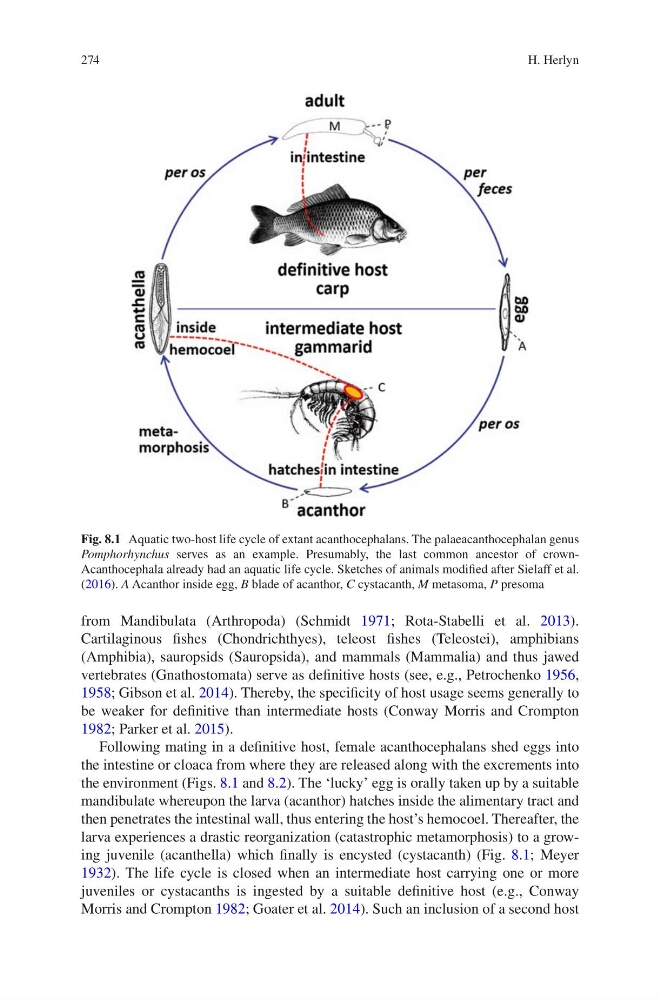
Following mating in a definitive host, female acanthocephalans shed eggs into
the intestine or cloaca from where they are released along with the excrements into
the environment (Figs. 8.1 and 8.2). The ‘lucky’ egg is orally taken up by a suitable
mandibulate whereupon the larva (acanthor) hatches inside the alimentary tract and
then penetrates the intestinal wall, thus entering the host’s hemocoel. Thereafter, the
larva experiences a drastic reorganization (catastrophic metamorphosis) to a growing juvenile (acanthella) which finally is encysted (cystacanth) (Fig. 8.1; Meyer
1932). The life cycle is closed when an intermediate host carrying one or more
juveniles or cystacanths is ingested by a suitable definitive host (e.g., Conway
Morris and Crompton 1982; Goater et al. 2014). Such an inclusion of a second host
Fig. 8.1 Aquatic two-host life cycle of extant acanthocephalans. The palaeacanthocephalan genus
Pomphorhynchus serves as an example. Presumably, the last common ancestor of crownAcanthocephala already had an aquatic life cycle. Sketches of animals modified after Sielaff et al.
(2016). A Acanthor inside egg, B blade of acanthor, C cystacanth, M metasoma, P presoma
H. Herlyn
from Mandibulata (Arthropoda) (Schmidt 1971; Rota-Stabelli et al. 2013).
Cartilaginous fishes (Chondrichthyes), teleost fishes (Teleostei), amphibians
(Amphibia), sauropsids (Sauropsida), and mammals (Mammalia) and thus jawed
vertebrates (Gnathostomata) serve as definitive hosts (see, e.g., Petrochenko 1956,
1958; Gibson et al. 2014). Thereby, the specificity of host usage seems generally to
be weaker for definitive than intermediate hosts (Conway Morris and Crompton
1982; Parker et al. 2015).
Following mating in a definitive host, female acanthocephalans shed eggs into
the intestine or cloaca from where they are released along with the excrements into
the environment (Figs. 8.1 and 8.2). The ‘lucky’ egg is orally taken up by a suitable
mandibulate whereupon the larva (acanthor) hatches inside the alimentary tract and
then penetrates the intestinal wall, thus entering the host’s hemocoel. Thereafter, the
larva experiences a drastic reorganization (catastrophic metamorphosis) to a growing juvenile (acanthella) which finally is encysted (cystacanth) (Fig. 8.1; Meyer
1932). The life cycle is closed when an intermediate host carrying one or more
juveniles or cystacanths is ingested by a suitable definitive host (e.g., Conway
Morris and Crompton 1982; Goater et al. 2014). Such an inclusion of a second host
Fig. 8.1 Aquatic two-host life cycle of extant acanthocephalans. The palaeacanthocephalan genus
Pomphorhynchus serves as an example. Presumably, the last common ancestor of crownAcanthocephala already had an aquatic life cycle. Sketches of animals modified after Sielaff et al.
(2016). A Acanthor inside egg, B blade of acanthor, C cystacanth, M metasoma, P presoma
H. Herlyn