

236
eggs have been particularly found with different techniques in subfossil (dessicated)
to fossil (permineralized) coprolites. Coprolites are known to be a KonservatLagerstätte (Seilacher et al. 2001; Qvarnström et al. 2016), the bacteria content of
feces induce early mineralization that allow the preservation of soft tissues in exquisite detail (e.g., muscles, parasite eggs, hair and feathers: Hollocher and Hollocher
2012; Chin 2021). As most fossil coprolites are permineralized, they are commonly
treated with HCl. Using such approaches nematode eggs have been recovered from
material dating back to the Triassic (Da Silva et al. 2014; Hugot et al. 2014) with
evidence of acanthocephalans and trematodes from the Cretaceous (Cardia et al.
2019a; Poinar and Boucot 2006). However, using such an approach might destroy
particular remains. Additional, and including older fossils have been discovered in
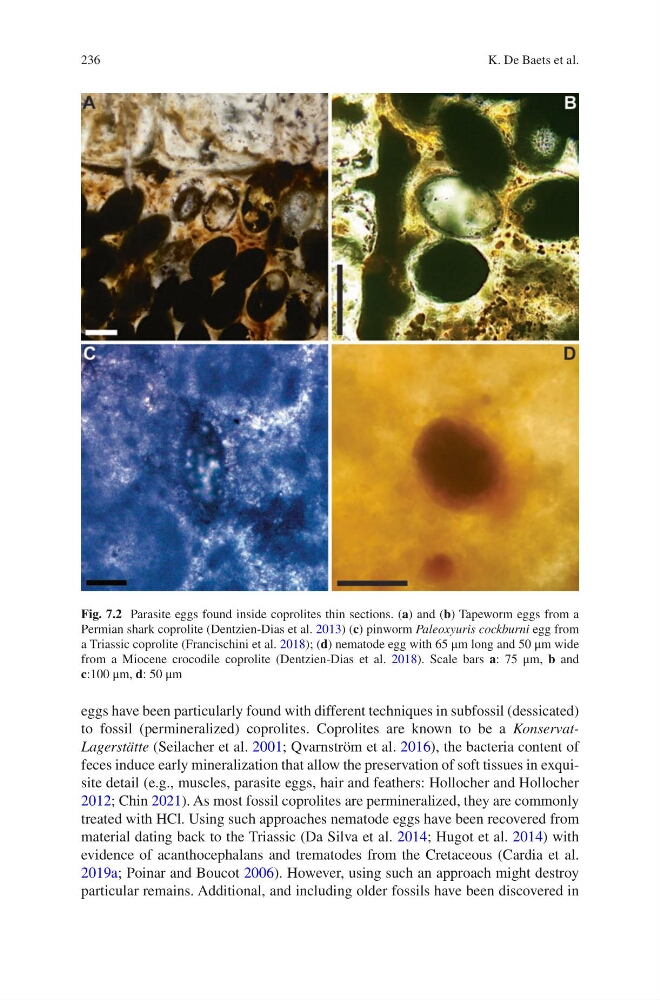
Fig. 7.2 Parasite eggs found inside coprolites thin sections. (a) and (b) Tapeworm eggs from a
Permian shark coprolite (Dentzien-Dias et al. 2013) (c) pinworm Paleoxyuris cockburni egg from
a Triassic coprolite (Francischini et al. 2018); (d) nematode egg with 65 μm long and 50 μm wide
from a Miocene crocodile coprolite (Dentzien-Dias et al. 2018). Scale bars a: 75 μm, b and
c:100 μm, d: 50 μm
K. De Baets et al.
eggs have been particularly found with different techniques in subfossil (dessicated)
to fossil (permineralized) coprolites. Coprolites are known to be a KonservatLagerstätte (Seilacher et al. 2001; Qvarnström et al. 2016), the bacteria content of
feces induce early mineralization that allow the preservation of soft tissues in exquisite detail (e.g., muscles, parasite eggs, hair and feathers: Hollocher and Hollocher
2012; Chin 2021). As most fossil coprolites are permineralized, they are commonly
treated with HCl. Using such approaches nematode eggs have been recovered from
material dating back to the Triassic (Da Silva et al. 2014; Hugot et al. 2014) with
evidence of acanthocephalans and trematodes from the Cretaceous (Cardia et al.
2019a; Poinar and Boucot 2006). However, using such an approach might destroy
particular remains. Additional, and including older fossils have been discovered in
Fig. 7.2 Parasite eggs found inside coprolites thin sections. (a) and (b) Tapeworm eggs from a
Permian shark coprolite (Dentzien-Dias et al. 2013) (c) pinworm Paleoxyuris cockburni egg from
a Triassic coprolite (Francischini et al. 2018); (d) nematode egg with 65 μm long and 50 μm wide
from a Miocene crocodile coprolite (Dentzien-Dias et al. 2018). Scale bars a: 75 μm, b and
c:100 μm, d: 50 μm
K. De Baets et al.