

235
transported away from their host making it hard to recognize their mode of life or
association. Endoparasitic forms might not be discovered at all as they reside within
their hosts; few have structures that are not likely decomposed along with the softtissues of their hosts. When body fossil evidence is found the often few remaining
characters can make it difficult to assign them to particular lineages (Schram 1973;
Muir et al. 2014). Additionally, due to convergent losses and gains of traits in the
diversification of helminths, they can look quite different from their free-living
ancestors and/or very similar to other extant clades of helminths (De Baets and
Littlewood 2015).
Soft-body imprints or remains have become particularly known from nematodes,
likely related to their resilient external cuticle—characteristic amongst both freeliving and parasitic forms. Sclerotized or otherwise more resistant structures such as
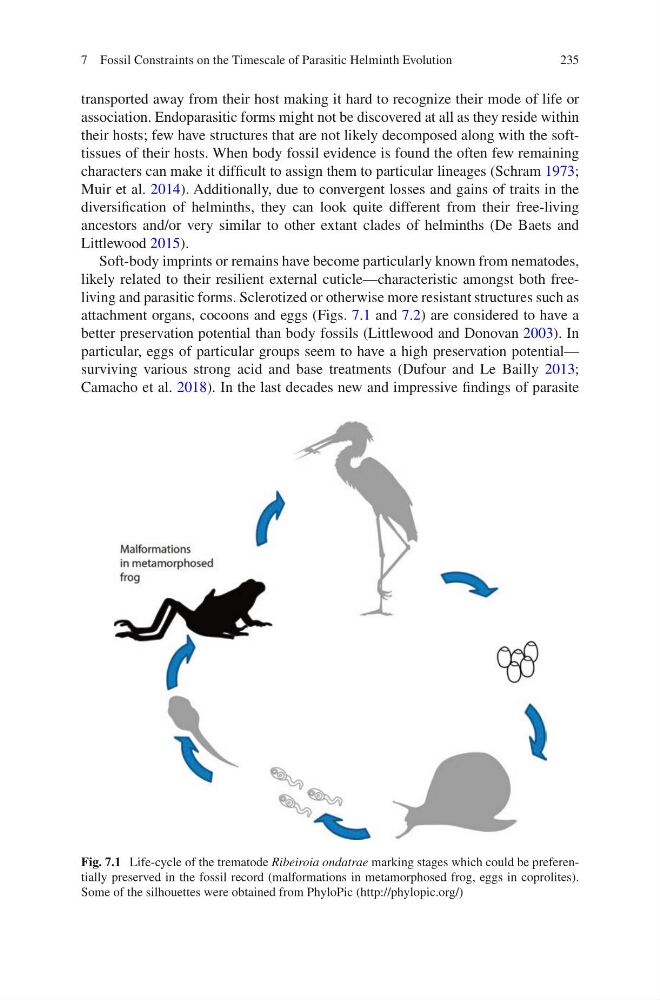
attachment organs, cocoons and eggs (Figs. 7.1 and 7.2) are considered to have a
better preservation potential than body fossils (Littlewood and Donovan 2003). In
particular, eggs of particular groups seem to have a high preservation potential—
surviving various strong acid and base treatments (Dufour and Le Bailly 2013;
Camacho et al. 2018). In the last decades new and impressive findings of parasite
Fig. 7.1 Life-cycle of the trematode Ribeiroia ondatrae marking stages which could be preferentially preserved in the fossil record (malformations in metamorphosed frog, eggs in coprolites).
Some of the silhouettes were obtained from PhyloPic (http://phylopic.org/)
7 Fossil Constraints on the Timescale of Parasitic Helminth Evolution
transported away from their host making it hard to recognize their mode of life or
association. Endoparasitic forms might not be discovered at all as they reside within
their hosts; few have structures that are not likely decomposed along with the softtissues of their hosts. When body fossil evidence is found the often few remaining
characters can make it difficult to assign them to particular lineages (Schram 1973;
Muir et al. 2014). Additionally, due to convergent losses and gains of traits in the
diversification of helminths, they can look quite different from their free-living
ancestors and/or very similar to other extant clades of helminths (De Baets and
Littlewood 2015).
Soft-body imprints or remains have become particularly known from nematodes,
likely related to their resilient external cuticle—characteristic amongst both freeliving and parasitic forms. Sclerotized or otherwise more resistant structures such as
attachment organs, cocoons and eggs (Figs. 7.1 and 7.2) are considered to have a
better preservation potential than body fossils (Littlewood and Donovan 2003). In
particular, eggs of particular groups seem to have a high preservation potential—
surviving various strong acid and base treatments (Dufour and Le Bailly 2013;
Camacho et al. 2018). In the last decades new and impressive findings of parasite
Fig. 7.1 Life-cycle of the trematode Ribeiroia ondatrae marking stages which could be preferentially preserved in the fossil record (malformations in metamorphosed frog, eggs in coprolites).
Some of the silhouettes were obtained from PhyloPic (http://phylopic.org/)
7 Fossil Constraints on the Timescale of Parasitic Helminth Evolution