

218
6.2.2.4 Pyramidellidae
Pyramidellidae are ectoparasites that feed on body fluids of their hosts and have
reduced the radula (e.g. Robertson and Mau-Lastovicka 1979; Healey 1998a;
Ponder and De Kayser 1998). Most of the verified hosts are polychaetes, gastropods
and bivalves, but there also appear to be various minor host groups such as polyplacophorans and echinoderms (Robertson and Mau-Lastovicka 1979). Pyramidellidae
are one of the most diverse gastropod families with more than 6000 living species
(Lygre and Schander 2010). Bouchet (2009) reported that 715 species are present in
the Philippines in an area of 15,000 ha (c. 150 km
2
) of coastal habitats to a depth
of 150 m.
Most pyramidellids are small (<10 mm) and have a high-spired shell with one or
more columellar plaits in the aperture (Fig. 6.3c). Shell shape and ornament are
quite variable in this family (see Bouchet 2009 for some examples). As heterobranchs they have heterostrophic, sinistral protoconchs which help to separate them
from convergent caenogastropods.
The fossil record of Pyramidellidae is hard to track; the earliest finds in the
PBDB dating from the Palaeozoic and Triassic refer to the modern genus Chemnitzia
and these assignments are all outdated—Chemnitzia was used as a waste basket
taxon, especially in the nineteenth century. Based on Sohl (1964), Tracey et al.
(1993) gave a Maastrichtian FAD. Kaim (2004) placed the Middle Jurassic
Chrysallida minuera (Late Bathonian, Poland) in Pyramidellidae and the similarity
to modern Chrysallida is indeed stunning although a distinct columellar fold has not
been shown; but is has an incipient bulge similar to that of some Recent pyramidellid species. Nevertheless, a Late Bathonian age can be accepted as FAD for
Pyramidellidae since folds are also absent or weak in some Recent Pyramidellidae.
This relatively old fossil record is somewhat surprising given molecular studies that
suggest that they are deeply rooted in Pulmonata (Dinapoli et al. 2011; Schrödl et al.
2011) which would be more congruent with a younger age. Amathinidae Ponder
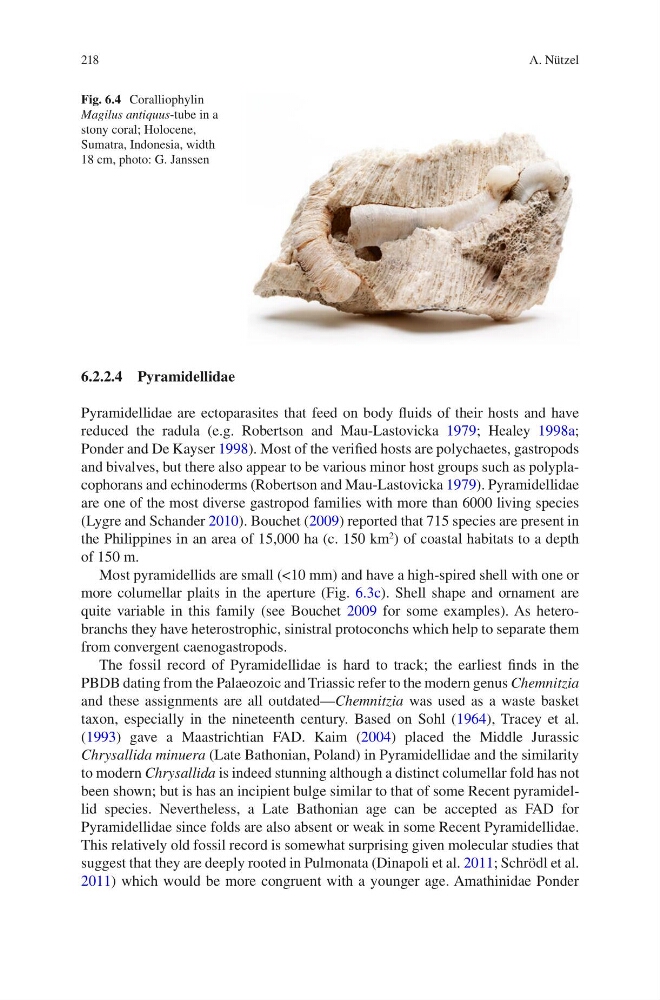
Fig. 6.4 Coralliophylin
Magilus antiquus-tube in a
stony coral; Holocene,
Sumatra, Indonesia, width
18 cm, photo: G. Janssen
A. Nützel
6.2.2.4 Pyramidellidae
Pyramidellidae are ectoparasites that feed on body fluids of their hosts and have
reduced the radula (e.g. Robertson and Mau-Lastovicka 1979; Healey 1998a;
Ponder and De Kayser 1998). Most of the verified hosts are polychaetes, gastropods
and bivalves, but there also appear to be various minor host groups such as polyplacophorans and echinoderms (Robertson and Mau-Lastovicka 1979). Pyramidellidae
are one of the most diverse gastropod families with more than 6000 living species
(Lygre and Schander 2010). Bouchet (2009) reported that 715 species are present in
the Philippines in an area of 15,000 ha (c. 150 km
2
) of coastal habitats to a depth
of 150 m.
Most pyramidellids are small (<10 mm) and have a high-spired shell with one or
more columellar plaits in the aperture (Fig. 6.3c). Shell shape and ornament are
quite variable in this family (see Bouchet 2009 for some examples). As heterobranchs they have heterostrophic, sinistral protoconchs which help to separate them
from convergent caenogastropods.
The fossil record of Pyramidellidae is hard to track; the earliest finds in the
PBDB dating from the Palaeozoic and Triassic refer to the modern genus Chemnitzia
and these assignments are all outdated—Chemnitzia was used as a waste basket
taxon, especially in the nineteenth century. Based on Sohl (1964), Tracey et al.
(1993) gave a Maastrichtian FAD. Kaim (2004) placed the Middle Jurassic
Chrysallida minuera (Late Bathonian, Poland) in Pyramidellidae and the similarity
to modern Chrysallida is indeed stunning although a distinct columellar fold has not
been shown; but is has an incipient bulge similar to that of some Recent pyramidellid species. Nevertheless, a Late Bathonian age can be accepted as FAD for
Pyramidellidae since folds are also absent or weak in some Recent Pyramidellidae.
This relatively old fossil record is somewhat surprising given molecular studies that
suggest that they are deeply rooted in Pulmonata (Dinapoli et al. 2011; Schrödl et al.
2011) which would be more congruent with a younger age. Amathinidae Ponder
Fig. 6.4 Coralliophylin
Magilus antiquus-tube in a
stony coral; Holocene,
Sumatra, Indonesia, width
18 cm, photo: G. Janssen
A. Nützel