

217
Triassic zygopleurid subfamily Ampezzopleurinae. Nützel (1998) suggested that
Epitoniidae arose from Ampezzopleurinae (Zygopleuridae) via Nystiellidae.
6.2.2.3 Coralliophilinae (Muricidae)
Coralliophilinae, a subfamily of Muricidae (Bouchet et al. 2017), is a moderately
diverse, small to medium-sized caenogastropod group with approximately 200–250
living species (Marshall and Olivero 2009). The shell morphology including ornamentation is quite variable. Coralliophilinae have reduced the radula and live parasitic on and in coelenterates (Robertson 1970). The genus Magilus lives within
stony corals and builds a tube within it (Fig. 6.4). Gittenberger and Gittenberger
(2011) reported a cryptic radiation of the coralliophilin endoparasitic genus
Leptoconchus. The species live in parasitic association with mushroom corals.
Coralliophilinae are known since the Late Cretaceous (Sohl 1964). Lozouet and
Renard (1998) reported one of the oldest members boring in corals from the
Oligocene of the Paris Basin.
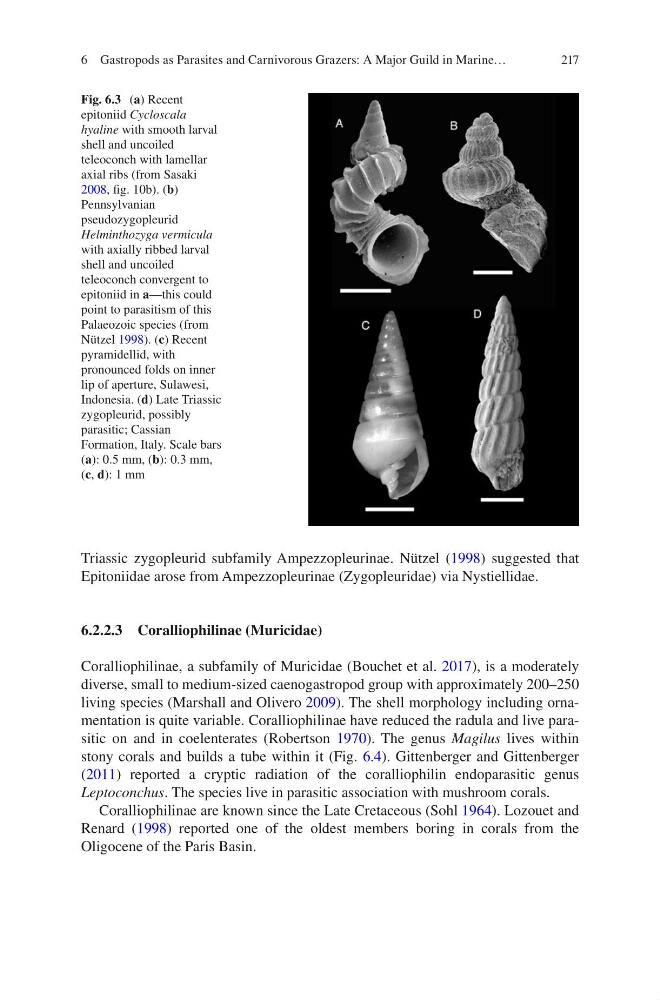
Fig. 6.3 (a) Recent
epitoniid Cycloscala
hyaline with smooth larval
shell and uncoiled
teleoconch with lamellar
axial ribs (from Sasaki
2008, fig. 10b). (b)
Pennsylvanian
pseudozygopleurid
Helminthozyga vermicula
with axially ribbed larval
shell and uncoiled
teleoconch convergent to
epitoniid in a—this could
point to parasitism of this
Palaeozoic species (from
Nützel 1998). (c) Recent
pyramidellid, with
pronounced folds on inner
lip of aperture, Sulawesi,
Indonesia. (d) Late Triassic
zygopleurid, possibly
parasitic; Cassian
Formation, Italy. Scale bars
(a): 0.5 mm, (b): 0.3 mm,
(c, d): 1 mm
6 Gastropods as Parasites and Carnivorous Grazers: A Major Guild in Marine…
Triassic zygopleurid subfamily Ampezzopleurinae. Nützel (1998) suggested that
Epitoniidae arose from Ampezzopleurinae (Zygopleuridae) via Nystiellidae.
6.2.2.3 Coralliophilinae (Muricidae)
Coralliophilinae, a subfamily of Muricidae (Bouchet et al. 2017), is a moderately
diverse, small to medium-sized caenogastropod group with approximately 200–250
living species (Marshall and Olivero 2009). The shell morphology including ornamentation is quite variable. Coralliophilinae have reduced the radula and live parasitic on and in coelenterates (Robertson 1970). The genus Magilus lives within
stony corals and builds a tube within it (Fig. 6.4). Gittenberger and Gittenberger
(2011) reported a cryptic radiation of the coralliophilin endoparasitic genus
Leptoconchus. The species live in parasitic association with mushroom corals.
Coralliophilinae are known since the Late Cretaceous (Sohl 1964). Lozouet and
Renard (1998) reported one of the oldest members boring in corals from the
Oligocene of the Paris Basin.
Fig. 6.3 (a) Recent
epitoniid Cycloscala
hyaline with smooth larval
shell and uncoiled
teleoconch with lamellar
axial ribs (from Sasaki
2008, fig. 10b). (b)
Pennsylvanian
pseudozygopleurid
Helminthozyga vermicula
with axially ribbed larval
shell and uncoiled
teleoconch convergent to
epitoniid in a—this could
point to parasitism of this
Palaeozoic species (from
Nützel 1998). (c) Recent
pyramidellid, with
pronounced folds on inner
lip of aperture, Sulawesi,
Indonesia. (d) Late Triassic
zygopleurid, possibly
parasitic; Cassian
Formation, Italy. Scale bars
(a): 0.5 mm, (b): 0.3 mm,
(c, d): 1 mm
6 Gastropods as Parasites and Carnivorous Grazers: A Major Guild in Marine…