

119
The free-living Polypodium body plan is relatively consistent with that of other
free-living cnidarians with an external ectoderm and internal endoderm (gastrodermis). We postulate that the independent sub-epidermal muscles may have evolved to
facilitate unrestricted reversal of ectoderm and endoderm positions when these
germ layers invert during formation of the mature stolon. Two Type I gonads
inferred to be female (with ‘oviducts’ opening into the gastric cavity) develop, but
mature eggs have not been observed and the gonadal complexes degenerate (Raikova
2008). Four Type II gonads (without gonoducts) support gametogenesis which is
described as first resembling spermatogenesis but subsequently becoming more
similar to oogenesis (entailing ‘reorientation of male into female gonad’; Raikova
2008). Fertilisation would be achieved at a much later stage given Raikova’s conclusion that the binucleate cells (produced by Type II gonads) that go on to invade fish
are haploid. Cleavage and early morula-like embryonic stages are observed within
fish eggs that may not develop for years (e.g. sterlet and beluga require up to 10 and
16 years to become reproductive, respectively) indicating prolonged arrested development of Polypodium stages following infection of juvenile fish (Raikova 1994). It
is unclear whether early invading binucleate cells multiply within fish and thus
eventually contribute to high percentages of infected eggs, however Raikova (2002)
notes that in sections of ovary from young fish, cells resembling binucleate stages
were repeatedly observed. Nourishment from the fish egg yolk is provided
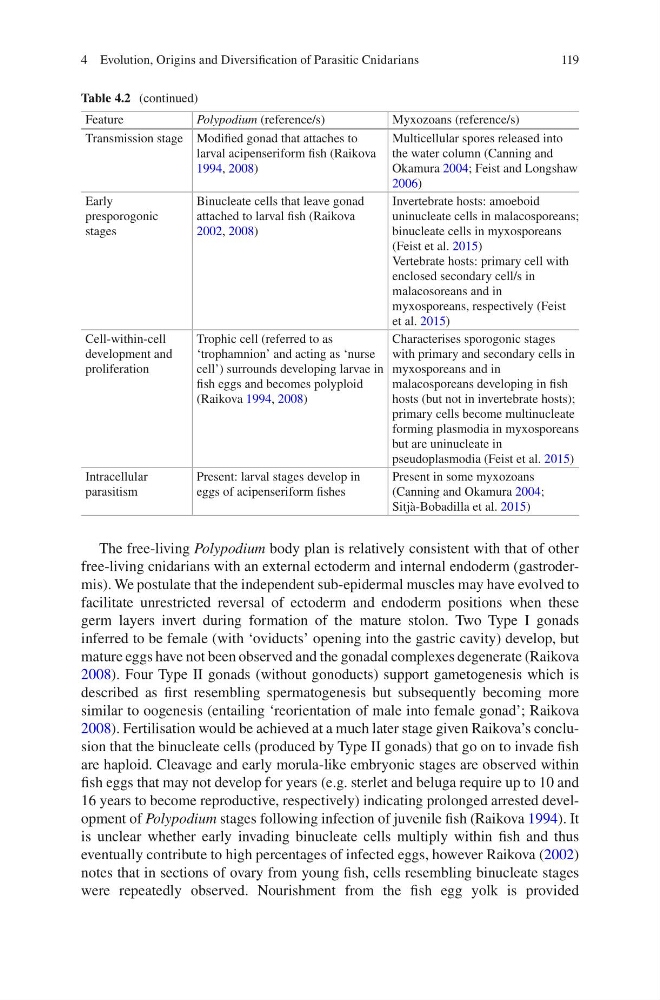
Table 4.2 (continued)
Feature
Polypodium (reference/s)
Myxozoans (reference/s)
Transmission stage Modified gonad that attaches to
larval acipenseriform fish (Raikova
1994, 2008)
Multicellular spores released into
the water column (Canning and
Okamura 2004; Feist and Longshaw
2006)
Early
presporogonic
stages
Binucleate cells that leave gonad
attached to larval fish (Raikova
2002, 2008)
Invertebrate hosts: amoeboid
uninucleate cells in malacosporeans;
binucleate cells in myxosporeans
(Feist et al. 2015)
Vertebrate hosts: primary cell with
enclosed secondary cell/s in
malacosoreans and in
myxosporeans, respectively (Feist
et al. 2015)
Cell-within-cell
development and
proliferation
Trophic cell (referred to as
‘trophamnion’ and acting as ‘nurse
cell’) surrounds developing larvae in
fish eggs and becomes polyploid
(Raikova 1994, 2008)
Characterises sporogonic stages
with primary and secondary cells in
myxosporeans and in
malacosporeans developing in fish
hosts (but not in invertebrate hosts);
primary cells become multinucleate
forming plasmodia in myxosporeans
but are uninucleate in
pseudoplasmodia (Feist et al. 2015)
Intracellular
parasitism
Present: larval stages develop in
eggs of acipenseriform fishes
Present in some myxozoans
(Canning and Okamura 2004;
Sitjà-Bobadilla et al. 2015)
4 Evolution, Origins and Diversification of Parasitic Cnidarians
The free-living Polypodium body plan is relatively consistent with that of other
free-living cnidarians with an external ectoderm and internal endoderm (gastrodermis). We postulate that the independent sub-epidermal muscles may have evolved to
facilitate unrestricted reversal of ectoderm and endoderm positions when these
germ layers invert during formation of the mature stolon. Two Type I gonads
inferred to be female (with ‘oviducts’ opening into the gastric cavity) develop, but
mature eggs have not been observed and the gonadal complexes degenerate (Raikova
2008). Four Type II gonads (without gonoducts) support gametogenesis which is
described as first resembling spermatogenesis but subsequently becoming more
similar to oogenesis (entailing ‘reorientation of male into female gonad’; Raikova
2008). Fertilisation would be achieved at a much later stage given Raikova’s conclusion that the binucleate cells (produced by Type II gonads) that go on to invade fish
are haploid. Cleavage and early morula-like embryonic stages are observed within
fish eggs that may not develop for years (e.g. sterlet and beluga require up to 10 and
16 years to become reproductive, respectively) indicating prolonged arrested development of Polypodium stages following infection of juvenile fish (Raikova 1994). It
is unclear whether early invading binucleate cells multiply within fish and thus
eventually contribute to high percentages of infected eggs, however Raikova (2002)
notes that in sections of ovary from young fish, cells resembling binucleate stages
were repeatedly observed. Nourishment from the fish egg yolk is provided
Table 4.2 (continued)
Feature
Polypodium (reference/s)
Myxozoans (reference/s)
Transmission stage Modified gonad that attaches to
larval acipenseriform fish (Raikova
1994, 2008)
Multicellular spores released into
the water column (Canning and
Okamura 2004; Feist and Longshaw
2006)
Early
presporogonic
stages
Binucleate cells that leave gonad
attached to larval fish (Raikova
2002, 2008)
Invertebrate hosts: amoeboid
uninucleate cells in malacosporeans;
binucleate cells in myxosporeans
(Feist et al. 2015)
Vertebrate hosts: primary cell with
enclosed secondary cell/s in
malacosoreans and in
myxosporeans, respectively (Feist
et al. 2015)
Cell-within-cell
development and
proliferation
Trophic cell (referred to as
‘trophamnion’ and acting as ‘nurse
cell’) surrounds developing larvae in
fish eggs and becomes polyploid
(Raikova 1994, 2008)
Characterises sporogonic stages
with primary and secondary cells in
myxosporeans and in
malacosporeans developing in fish
hosts (but not in invertebrate hosts);
primary cells become multinucleate
forming plasmodia in myxosporeans
but are uninucleate in
pseudoplasmodia (Feist et al. 2015)
Intracellular
parasitism
Present: larval stages develop in
eggs of acipenseriform fishes
Present in some myxozoans
(Canning and Okamura 2004;
Sitjà-Bobadilla et al. 2015)
4 Evolution, Origins and Diversification of Parasitic Cnidarians