

118
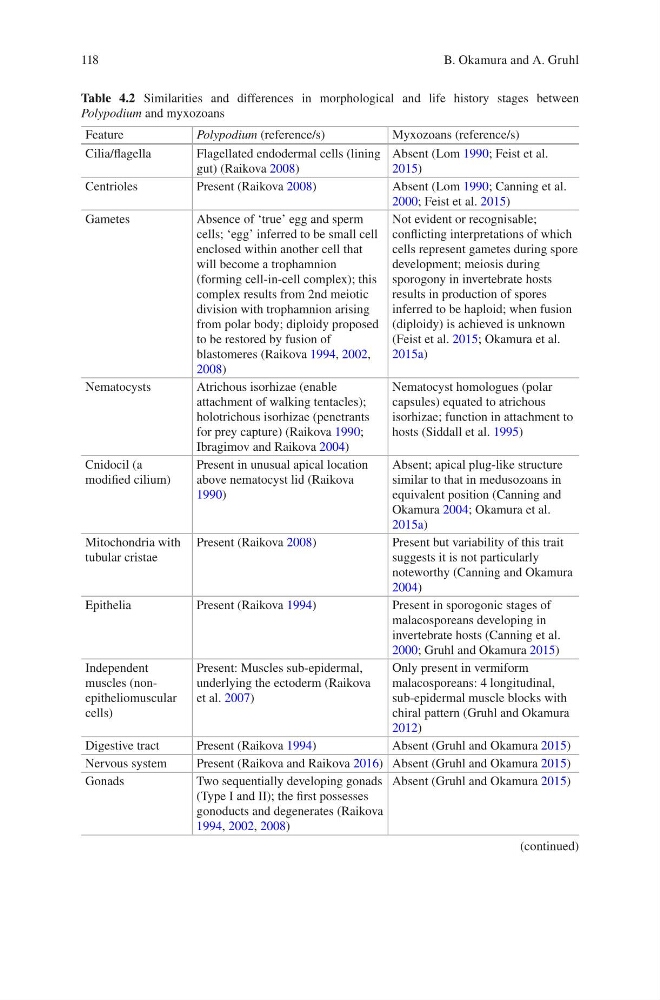
Table 4.2 Similarities and differences in morphological and life history stages between
Polypodium and myxozoans
Feature
Polypodium (reference/s)
Myxozoans (reference/s)
Cilia/flagella
Flagellated endodermal cells (lining
gut) (Raikova 2008)
Absent (Lom 1990; Feist et al.
2015)
Centrioles
Present (Raikova 2008)
Absent (Lom 1990; Canning et al.
2000; Feist et al. 2015)
Gametes
Absence of ‘true’ egg and sperm
cells; ‘egg’ inferred to be small cell
enclosed within another cell that
will become a trophamnion
(forming cell-in-cell complex); this
complex results from 2nd meiotic
division with trophamnion arising
from polar body; diploidy proposed
to be restored by fusion of
blastomeres (Raikova 1994, 2002,
2008)
Not evident or recognisable;
conflicting interpretations of which
cells represent gametes during spore
development; meiosis during
sporogony in invertebrate hosts
results in production of spores
inferred to be haploid; when fusion
(diploidy) is achieved is unknown
(Feist et al. 2015; Okamura et al.
2015a)
Nematocysts
Atrichous isorhizae (enable
attachment of walking tentacles);
holotrichous isorhizae (penetrants
for prey capture) (Raikova 1990;
Ibragimov and Raikova 2004)
Nematocyst homologues (polar
capsules) equated to atrichous
isorhizae; function in attachment to
hosts (Siddall et al. 1995)
Cnidocil (a
modified cilium)
Present in unusual apical location
above nematocyst lid (Raikova
1990)
Absent; apical plug-like structure
similar to that in medusozoans in
equivalent position (Canning and
Okamura 2004; Okamura et al.
2015a)
Mitochondria with
tubular cristae
Present (Raikova 2008)
Present but variability of this trait
suggests it is not particularly
noteworthy (Canning and Okamura
2004)
Epithelia
Present (Raikova 1994)
Present in sporogonic stages of
malacosporeans developing in
invertebrate hosts (Canning et al.
2000; Gruhl and Okamura 2015)
Independent
muscles (nonepitheliomuscular
cells)
Present: Muscles sub-epidermal,
underlying the ectoderm (Raikova
et al. 2007)
Only present in vermiform
malacosporeans: 4 longitudinal,
sub-epidermal muscle blocks with
chiral pattern (Gruhl and Okamura
2012)
Digestive tract
Present (Raikova 1994)
Absent (Gruhl and Okamura 2015)
Nervous system
Present (Raikova and Raikova 2016) Absent (Gruhl and Okamura 2015)
Gonads
Two sequentially developing gonads
(Type I and II); the first possesses
gonoducts and degenerates (Raikova
1994, 2002, 2008)
Absent (Gruhl and Okamura 2015)
(continued)
B. Okamura and A. Gruhl
Table 4.2 Similarities and differences in morphological and life history stages between
Polypodium and myxozoans
Feature
Polypodium (reference/s)
Myxozoans (reference/s)
Cilia/flagella
Flagellated endodermal cells (lining
gut) (Raikova 2008)
Absent (Lom 1990; Feist et al.
2015)
Centrioles
Present (Raikova 2008)
Absent (Lom 1990; Canning et al.
2000; Feist et al. 2015)
Gametes
Absence of ‘true’ egg and sperm
cells; ‘egg’ inferred to be small cell
enclosed within another cell that
will become a trophamnion
(forming cell-in-cell complex); this
complex results from 2nd meiotic
division with trophamnion arising
from polar body; diploidy proposed
to be restored by fusion of
blastomeres (Raikova 1994, 2002,
2008)
Not evident or recognisable;
conflicting interpretations of which
cells represent gametes during spore
development; meiosis during
sporogony in invertebrate hosts
results in production of spores
inferred to be haploid; when fusion
(diploidy) is achieved is unknown
(Feist et al. 2015; Okamura et al.
2015a)
Nematocysts
Atrichous isorhizae (enable
attachment of walking tentacles);
holotrichous isorhizae (penetrants
for prey capture) (Raikova 1990;
Ibragimov and Raikova 2004)
Nematocyst homologues (polar
capsules) equated to atrichous
isorhizae; function in attachment to
hosts (Siddall et al. 1995)
Cnidocil (a
modified cilium)
Present in unusual apical location
above nematocyst lid (Raikova
1990)
Absent; apical plug-like structure
similar to that in medusozoans in
equivalent position (Canning and
Okamura 2004; Okamura et al.
2015a)
Mitochondria with
tubular cristae
Present (Raikova 2008)
Present but variability of this trait
suggests it is not particularly
noteworthy (Canning and Okamura
2004)
Epithelia
Present (Raikova 1994)
Present in sporogonic stages of
malacosporeans developing in
invertebrate hosts (Canning et al.
2000; Gruhl and Okamura 2015)
Independent
muscles (nonepitheliomuscular
cells)
Present: Muscles sub-epidermal,
underlying the ectoderm (Raikova
et al. 2007)
Only present in vermiform
malacosporeans: 4 longitudinal,
sub-epidermal muscle blocks with
chiral pattern (Gruhl and Okamura
2012)
Digestive tract
Present (Raikova 1994)
Absent (Gruhl and Okamura 2015)
Nervous system
Present (Raikova and Raikova 2016) Absent (Gruhl and Okamura 2015)
Gonads
Two sequentially developing gonads
(Type I and II); the first possesses
gonoducts and degenerates (Raikova
1994, 2002, 2008)
Absent (Gruhl and Okamura 2015)
(continued)
B. Okamura and A. Gruhl