

4 Utilising Passive Design Strategies for Analysing Thermal …
47
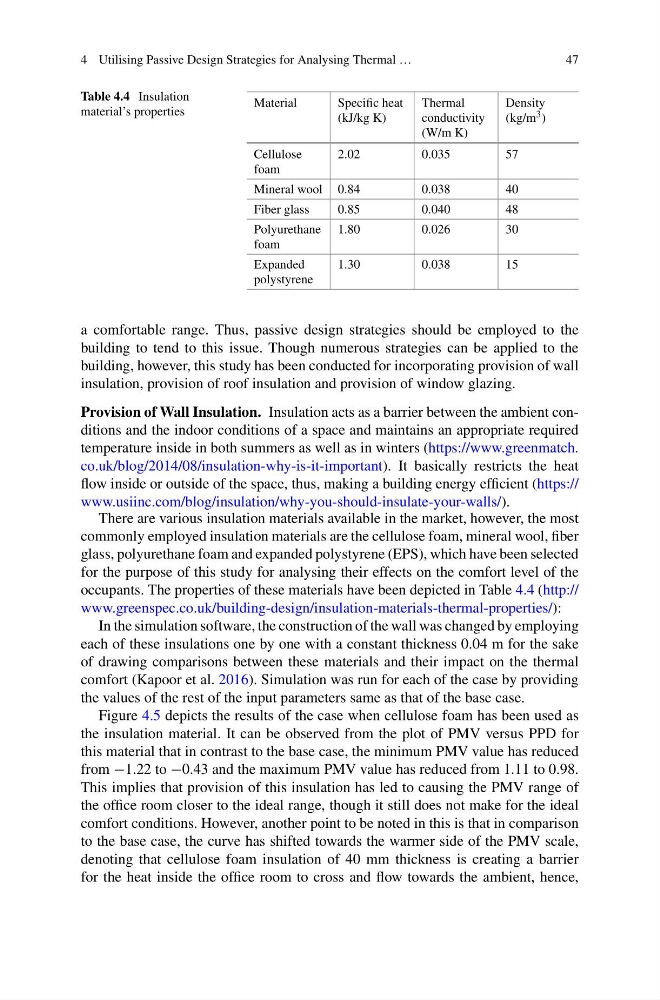
Table 4.4 Insulation
material’s properties
Material
Specific heat
(kJ/kg K)
Thermal
conductivity
(W/m K)
Density
(kg/m 3 )
Cellulose
foam
2.02
0.035
57
Mineral wool 0.84
0.038
40
Fiber glass
0.85
0.040
48
Polyurethane
foam
1.80
0.026
30
Expanded
polystyrene
1.30
0.038
15
a comfortable range. Thus, passive design strategies should be employed to the
building to tend to this issue. Though numerous strategies can be applied to the
building, however, this study has been conducted for incorporating provision of wall
insulation, provision of roof insulation and provision of window glazing.
Provision of Wall Insulation. Insulation acts as a barrier between the ambient conditions and the indoor conditions of a space and maintains an appropriate required
temperature inside in both summers as well as in winters (https://www.greenmatch.
co.uk/blog/2014/08/insulation-why-is-it-important). It basically restricts the heat
flow inside or outside of the space, thus, making a building energy efficient (https://
www.usiinc.com/blog/insulation/why-you-should-insulate-your-walls/).
There are various insulation materials available in the market, however, the most
commonly employed insulation materials are the cellulose foam, mineral wool, fiber
glass, polyurethane foam and expanded polystyrene (EPS), which have been selected
for the purpose of this study for analysing their effects on the comfort level of the
occupants. The properties of these materials have been depicted in Table 4.4 (http://
www.greenspec.co.uk/building-design/insulation-materials-thermal-properties/):
In the simulation software, the construction of the wall was changed by employing
each of these insulations one by one with a constant thickness 0.04 m for the sake
of drawing comparisons between these materials and their impact on the thermal
comfort (Kapoor et al. 2016). Simulation was run for each of the case by providing
the values of the rest of the input parameters same as that of the base case.
Figure 4.5 depicts the results of the case when cellulose foam has been used as
the insulation material. It can be observed from the plot of PMV versus PPD for
this material that in contrast to the base case, the minimum PMV value has reduced
from −1.22 to −0.43 and the maximum PMV value has reduced from 1.11 to 0.98.
This implies that provision of this insulation has led to causing the PMV range of
the office room closer to the ideal range, though it still does not make for the ideal
comfort conditions. However, another point to be noted in this is that in comparison
to the base case, the curve has shifted towards the warmer side of the PMV scale,
denoting that cellulose foam insulation of 40 mm thickness is creating a barrier
for the heat inside the office room to cross and flow towards the ambient, hence,
47
Table 4.4 Insulation
material’s properties
Material
Specific heat
(kJ/kg K)
Thermal
conductivity
(W/m K)
Density
(kg/m 3 )
Cellulose
foam
2.02
0.035
57
Mineral wool 0.84
0.038
40
Fiber glass
0.85
0.040
48
Polyurethane
foam
1.80
0.026
30
Expanded
polystyrene
1.30
0.038
15
a comfortable range. Thus, passive design strategies should be employed to the
building to tend to this issue. Though numerous strategies can be applied to the
building, however, this study has been conducted for incorporating provision of wall
insulation, provision of roof insulation and provision of window glazing.
Provision of Wall Insulation. Insulation acts as a barrier between the ambient conditions and the indoor conditions of a space and maintains an appropriate required
temperature inside in both summers as well as in winters (https://www.greenmatch.
co.uk/blog/2014/08/insulation-why-is-it-important). It basically restricts the heat
flow inside or outside of the space, thus, making a building energy efficient (https://
www.usiinc.com/blog/insulation/why-you-should-insulate-your-walls/).
There are various insulation materials available in the market, however, the most
commonly employed insulation materials are the cellulose foam, mineral wool, fiber
glass, polyurethane foam and expanded polystyrene (EPS), which have been selected
for the purpose of this study for analysing their effects on the comfort level of the
occupants. The properties of these materials have been depicted in Table 4.4 (http://
www.greenspec.co.uk/building-design/insulation-materials-thermal-properties/):
In the simulation software, the construction of the wall was changed by employing
each of these insulations one by one with a constant thickness 0.04 m for the sake
of drawing comparisons between these materials and their impact on the thermal
comfort (Kapoor et al. 2016). Simulation was run for each of the case by providing
the values of the rest of the input parameters same as that of the base case.
Figure 4.5 depicts the results of the case when cellulose foam has been used as
the insulation material. It can be observed from the plot of PMV versus PPD for
this material that in contrast to the base case, the minimum PMV value has reduced
from −1.22 to −0.43 and the maximum PMV value has reduced from 1.11 to 0.98.
This implies that provision of this insulation has led to causing the PMV range of
the office room closer to the ideal range, though it still does not make for the ideal
comfort conditions. However, another point to be noted in this is that in comparison
to the base case, the curve has shifted towards the warmer side of the PMV scale,
denoting that cellulose foam insulation of 40 mm thickness is creating a barrier
for the heat inside the office room to cross and flow towards the ambient, hence,