

392
A. Mishra
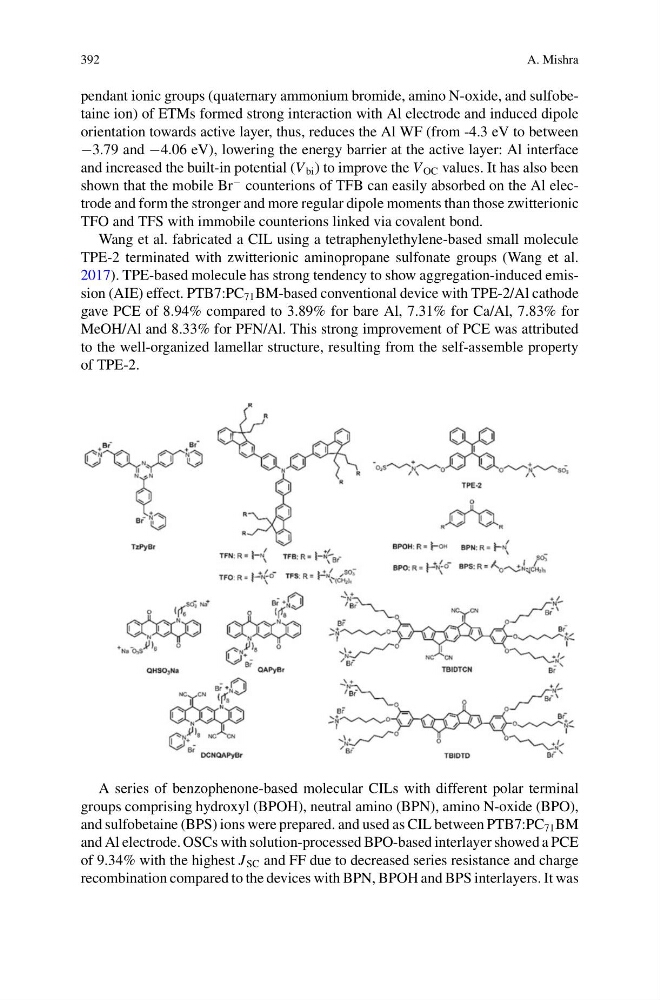
pendant ionic groups (quaternary ammonium bromide, amino N-oxide, and sulfobetaine ion) of ETMs formed strong interaction with Al electrode and induced dipole
orientation towards active layer, thus, reduces the Al WF (from -4.3 eV to between
−3.79 and −4.06 eV), lowering the energy barrier at the active layer: Al interface
and increased the built-in potential (V bi ) to improve the V OC values. It has also been
shown that the mobile Br
− counterions of TFB can easily absorbed on the Al electrode and form the stronger and more regular dipole moments than those zwitterionic
TFO and TFS with immobile counterions linked via covalent bond.
Wang et al. fabricated a CIL using a tetraphenylethylene-based small molecule
TPE-2 terminated with zwitterionic aminopropane sulfonate groups (Wang et al.
2017). TPE-based molecule has strong tendency to show aggregation-induced emission (AIE) effect. PTB7:PC 71 BM-based conventional device with TPE-2/Al cathode
gave PCE of 8.94% compared to 3.89% for bare Al, 7.31% for Ca/Al, 7.83% for
MeOH/Al and 8.33% for PFN/Al. This strong improvement of PCE was attributed
to the well-organized lamellar structure, resulting from the self-assemble property
of TPE-2.
A series of benzophenone-based molecular CILs with different polar terminal
groups comprising hydroxyl (BPOH), neutral amino (BPN), amino N-oxide (BPO),
and sulfobetaine (BPS) ions were prepared. and used as CIL between PTB7:PC 71 BM
and Al electrode. OSCs with solution-processed BPO-based interlayer showed a PCE
of 9.34% with the highest J SC and FF due to decreased series resistance and charge
recombination compared to the devices with BPN, BPOH and BPS interlayers. It was
A. Mishra
pendant ionic groups (quaternary ammonium bromide, amino N-oxide, and sulfobetaine ion) of ETMs formed strong interaction with Al electrode and induced dipole
orientation towards active layer, thus, reduces the Al WF (from -4.3 eV to between
−3.79 and −4.06 eV), lowering the energy barrier at the active layer: Al interface
and increased the built-in potential (V bi ) to improve the V OC values. It has also been
shown that the mobile Br
− counterions of TFB can easily absorbed on the Al electrode and form the stronger and more regular dipole moments than those zwitterionic
TFO and TFS with immobile counterions linked via covalent bond.
Wang et al. fabricated a CIL using a tetraphenylethylene-based small molecule
TPE-2 terminated with zwitterionic aminopropane sulfonate groups (Wang et al.
2017). TPE-based molecule has strong tendency to show aggregation-induced emission (AIE) effect. PTB7:PC 71 BM-based conventional device with TPE-2/Al cathode
gave PCE of 8.94% compared to 3.89% for bare Al, 7.31% for Ca/Al, 7.83% for
MeOH/Al and 8.33% for PFN/Al. This strong improvement of PCE was attributed
to the well-organized lamellar structure, resulting from the self-assemble property
of TPE-2.
A series of benzophenone-based molecular CILs with different polar terminal
groups comprising hydroxyl (BPOH), neutral amino (BPN), amino N-oxide (BPO),
and sulfobetaine (BPS) ions were prepared. and used as CIL between PTB7:PC 71 BM
and Al electrode. OSCs with solution-processed BPO-based interlayer showed a PCE
of 9.34% with the highest J SC and FF due to decreased series resistance and charge
recombination compared to the devices with BPN, BPOH and BPS interlayers. It was