

18 Interfacial Materials for Organic Solar Cells
391
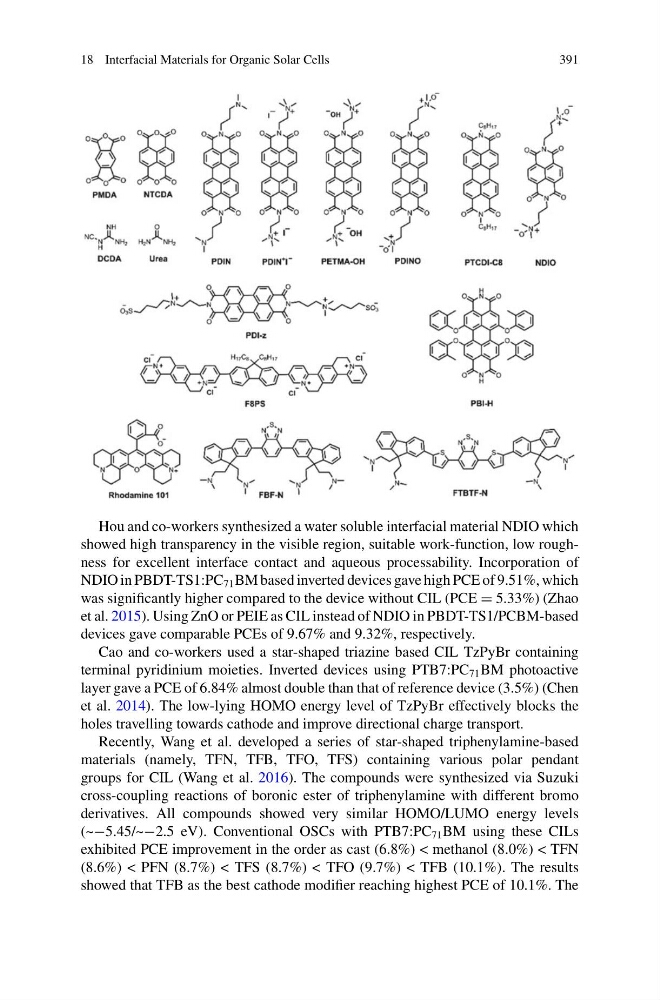
Hou and co-workers synthesized a water soluble interfacial material NDIO which
showed high transparency in the visible region, suitable work-function, low roughness for excellent interface contact and aqueous processability. Incorporation of
NDIO in PBDT-TS1:PC 71 BM based inverted devices gave high PCE of 9.51%, which
was significantly higher compared to the device without CIL (PCE = 5.33%) (Zhao
et al. 2015). Using ZnO or PEIE as CIL instead of NDIO in PBDT-TS1/PCBM-based
devices gave comparable PCEs of 9.67% and 9.32%, respectively.
Cao and co-workers used a star-shaped triazine based CIL TzPyBr containing
terminal pyridinium moieties. Inverted devices using PTB7:PC 71 BM photoactive
layer gave a PCE of 6.84% almost double than that of reference device (3.5%) (Chen
et al. 2014). The low-lying HOMO energy level of TzPyBr effectively blocks the
holes travelling towards cathode and improve directional charge transport.
Recently, Wang et al. developed a series of star-shaped triphenylamine-based
materials (namely, TFN, TFB, TFO, TFS) containing various polar pendant
groups for CIL (Wang et al. 2016). The compounds were synthesized via Suzuki
cross-coupling reactions of boronic ester of triphenylamine with different bromo
derivatives. All compounds showed very similar HOMO/LUMO energy levels
(~−5.45/~−2.5 eV). Conventional OSCs with PTB7:PC 71 BM using these CILs
exhibited PCE improvement in the order as cast (6.8%) < methanol (8.0%) < TFN
(8.6%) < PFN (8.7%) < TFS (8.7%) < TFO (9.7%) < TFB (10.1%). The results
showed that TFB as the best cathode modifier reaching highest PCE of 10.1%. The
391
Hou and co-workers synthesized a water soluble interfacial material NDIO which
showed high transparency in the visible region, suitable work-function, low roughness for excellent interface contact and aqueous processability. Incorporation of
NDIO in PBDT-TS1:PC 71 BM based inverted devices gave high PCE of 9.51%, which
was significantly higher compared to the device without CIL (PCE = 5.33%) (Zhao
et al. 2015). Using ZnO or PEIE as CIL instead of NDIO in PBDT-TS1/PCBM-based
devices gave comparable PCEs of 9.67% and 9.32%, respectively.
Cao and co-workers used a star-shaped triazine based CIL TzPyBr containing
terminal pyridinium moieties. Inverted devices using PTB7:PC 71 BM photoactive
layer gave a PCE of 6.84% almost double than that of reference device (3.5%) (Chen
et al. 2014). The low-lying HOMO energy level of TzPyBr effectively blocks the
holes travelling towards cathode and improve directional charge transport.
Recently, Wang et al. developed a series of star-shaped triphenylamine-based
materials (namely, TFN, TFB, TFO, TFS) containing various polar pendant
groups for CIL (Wang et al. 2016). The compounds were synthesized via Suzuki
cross-coupling reactions of boronic ester of triphenylamine with different bromo
derivatives. All compounds showed very similar HOMO/LUMO energy levels
(~−5.45/~−2.5 eV). Conventional OSCs with PTB7:PC 71 BM using these CILs
exhibited PCE improvement in the order as cast (6.8%) < methanol (8.0%) < TFN
(8.6%) < PFN (8.7%) < TFS (8.7%) < TFO (9.7%) < TFB (10.1%). The results
showed that TFB as the best cathode modifier reaching highest PCE of 10.1%. The