

374
A. Mishra
2017; Mishra and Sahu 2019). In tandem cells the PCE of around 17% was recently
being reported (Meng et al. 2018). Theoretically it has been demonstrated that PCE
close to 20% is not so far to realize for tandem cell based on the optimized device
configuration, material bandgaps alignment and high achievable fill factors (FF)
(Li et al. 2014a). A typical bulk-heterojunction solar cells (BHJSC) comprise of
donor (D):acceptor (A) based organic photoactive layer sandwiched between two
electrodes. The excitons (electron-hole pair) generated in the photoactive layer after
light excitation needs to move towards D: A interface to separate holes and electrons
which then transport to the respective electrodes through highest occupied molecular
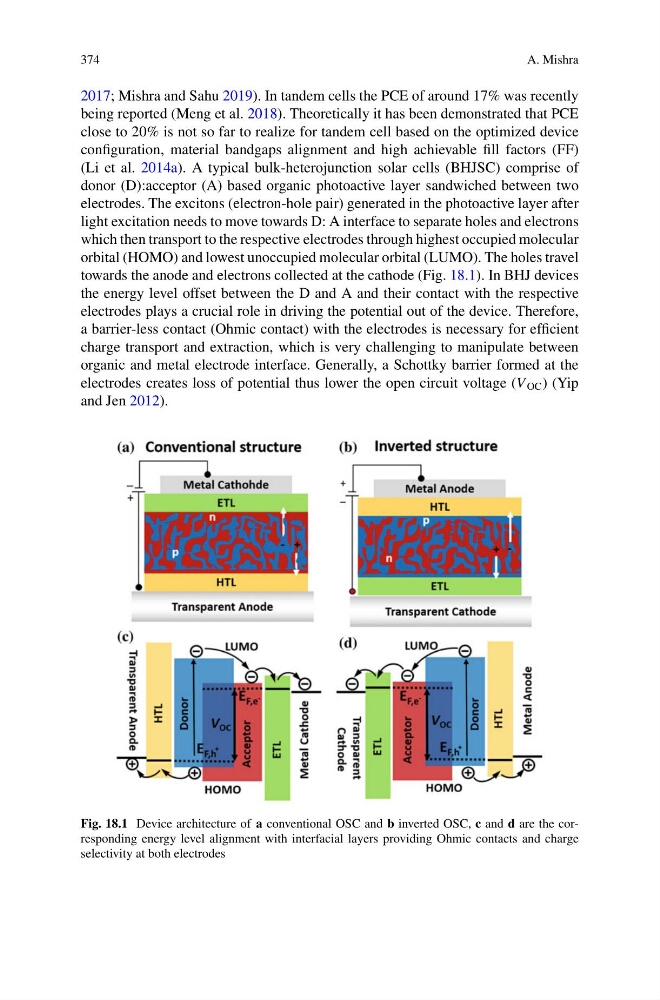
orbital (HOMO) and lowest unoccupied molecular orbital (LUMO). The holes travel
towards the anode and electrons collected at the cathode (Fig. 18.1). In BHJ devices
the energy level offset between the D and A and their contact with the respective
electrodes plays a crucial role in driving the potential out of the device. Therefore,
a barrier-less contact (Ohmic contact) with the electrodes is necessary for efficient
charge transport and extraction, which is very challenging to manipulate between
organic and metal electrode interface. Generally, a Schottky barrier formed at the
electrodes creates loss of potential thus lower the open circuit voltage (V OC ) (Yip
and Jen 2012).
Fig. 18.1 Device architecture of a conventional OSC and b inverted OSC, c and d are the corresponding energy level alignment with interfacial layers providing Ohmic contacts and charge
selectivity at both electrodes
A. Mishra
2017; Mishra and Sahu 2019). In tandem cells the PCE of around 17% was recently
being reported (Meng et al. 2018). Theoretically it has been demonstrated that PCE
close to 20% is not so far to realize for tandem cell based on the optimized device
configuration, material bandgaps alignment and high achievable fill factors (FF)
(Li et al. 2014a). A typical bulk-heterojunction solar cells (BHJSC) comprise of
donor (D):acceptor (A) based organic photoactive layer sandwiched between two
electrodes. The excitons (electron-hole pair) generated in the photoactive layer after
light excitation needs to move towards D: A interface to separate holes and electrons
which then transport to the respective electrodes through highest occupied molecular
orbital (HOMO) and lowest unoccupied molecular orbital (LUMO). The holes travel
towards the anode and electrons collected at the cathode (Fig. 18.1). In BHJ devices
the energy level offset between the D and A and their contact with the respective
electrodes plays a crucial role in driving the potential out of the device. Therefore,
a barrier-less contact (Ohmic contact) with the electrodes is necessary for efficient
charge transport and extraction, which is very challenging to manipulate between
organic and metal electrode interface. Generally, a Schottky barrier formed at the
electrodes creates loss of potential thus lower the open circuit voltage (V OC ) (Yip
and Jen 2012).
Fig. 18.1 Device architecture of a conventional OSC and b inverted OSC, c and d are the corresponding energy level alignment with interfacial layers providing Ohmic contacts and charge
selectivity at both electrodes